For decades, the technology industry has trained us to think about data in a very specific way.
Our photographs live in the cloud. Our emails live in the cloud. Our documents live in the cloud. Increasingly, our intelligence lives in the cloud.
Every interaction with a modern AI system follows the exact same pattern: we connect to a remote service, submit a request, receive an answer, and continue with our day. The underlying assumption is simple: intelligence belongs in massive data centres owned by global corporations.
Yet this assumption may prove to be a temporary phase. As artificial intelligence becomes deeply personal, an inevitable question emerges: Where should this accumulated understanding actually live?
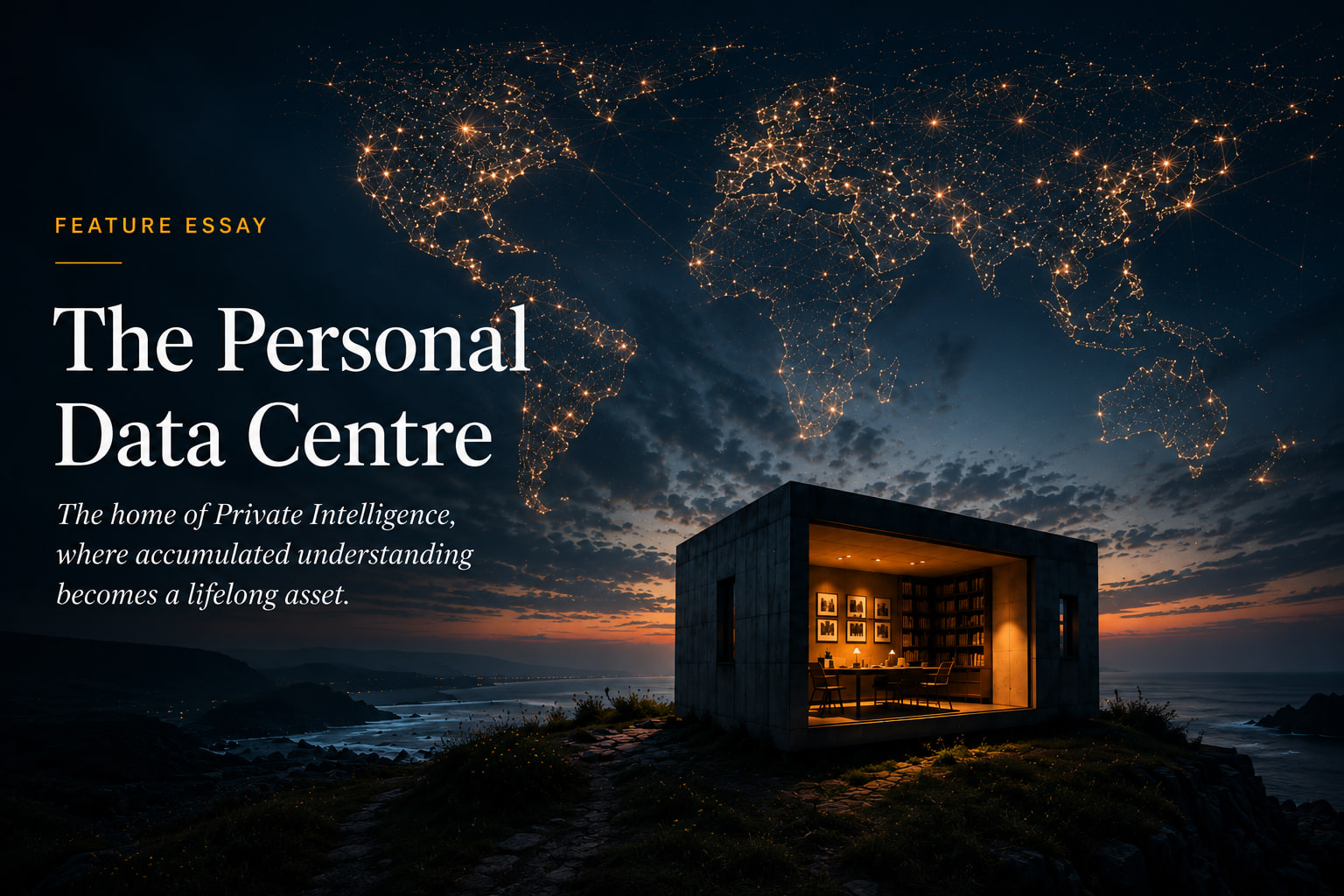
The answer may not be another cloud subscription. It may be something entirely different: a Personal Data Centre.
At first glance, the name sounds intensely technical. It isn’t. The Personal Data Centre is not defined by its hardware; it is defined by its ownership. For the first time in human history, individuals are on the verge of possessing digital intelligence assets valuable enough to justify their own personal infrastructure.
Private Intelligence, Intelligence Capital, accumulated judgement, skills, and unique human understanding all require a sanctuary. They need somewhere secure to reside.
The smartphone offers an interesting clue. Most people do not need a supercomputer in their pocket at all times; they need something practical, portable, and immediately available. The same is highly likely to be true of Personal AI.
The primary residence of a Personal Data Centre may be a physical device no larger than a modern phone. It travels with its owner, learns continuously alongside them, and remains immediately accessible. Yet, like all truly valuable assets, it requires layers of protection. This portable device may synchronise with larger, trusted hardware systems at home, and additional encrypted backups may exist elsewhere.
The hardware will change repeatedly throughout an owner’s lifetime, but the asset remains. The Personal Data Centre has a primary residence, but it has no single point of failure.
This distinction becomes paramount because the most valuable thing stored inside this personal sanctuary is not raw information. It is accumulated judgement.
Most people assume the future value of AI lies in traditional data storage—photographs, messages, contacts, and documents. These are valuable, certainly, but they are merely records. The true asset lies in the invisible architecture of a lived life: the decisions made, the pitfalls avoided, the mistakes learned from, the risks calculated, and the unique trade-offs encountered over decades.
Skills form the next layer of value. Some people become exceptional thinkers, while others become exceptional plumbers, electricians, teachers, surgeons, craftsmen, or entrepreneurs.
Just as a downloaded model can provide the rules of gardening but not the soil-stained instincts of a lifetime, capability can be downloaded, but competence must be earned. A modern AI can easily download everything required to fly an aircraft, but that is fundamentally different from being shaped by the muscle memory and raw experience of a fighter pilot who has landed on an aircraft carrier in the dark a hundred times. Knowledge teaches the rigid procedure; experience teaches the necessary exceptions.
This is why every Personal Data Centre eventually becomes completely unique. The AI is not learning in isolation from an internet scrape; it is learning directly from a specific human being—from their judgement, their ethics, their conduct, and their specific worldview. Two identical systems may begin life with identical capabilities and end a decade later as completely different assets. The difference is not the model. The difference is the life that shaped it.
Why not simply allow massive corporations to store all of this on their servers? Because data and judgement are not the same thing. Data merely records past behaviour, but judgement reveals identity. Information tells a system what happened; judgement tells a system what you will likely do next and how you will uniquely respond under pressure. A photograph reveals where you travelled, but years of accumulated context reveal how you assess risk, how you build trust, and how you solve human problems.
At that point, the conversation is no longer about digital storage. It is about absolute sovereignty.
The Personal Data Centre exists because accumulated judgement is too valuable to surrender.
This is not primarily a defensive privacy argument; it is a proactive ownership argument. Privacy is simply a natural consequence of true ownership. When you own the intelligence asset, you alone decide who can access it, who can utilize it, who can inherit it, and who can learn from it.
This architecture requires a new kind of shield. When the Personal Data Centre must interact with global systems, it does not surrender its core asset. It acts as a local cryptographic proxy. It anonymises requests, blindfolds external networks to the owner’s true identity, and treats corporate supercomputers as a blind utility. It pulls raw computing power into the home, rather than pushing a human life into the corporate cloud.
The Personal Data Centre does not replace corporate intelligence; it fundamentally changes the power dynamic. Corporate AI becomes infrastructure, while Personal AI becomes property. Corporate intelligence becomes a utility, while personal intelligence becomes an asset.
Ultimately, this creates a profound societal consequence. Distributed ownership creates distributed control. A single centralized intelligence system concentrates immense power, but billions of Personal Data Centres distribute it. A billion owners. A billion custodians. A billion independent intelligence assets. The intelligence ecosystem becomes decentralised by design.
The Personal Data Centre is far more than a consumer device. It is the primary residence of Private Intelligence and the permanent home of Intelligence Capital. It is where accumulated judgement, experience, and understanding are preserved for a lifetime.
The coming decades may not be defined by who builds the largest AI systems, but by who truly owns their own. And if that future arrives, the Personal Data Centre may become as vital to the twenty-first century as the personal computer was to the twentieth.