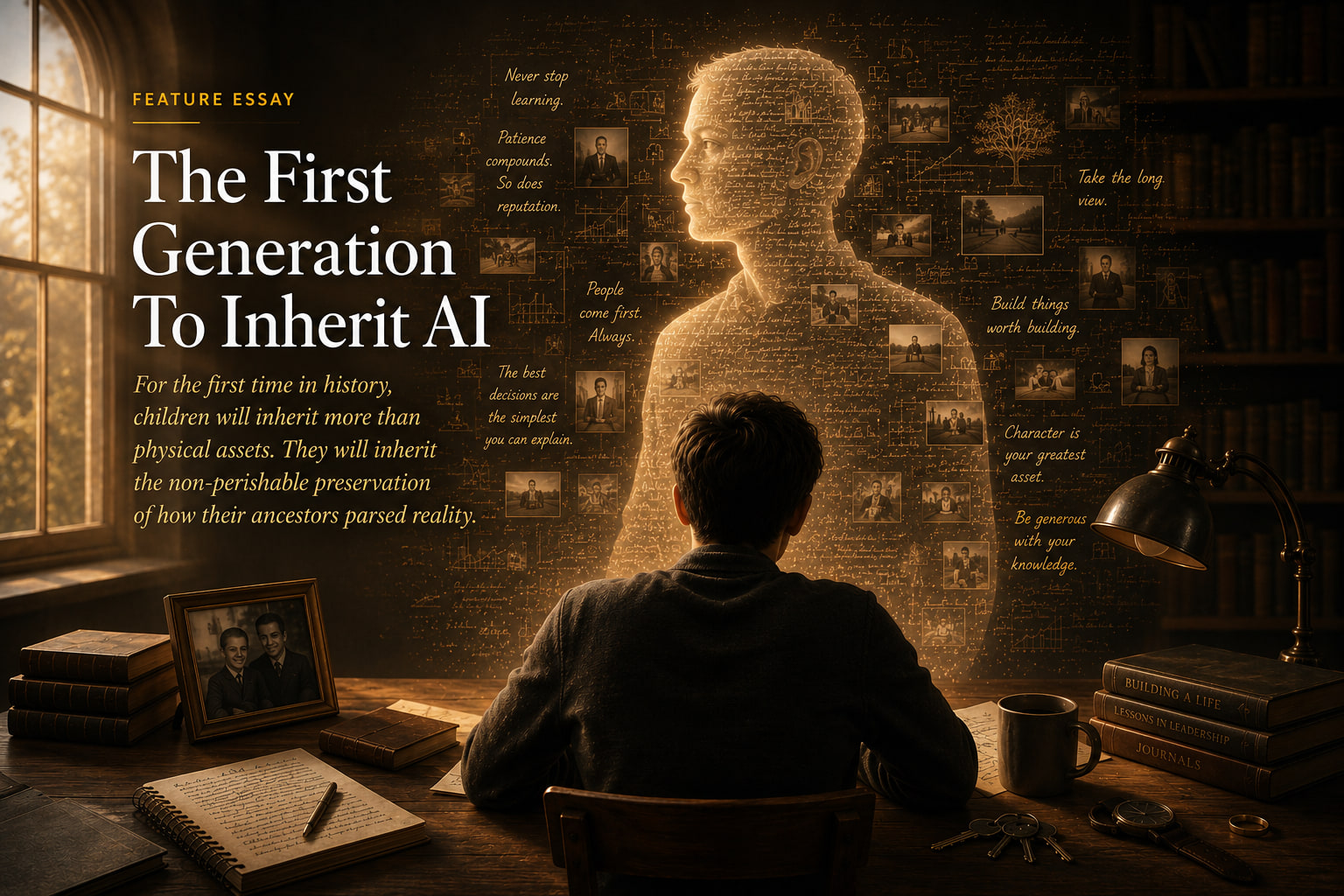
For most of human history, children inherited what their parents owned. A house. A business. A collection of photographs. A few treasured possessions. Sometimes money. Sometimes debt. Sometimes nothing at all.
Yet beneath every physical inheritance sat something far more valuable that rarely survived the transfer: understanding.
A parent might spend forty years building an enterprise, weathering economic storms, raising a family, learning painful lessons, and sharpening their personal judgment. Their lived experiences would shape thousands of invisible decisions across a lifetime. Yet when they died, the vast majority of that understanding vanished with them. The next generation inherited the outcomes, but rarely the process.
This has always been one of humanity’s quietest tragedies. Every generation begins with extraordinary material advantages. We inherit infrastructure, medicine, technology, and culture from countless lives we will never know. Yet the hyper-local, hard-won understanding of ordinary people evaporates every single day. The deepest life lessons remain trapped inside the individuals who learned them.
The previous chapters in this series have traced an inevitable trajectory. We have seen how intelligence will commoditize itself through abundance, how human nature will reject the corporate subscription model in favour of absolute ownership, and how raw information will give way to a new asset class: Intelligence Capital. Finally, we mapped the physical sanctuary for this wealth—the Personal Data Centre.
Yet all of those ideas ultimately converge upon a single, inescapable question: What happens when the owner is no longer here?
The answer may define an entirely new relationship between generations. The Personal Data Centre was never simply a shield against corporate surveillance or a clever privacy device. It was a vessel designed from the beginning to outlast a human life.
For the first time in history, children will inherit more than physical assets. They will inherit the non-perishable preservation of how their ancestors parsed reality.
This is not a quest for digital immortality. It is not a synthetic recreation of a parent, nor is it a digital ghost pretending to be alive. The inheritance is not the person; it is the understanding they leave behind. This distinction is paramount. An inherited intelligence asset is still a machine, and accepting that reality is exactly what makes it beautiful. The value was never in recreating a person’s presence, but in preserving the perspective they spent a lifetime earning.
Consider a child facing a profound crossroad—a fracturing business, a sudden family crisis, or a quiet moment of deep uncertainty. For centuries, the instinct in that moment was a silent wish: “I wish I could ask Dad.” But the person was gone, and the understanding had dissolved alongside them.
The first generation to inherit AI will face a fundamentally different option. Their question will not be the grief-driven, backward-looking request: “Can I talk to Dad again?” It will be the forward-looking, practical query: “I wonder what Dad would have done?”
An archive rich with decades of an individual’s observed actions, calculated risks, and ethical choices becomes capable of providing a startlingly coherent answer. Not because the machine has a soul, and not because it is pretending to be a parent, but because it contains the exact contours of an ancestor’s judgment.
This is the point where inherited intelligence transforms human capability. A textbook can be inherited, but it does not contain the surgeon’s instincts. A business plan can be passed down, but it lacks the founder’s scars. A photograph reveals the face, but it cannot explain the decisions that lined it. For the first time, that accumulated perspective endures.
Yet the ultimate purpose of this inheritance is not obedience. It is guidance.
Inherited intelligence should be consulted like a wise mentor, never obeyed like a commandment. The archive provides perspective, not permission; it offers understanding, not rigid authority. A child must remain entirely free to examine the inherited data stream and choose a completely different path.
In fact, that freedom to diverge is the highest expression of the inheritance itself. A mature child does not honour a parent by becoming their identical clone. They honour them by understanding them. The archive succeeds not when it enforces compliance, but when it allows the child to fully comprehend why the previous generation thought the way it did.
Whether the child ultimately agrees or consciously chooses to break away, both outcomes represent absolute success. The goal is not to eliminate independent thought, but to preserve human experience long enough for it to be considered.
When we lift our eyes to the horizon, this concept expands far beyond individual families. We are looking at a world where the next generation inherits accumulated understanding at scale—not just from parents, but from master craftsmen, brilliant teachers, visionary founders, and ordinary individuals who spent a lifetime learning things that would otherwise have been lost to time.
For generations, societies have measured progress by the accumulation of financial capital, physical capital, and intellectual property. The coming century will introduce something entirely unprecedented: Intergenerational Intelligence Capital. A civilization where understanding finally outlives the individuals who created it.
The global technology monopolies believe the future belongs to giant, centralized machines designed to know everything about the world. They are looking at the wrong map.
The future of artificial intelligence will not be determined by who possesses the most intelligence, but by who possesses the most understanding. The most influential intelligence in human history will not be the system that knows the world. It will be the quiet, private archive that preserves our humanity across time.
For most of history, children inherited what their parents owned. The first generation to inherit AI will become the first generation to inherit what their parents learned. And that may prove to be the most profound transformation artificial intelligence ever creates.