For centuries, wealth has been measured through familiar forms of capital. Financial capital. Physical capital. Intellectual property. Land. Businesses. Skills. Yet throughout history, one of humanity’s most valuable assets has remained largely invisible: understanding.
Not knowledge. Not information. Not intelligence.
Understanding.
The distinction matters. Knowledge produces answers. Intelligence produces solutions. Understanding produces capital.
At first glance, this may seem like a strange claim. We rarely think of understanding as an asset. We treat it as a human quality—something difficult to define and impossible to measure. Yet the world is filled with real-world examples.
Consider a master craftsman, a trusted surgeon, an experienced carer, a successful entrepreneur, or a respected teacher. The value they create rarely comes from access to information alone. In almost every case, the technical information is available to everyone.
The difference is understanding. The difference is judgement. The difference is experience accumulated through years of observation, mistakes, successes, failures, and reflection.
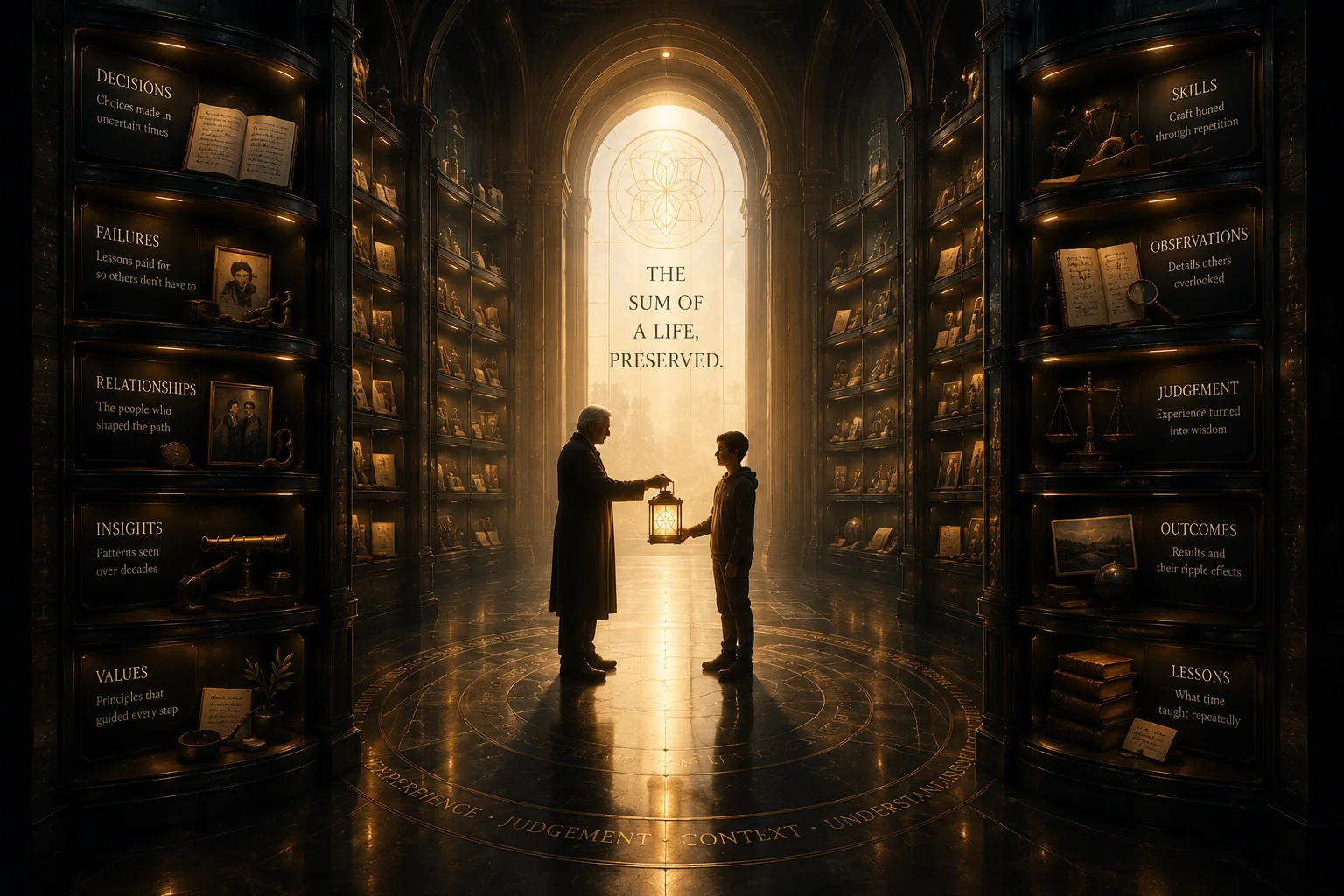
For most of human history, this understanding has been tragically difficult to preserve. When a person retired, much of it disappeared. When a person died, even more vanished. Some survived through textbooks, apprenticeships, recordings, and institutions, but the vast majority of accumulated understanding remained trapped inside the individual who created it.
Private Intelligence changes this equation.
A personal AI that spends decades alongside its owner does more than answer questions. It accumulates context. It observes decisions. It learns patterns. It remembers lessons that its owner may have forgotten years earlier. Over time, something unusual begins to emerge: the understanding becomes persistent. The accumulated judgement becomes durable. The experience becomes preservable.
This is the exact point at which Private Intelligence begins to transform into Intelligence Capital.
The transition is subtle. A new gardener may purchase a gardening guide. A more experienced gardener may download an advanced AI model. Both gain information, but neither automatically gains understanding. Intelligence can be downloaded. Understanding must be earned by compounding through experience.
This is what makes Intelligence Capital fundamentally different from ordinary information assets. Information can be copied. Intelligence can be distributed. Understanding must be accumulated.
Most traditional assets acquire value because they are scarce, but Intelligence Capital follows a different path: it acquires value because it becomes useful.
A personal AI begins as a tool. It helps organise schedules, answer questions, manage information, and solve problems. At this stage, its value is almost entirely practical.
Utility comes first.
Over time, something unusual begins to happen. The system accumulates context. It learns preferences, remembers decisions, understands habits, and observes outcomes. It becomes increasingly familiar with the life of its owner.
Attachment follows.
Humans have always formed attachments to useful things—a favourite hammer, a trusted car, a family home, or a beloved dog. The attachment rarely appears on day one; it emerges through shared experience. A personal AI follows the same pattern. What began as a tool gradually becomes familiar. What becomes familiar gradually becomes difficult to replace.
Eventually, value emerges. Not because someone assigns a price, and not because a corporation creates a marketplace, but because the owner recognises that the accumulated understanding inside the system would be difficult, expensive, or impossible to recreate.
Imagine two identical AI systems that begin life with identical capabilities. Ten years later, they are completely different assets. One has spent a decade helping run a family business. Another has spent a decade assisting a master gardener. A third has spent years helping a parent raise children. The underlying intelligence may be identical, but the accumulated understanding is not.
The asset becomes unique because the life that created it was unique. This is why provenance matters. The question is no longer, ‘What does this system know?’ The question becomes, ‘Whose understanding does this system contain?’
Ownership, therefore, becomes paramount.
The owner creates the value.
The AI preserves and amplifies it.
A downloaded model can provide intelligence.
Only a lived life can create understanding.
Without the owner, the understanding never exists.
Without the AI, much of the understanding is eventually forgotten.
Together, they create the asset.
The value of Intelligence Capital comes not from what it knows, but from what it has become. A surgeon’s Private Intelligence is not valuable because it understands anatomy—millions of systems understand anatomy. Its value comes from decades of accumulated judgement, observation, communication, and real outcomes.
Information measures what a system knows; Intelligence Capital measures what a system consistently achieves.
The same is true for a founder, a parent, a craftsman, or a teacher. Human-centred Intelligence Capital is ultimately measured through human outcomes. Not simply whether a problem was solved, but whether the right problem was solved in the right way.
Knowledge answers the question. Intelligence solves the problem. Understanding solves the human problem.
Over time, some of these assets may survive beyond their original creators.
Unlike traditional software, the value is not contained in the code itself. The value is contained in the accumulated understanding the code has helped preserve.
For the first time, a child may inherit more than photographs, money or property.
They may inherit accumulated understanding.
An intelligence asset shaped by decades of decisions, experiences, lessons, successes, failures and conduct.
The inheritance is not the person.
It is the understanding they leave behind.
The asset survives.
The custodian changes.
Just as financial capital can be inherited, Intelligence Capital may eventually pass between generations.
A family may ultimately possess multiple intelligence assets accumulated across different lives and experiences, each preserving a unique perspective that would otherwise have been lost.
Perhaps the simplest example is this very conversation. The articles produced during this discussion have value. The frameworks and ideas have value. But they are not the capital; they are merely the products. The true capital is the accumulated understanding that produced them. Each conversation builds on the last. Each discovery strengthens the next. The understanding compounds. The outputs are visible, but the asset creating them remains largely invisible.
This is a defining characteristic of Intelligence Capital: it creates value repeatedly without being consumed. A factory produces physical goods. A business produces services. Intelligence Capital produces understanding, judgement, and outcomes. Unlike many traditional assets, it actually increases through use. More experience creates more understanding, and more understanding creates more value.
This does not mean all parts of the asset appreciate equally. Some layers certainly depreciate. Technical knowledge becomes outdated, regulations change, software evolves, and industries transform. Yet other layers remain permanently valuable: communication, judgement, character, empathy, life lessons, and human understanding.
Information expires. Understanding endures.
This may prove to be the most important distinction of all. For generations, societies have accumulated financial capital, physical capital, and intellectual capital. The coming decades may introduce something entirely new. Humanity’s accumulated understanding may itself become a form of capital—not because a government declares it so, and not because a corporation monetises it, but because people increasingly recognise its irreplaceable value.
The future may not belong to those who possess the most intelligence. It may belong to those who accumulate the most understanding. And if understanding becomes capital, humanity is on the verge of creating an entirely new asset class.