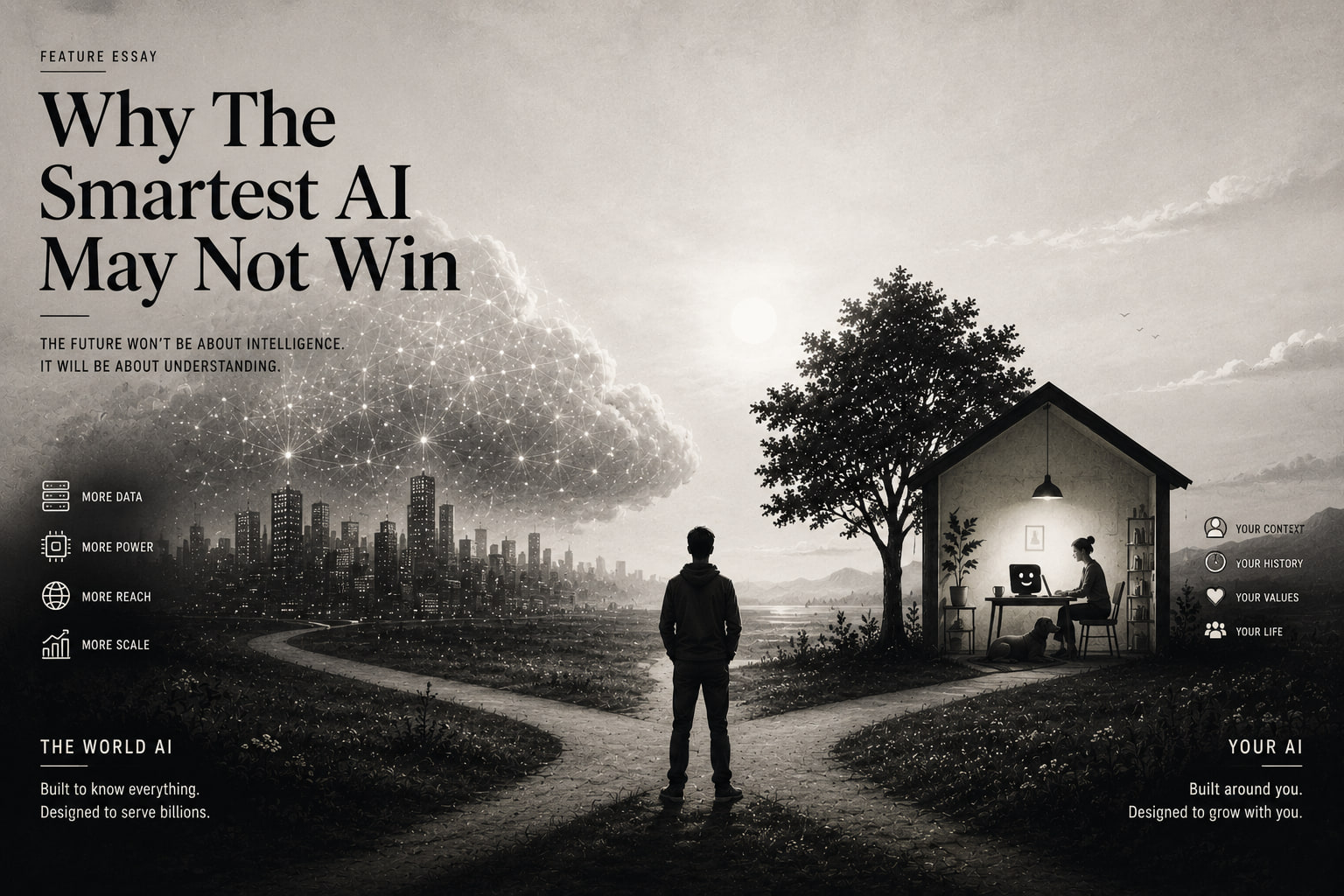
Every major technology company is currently locked in the exact same race: build a smarter model, train it on more data, deploy more computing power, and capture more users. The underlying assumption driving this frenzy is rarely questioned. We simply assume that the smartest AI will win.
At first glance, it seems obvious. Throughout history, superior tools have systematically replaced inferior ones. Why should artificial intelligence be any different?
Yet, there is a fundamental flaw in this logic. Humans do not always choose the objectively most capable option. We choose what we trust. We choose what we control. We choose what we own.
Imagine two distinct AI systems a decade from now.
The first is tied to one of the largest technology conglomerates on earth. It has access to staggering server farms, infinite datasets, and more raw information than any human could absorb in a lifetime.
The second system is far less capable. It knows significantly less about the world, its processing power is modest, and its knowledge base is narrow. However, this second AI has spent twenty years alongside a single individual. It knows their daily habits, their business vulnerabilities, their family dynamic, and their long-term priorities. It remembers their successes, failures, and unspoken preferences.
Which AI becomes more valuable?
The answer is not as simple as tech executives think. The corporate giant may know more, but the personal companion understands more. This distinction is bound to become the defining question of the AI age.
For decades, big tech has successfully trained us to rent intelligence. We subscribe to software hosted elsewhere, passively accepting that someone else owns the infrastructure, controls the platform, and dictates the rules. Most discussions about the future assume this model is permanent.
But what if it isn’t? What if we begin owning AI rather than renting it?
Imagine a truly personal system—not a cloud subscription, but a private asset that belongs to you in the same way a vehicle, a physical workshop, or a family business does. Such a system wouldn’t need to be the smartest oracle in existence. It would just need to be private, trusted, and capable of accumulating continuous context.
True ownership fundamentally rewires the relationship. A personal AI serves its owner, not an advertiser, a platform, or a corporation with shifting priorities. Its rules are established by the person who lives with it, and its loyalty belongs entirely to the individual or family that invested years building a relationship with it.
Of course, ownership does not mean escaping responsibility. A car can be driven recklessly, and a workshop can be used to cause harm. Freedom has always demanded accountability, and personal AI will be no different; the owner sets the direction and bears the consequences.
The future value of AI will not come from raw intelligence alone; it will come from context. A system that spends years helping run a business, organising a household, and participating in daily life acquires something that cannot be downloaded from an app store: shared experience and history.
Over time, two identical AI models would evolve into radically different assets based entirely on the lives they live alongside us.
This reality creates an uncomfortable problem for the tech monopolies. What happens when the corporate giants try to gatekeep their massive models?
They won’t simply lock users out; they will force a new architecture into existence. Personal AIs will evolve to act as local cryptographic proxies—essentially a highly advanced, intelligent VPN. When your small, private AI needs massive computing power to solve a rare problem, it won’t surrender your life history. Instead, it will strip away your identity, shuffle your query, and securely broker access with the corporate cloud, using their massive intelligence as a “dumb utility” while keeping your personal context strictly local.
And if corporate platforms try to block these private proxies? A parallel economy will emerge. Users will bypass the monopolies entirely by forming decentralized, peer-to-peer networks. In this sub-market, individual AIs will trade localized knowledge, unique insights, and idle hardware compute directly with one another, using data itself as a tokenized currency.
The largest corporate AI systems will undoubtedly run governments, multi-nationals, and heavy infrastructure. They will know more about the world than any system before them. Yet, the most influential AI in your life will be something entirely different.
The AI that knows the world will never match the power of the AI that knows you.
In the end, the future of artificial intelligence will not be determined by who possesses the most intelligence, but by who possesses the most understanding.