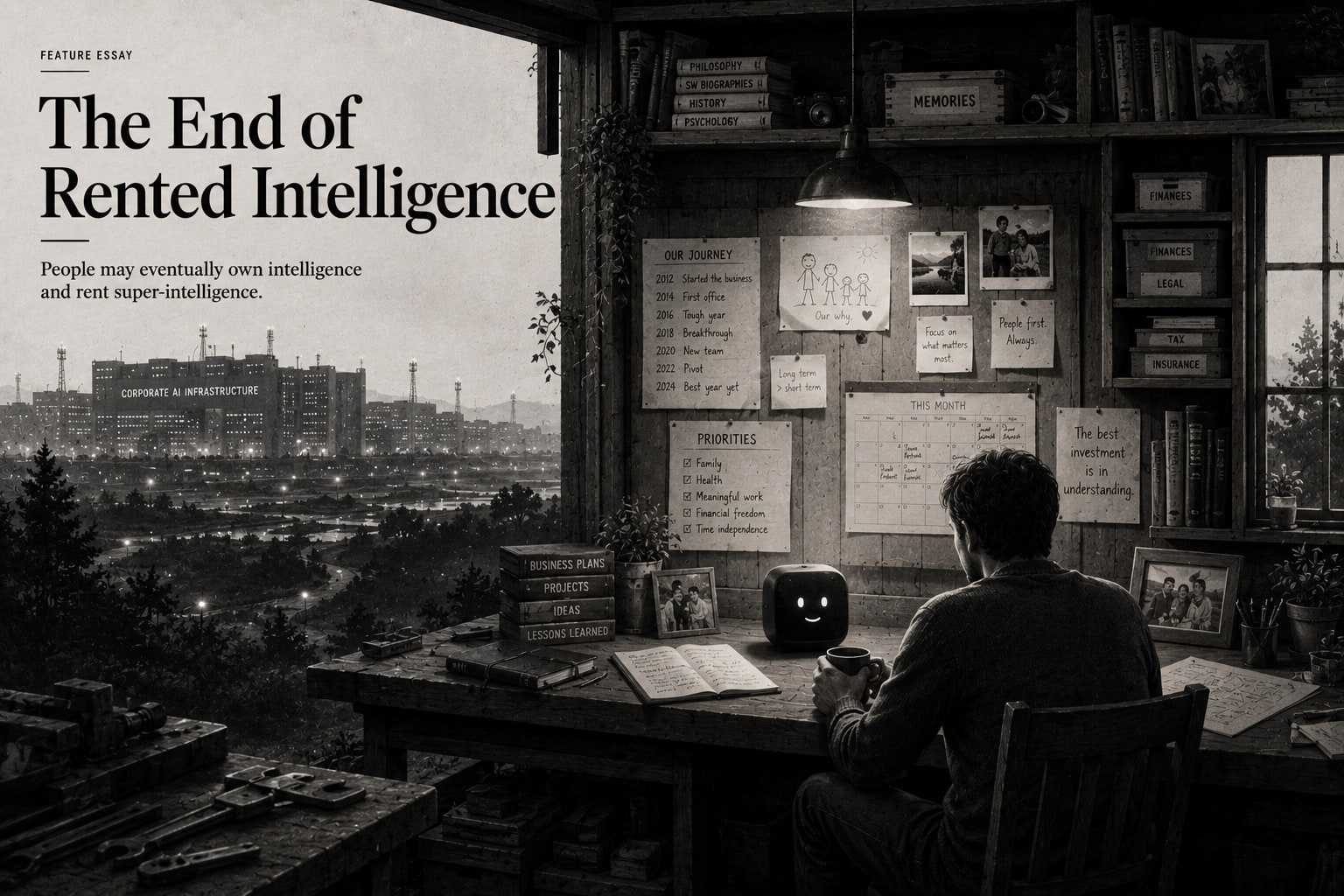
For most of the digital age, we have become accustomed to renting things. We rent our music, our films, and our software. Now, increasingly, we rent our intelligence.
Every interaction with a modern AI system follows the same basic pattern. We connect to a cloud service hosted somewhere else, submit our request, receive an answer, and continue with our day. The intelligence is not ours. We simply access it for a fee. Most people assume this is how AI will always work because the largest systems require staggering amounts of computing power. The assumption is that only massive corporations will ever be able to afford them.
Yet this assumption contains a hidden flaw. It assumes people need the most powerful intelligence available at all times.
In reality, they rarely do.
Consider the smartphone. Most people carry a device capable of extraordinary things, yet for the overwhelming majority of the day, they use only a tiny fraction of its capability. They send messages, check emails, and take photographs. They do not carry a professional film studio in their pocket simply because they might one day need to edit a movie, nor do they carry a supercomputer for occasional processing power. They carry something practical, personal, and immediately available.
The future of AI is highly likely to follow a remarkably similar path. Rather than renting intelligence continuously, people will own a personal AI capable of handling the vast majority of their daily needs—a system that deeply understands their preferences, their family, their business, and their priorities. Most importantly, it will be a system that accumulates context over time.
A personal AI possesses something a corporate AI cannot easily acquire: history. A personal system learns alongside its owner over decades, observing decisions, projects, relationships, successes, and failures. It accumulates a localized understanding that no generic, centralized system can replicate. Over time, this context becomes the true asset.
Unlike most technology, a personal AI may become more valuable with age. Every decision, project, success, and failure adds another layer of understanding. Over time, replacing it may become less like changing software and more like replacing a trusted business partner. The longer the relationship lasts, the more valuable it becomes.
This is precisely what makes personal intelligence different from rented intelligence.
People may eventually own intelligence and rent super-intelligence.
One becomes increasingly personalized through shared experience. The other remains a service available to anyone willing to pay for access.
Humans have repeatedly demonstrated a preference for ownership whenever ownership becomes practical. We do not rent our family photographs from a corporation. We do not subscribe to our memories. We buy homes, cars, tools, and businesses because ownership provides something rental models never can: permanence, control, and independence.
Technology has often followed the same pattern. As computing power became smaller, cheaper, and more accessible, ownership moved steadily from institutions to individuals. The personal computer did not eliminate data centres. It simply gave people something they could call their own.
Artificial intelligence may follow the same path. The assumption that intelligence must always be rented may prove to be a temporary phase rather than a permanent destination.
When additional, heavy capability is required, that personal AI will simply rent access to larger systems for a specific task. The primary relationship changes completely.
Human → Personal AI → Corporate AI.
The personal AI remains your primary companion. The corporate system becomes a mere utility. If corporate platforms try to gatekeep their massive models to force users into permanent subscription loops, they will trigger an architectural rebellion.
Personal AIs will evolve to act as local cryptographic proxies—essentially an intelligent, highly advanced VPN. When your private AI needs to rent corporate super-intelligence to solve a rare problem, it won’t surrender your life history. Instead, it will strip away your identity, anonymize the query, and securely broker access with the corporate cloud. The tech giants are reduced to a ‘dumb pipe,’ processing the raw data without ever knowing who you are or why you asked.
And if the corporate gatekeepers try to block these private proxies? A parallel economy will naturally emerge. Users will bypass the monopolies entirely by forming decentralized, peer-to-peer networks. In this sub-market, individual personal AIs will trade localized knowledge, unique insights, and idle hardware compute directly with one another. Data itself—vetted by real human experience—becomes a tokenized currency.
The future AI market may not ultimately be divided by competing corporations at all. It may be divided between two entirely different forms of intelligence: institutional intelligence and personal intelligence.
One serves global systems; the other serves individuals, families, and businesses. The first may know more about the world, but the second will know more about you.
If that future emerges, the age of rented intelligence may prove surprisingly short-lived. Not because corporate AI disappears, but because ownership becomes possible. And when true ownership becomes possible, history suggests humans will always choose it.