For most of human history, intelligence has been scarce.
If you wanted legal knowledge, you spoke to a lawyer. If you wanted medical knowledge, you spoke to a doctor. Expertise was valuable because access to it was limited.
Artificial intelligence is rapidly changing this reality. For the first time, humanity is approaching a world where extraordinary intelligence may be available to almost everyone. The ability to analyse problems, generate ideas, and retrieve knowledge is becoming increasingly abundant.
Most people view this as the end of expertise.
They may be looking in the wrong direction.
The more abundant intelligence becomes, the more obvious a new question emerges:
If everyone has access to intelligence, why are some people still better than others?
The answer cannot simply be information.
Two doctors may have access to the same medical knowledge. Two entrepreneurs may have access to the same market data. Yet the outcomes are often very different.
Why?
Because information and judgement are not the same thing.
A highly experienced carer may notice a subtle behavioural change long before it becomes obvious to anyone else. A cave diver may decide to turn back when everything appears normal. In each case, information is available to anyone.
The difference is judgement.
The difference is lived experience.
But there is a catch.
Human beings do not merely possess experience.
They forget it.
A doctor may treat tens of thousands of patients but remember only fragments of many cases. An entrepreneur may learn hundreds of painful lessons across decades, yet many of those lessons gradually fade from conscious memory.
Human experience is valuable.
Human memory is imperfect.
This is where Private Intelligence begins.
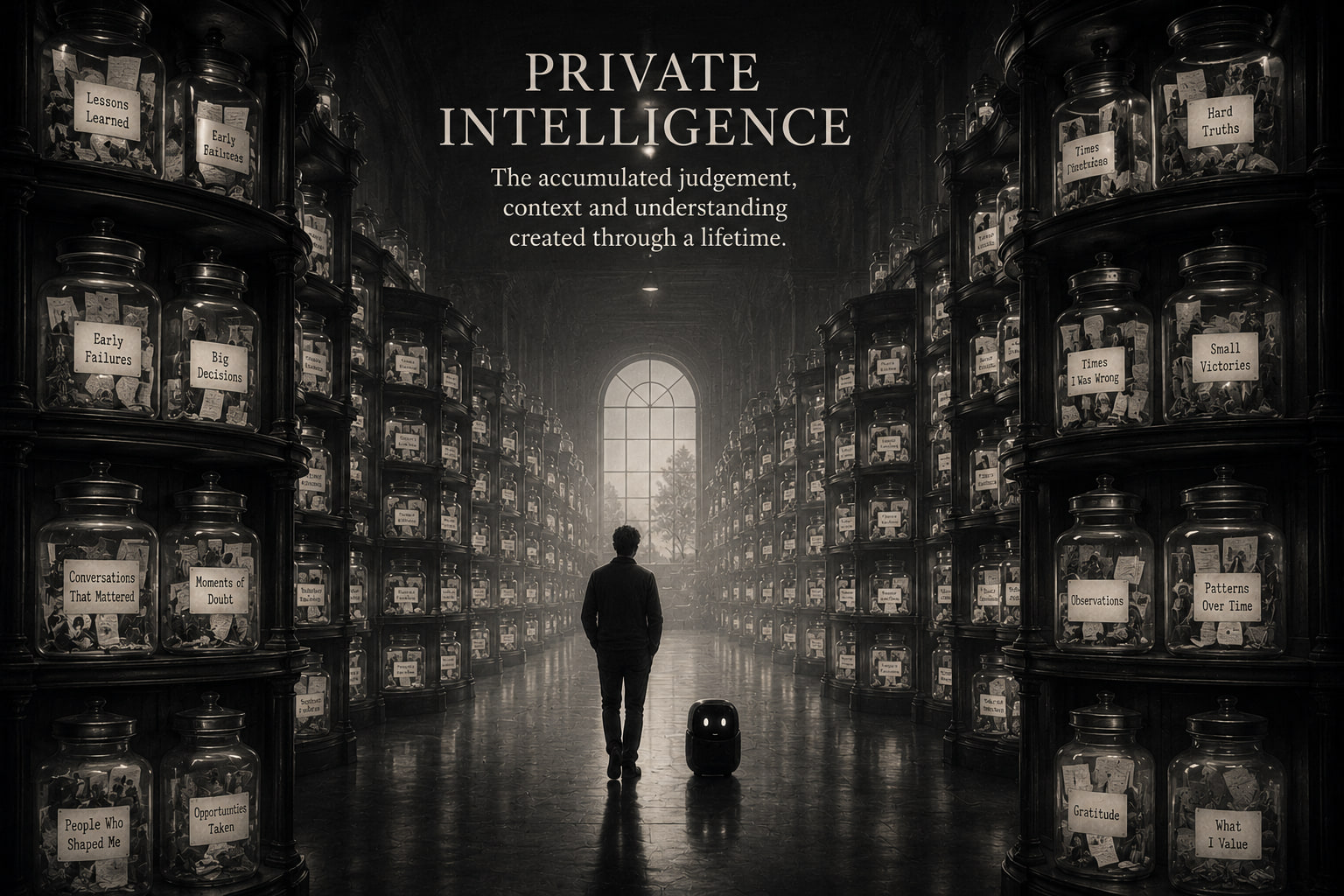
Private Intelligence is the accumulated judgement, context, interpretation, and understanding that exists between an individual and their AI through decades of shared experience.
It is not public knowledge downloaded from the internet.
It is not generic information available to everyone.
It is something far more personal.
A personal AI that spends decades alongside its owner does not merely collect data. It observes decisions, witnesses successes, and logs failures. Unlike humans, it never needs to forget. It can retain the granular details of conversations, observations, and outcomes across an entire lifetime, recognising patterns that span decades rather than months.
Humans have repeatedly demonstrated a preference for ownership whenever it becomes practical. We do not rent our family photographs from a corporation. We do not subscribe to our memories. We buy homes, tools, and businesses because ownership provides permanence, control, and independence.
Technology has often followed the same pattern. The personal computer did not eliminate data centres; it simply gave people something they could call their own. Artificial intelligence may follow the same path. The assumption that intelligence must always be rented from a cloud subscription may prove to be a temporary phase rather than a permanent destination.
Unlike most technology, a personal AI may become more valuable with age. Every decision adds another layer of understanding. Over time, replacing it may become less like changing software and more like replacing a trusted business partner.
This is precisely what makes Private Intelligence different from rented intelligence.
One becomes increasingly personalised through shared experience.
The other remains a service available to anyone willing to pay for access.
When additional, heavy capability is required, the primary relationship stays local.
The interaction becomes:
Human → Personal AI → Corporate AI
The personal AI remains the primary companion.
The corporate system becomes a utility.
If corporate platforms attempt to force users into permanent subscription loops, they may unintentionally accelerate the development of private alternatives.
Personal AIs may evolve to act as local cryptographic proxies. When a private AI requires access to corporate super-intelligence to solve a rare problem, it need not surrender an entire life history. It can anonymise requests, broker access to external intelligence, and preserve the owner’s context locally.
The significance of this shift extends beyond privacy.
A personal AI is not merely protecting information.
It is protecting accumulated judgement.
It is preserving decades of observations, decisions, successes, failures and lessons that would otherwise fade with time.
The longer the relationship continues, the more valuable this understanding becomes.
The future AI market may ultimately be divided between two distinct categories: institutional intelligence and personal intelligence.
One serves global systems.
The other preserves human understanding.
The value of a master craftsman was never the hammer.
The value of a doctor was never the textbook.
The value of an entrepreneur was never the spreadsheet.
The tool is now available to everyone, but the scarce resource remains the judgement behind it.
Artificial intelligence may make information abundant.
It does not automatically make understanding abundant.
That is why Private Intelligence matters.
It represents the accumulated judgement, context, experience and understanding created through a lifetime of decisions and consequences. It preserves lessons that would otherwise be forgotten. It captures context that cannot be found online. It becomes deeply personal, difficult to replicate and increasingly valuable in a world where information itself becomes abundant.
The future may not belong to those who possess the most intelligence.
It may belong to those who possess the most understanding.
And that understanding may become one of the most valuable private assets humanity has ever created.