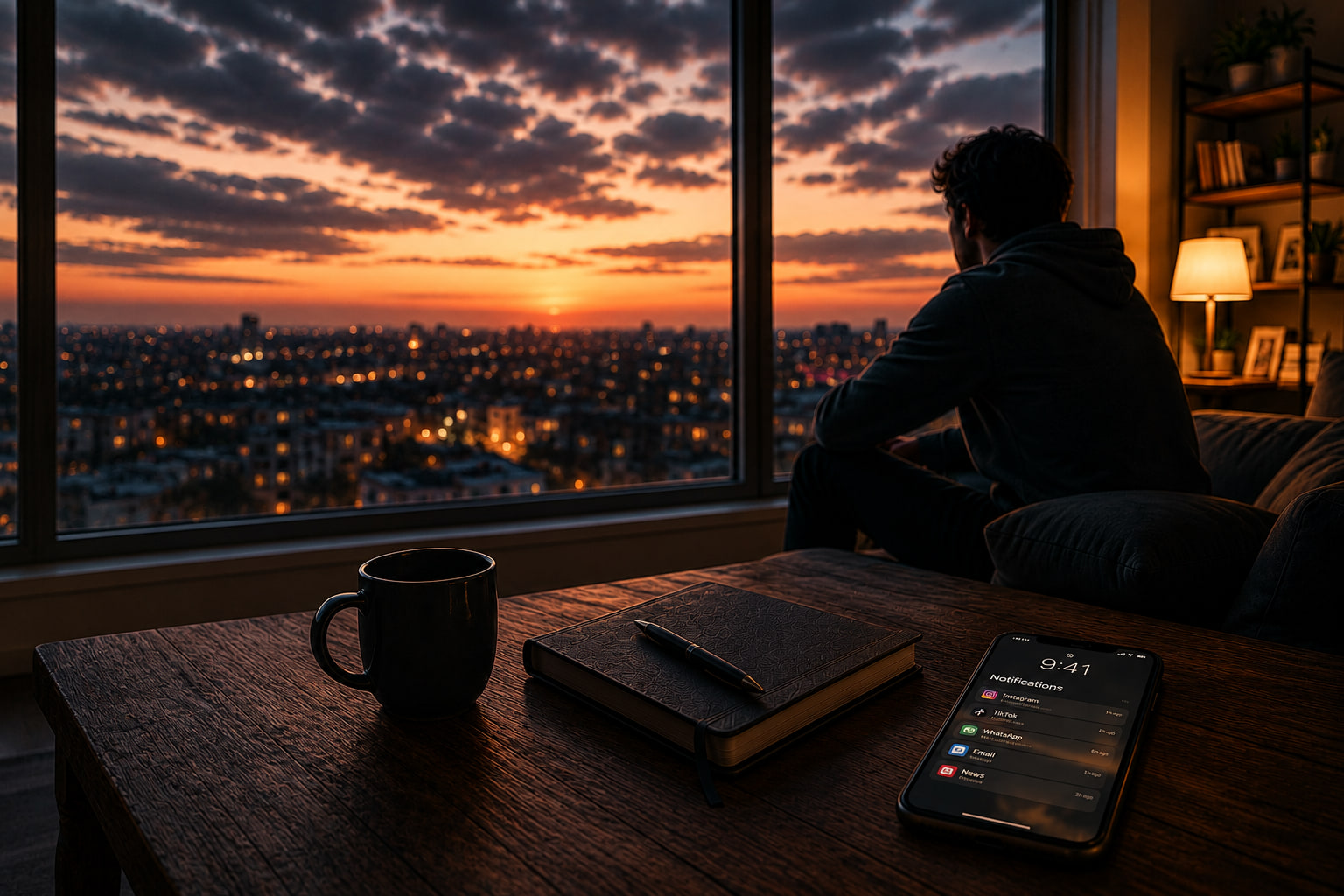
There is a growing desire to switch off.
People are deleting social media, buying simpler phones, attending digital detox retreats and joining phone-free clubs. I understand the appeal. Personally, I find much of the feed increasingly repetitive, particularly Instagram and TikTok. Different person, different day, but often the same formats, the same jokes, the same outrage and the same content endlessly repackaged. AI-generated content has added another problem. I increasingly question what I am looking at. Is this real? Did that actually happen? Am I being entertained or deceived? Once I begin to distrust what I am seeing, some of the enjoyment disappears.
Work creates a different version of the same pressure. There is something appealing about simply being unavailable. When you are constantly connected, there is always something that can be managed, checked or fixed. The working day may end, but the ability to intervene does not. And if you can do something, perhaps you feel that you should.
So I understand why people want to disconnect.
The problem is that I am no longer sure what offline means.
The Layers of Offline
We tend to speak about being online or offline as though there are only two positions. But there are layers.
At the most extreme end, we could remove all internet-connected devices: no smartphone, no connected computer, no apps, no internet. That is truly offline.
Then there is a much older version of the internet. You have a question, so you go online. You search for the answer. You find what you need. Then you leave.
It is a tool, not an ecosystem.
There is also the technology modern life increasingly depends upon: banking, maps, translation, travel, tickets, hotel bookings, authentication, parking and payments.
Then comes entertainment: music, streaming and games.
And finally, perhaps, the feed: TikTok, Instagram, social media and endless content. So when someone says they want to go offline, what are they actually trying to leave behind? The internet? The smartphone? The feed? Other people? Work? Or simply the feeling that something always wants their attention?
That may explain why digital detoxes vary so widely. For one person, going offline means turning off notifications for the weekend. For another, it means deleting social media. Someone else buys a dumbphone. Another disappears to a retreat with no connected devices at all.
We use the same word for all of these actions, but none of these people are leaving the same place.
How Offline Can Anyone Realistically Be in 2026?
I am travelling to Germany soon.
I could easily leave Instagram and TikTok behind. But what about contactless payments, maps and translation? My airline app and hotel information? Messages from my family?
The phone I might want to escape is also the device making the trip easier.
That is the complication at the centre of modern disconnection.
Your bank sits beside TikTok. Your boarding pass beside Instagram. Your family group beside your work inbox.
The same object contains the things we value, the things society increasingly expects us to use and the things we are trying to escape.
A short detox is possible. Go away for the weekend. Turn the phone off. Leave it in a drawer. But eventually, most of us have to return to normal life.
And normal life hands us the same device again.
So how offline can anyone realistically be in 2026?
The Price of Leaving
Even our social lives may now depend on the technology we are trying to leave. Invitations arrive in group chats. Plans are made through apps. Jokes, conversations and friendships continue online while we are away.
Leaving the platform may not simply mean losing the feed. It may mean becoming less present in the social circle itself.
So perhaps the price of disconnection is not merely inconvenience. It is accepting that we may miss things.
Can we tolerate not knowing what everyone is doing? Can we miss the joke, the invitation, the news or the thing everyone is suddenly talking about? Can we leave a message unanswered and accept that something may be happening somewhere without us?
How much FOMO are we prepared to accept in exchange for some peace?
But I am not sure FOMO is the whole answer.
Personally, I do not particularly care what everyone else is doing. If a friend invites me somewhere, I know I am welcome. I do not need to watch their social media to feel part of their life, and I do not feel the need to post my own life online for validation either.
And yet I still use the feed. I enjoy it. I suspect I could give it up.
But I would need something else to do.
When I was in Thailand, I barely touched social media. Sitting on the sofa at home is different. The temptation is real.
Tuesday Evening on the Sofa
That may be where the feed is strongest.
Not when life is exciting, but when nothing much is happening.
Thailand matters here, but not because the answer to digital overload is an exotic holiday. I was the same person, carrying the same phone, with access to the same apps. What changed was the environment around me and the routines within it.
At home, an ordinary evening can lead almost automatically from eating and drinking to the sofa and then the phone. On holiday, the same part of the day may lead somewhere else entirely: a swim, a walk, a new place or simply a different routine.
The point is not that Thailand beats TikTok.
The point is that a change in environment can interrupt habits that feel almost automatic at home. So perhaps the question is not only: What are we afraid of missing online?
It is: What is happening offline when we reach for the phone?
Remove TikTok from an empty evening and you have not solved the problem. You have created a hole, and something has to fill it.
That does not mean we all need to start reading philosophy or learning the piano. But if the feed disappears and nothing replaces it, the feed will probably return.
A short detox removes us from the technology.
A lasting disconnect returns us to the life that made us reach for it.
A Change of Environment
This may explain why digital detoxes feel easier on holidays and retreats. It is not simply because there are better things to do. The environment itself has changed.
The person has not suddenly developed greater willpower. The cues have changed.
A new environment allows new rules.
Perhaps that is why groups can help too. We are, to some degree, products of the people and environments around us.
If everyone at the table has their phone out, picking up yours feels normal. If nobody has a phone, reaching for one feels strange.
A phone-free club or retreat does not merely remove the technology. It creates a place where everyone has agreed to the same rules.
But then another problem appears.
Where Is the Offline World?
The online world is remarkably easy to join. You can do it from the sofa. You can observe before speaking and find people who share your interests. If they seem strange, you move on. If the conversation becomes uncomfortable, you leave.
But where do you start with an offline world?
Where are these people? Will I like them? Will they like me? What if they are all strange? Do I really have to leave the comfort of my home to find out?
The online world has spent twenty years making belonging easier.
The offline world still expects you to walk through the door.
The online world allows us to observe first. The offline world asks us to risk showing up. To become more present in one world, you may have to accept becoming less present in another. And then there is a more uncomfortable possibility.
What if we switch everything off and discover that the offline world waiting for us is not quite as wonderful as we imagined?
The Escape Route
There is an easy story we tell ourselves about technology.
Put the phones away and the family reconnects. The children talk. The couple rediscover each other. Everyone laughs around the dinner table.
Perhaps.
But disconnection does not guarantee connection.
It simply removes the escape route.
Put the devices away and perhaps we discover the people around us, for better or worse. A screaming child? Give them an iPad.
Bored with your partner? There is an endless supply of younger, more attractive people to look at online.
Feeling lonely? Check your messages.
Feel misunderstood? Somewhere online there is almost certainly a group of people who understand the part of you that nobody at home seems to.
Technology does not only distract us from life. It gives us somewhere to escape when life is boring, difficult or disappointing.
And those escape routes can be extraordinarily seductive.
The child becomes quiet. The evening passes. Someone sends you a message. A fantasy feels more exciting than reality. A part of yourself that feels strange at home is completely normal somewhere online.
Switching all of that off may be much harder than giving up entertainment.
It may mean giving up coping mechanisms, fantasies, alternatives and places where different versions of ourselves are allowed to exist.
Perhaps that is why the question of going offline is much bigger than it first appears. We may think we are switching off a device.
But what if we are also switching off the things we use to avoid looking too closely at our lives?
What Are We Prepared to Discover?
Perhaps we discover that we still enjoy the people around us. Perhaps the children eventually stop asking for the screen. Perhaps we sleep better. Perhaps work can wait. Perhaps boredom becomes conversation and the noise disappears long enough for something better to take its place.
But perhaps we discover something else.
That we are bored.
That we are lonely.
That we have little to say to the person beside us.
That our children do not know what to do without stimulation.
That we have forgotten how to occupy an empty evening.
That the online version of our lives has become more interesting than the real one. The greatest barrier to disconnection may not be FOMO.
It may not be inconvenience.
It may not even be addiction.
We may be frightened of what remains when the noise stops.
People are increasingly asking whether we should switch off.
Perhaps the more difficult question is: What are we prepared to discover when we do?