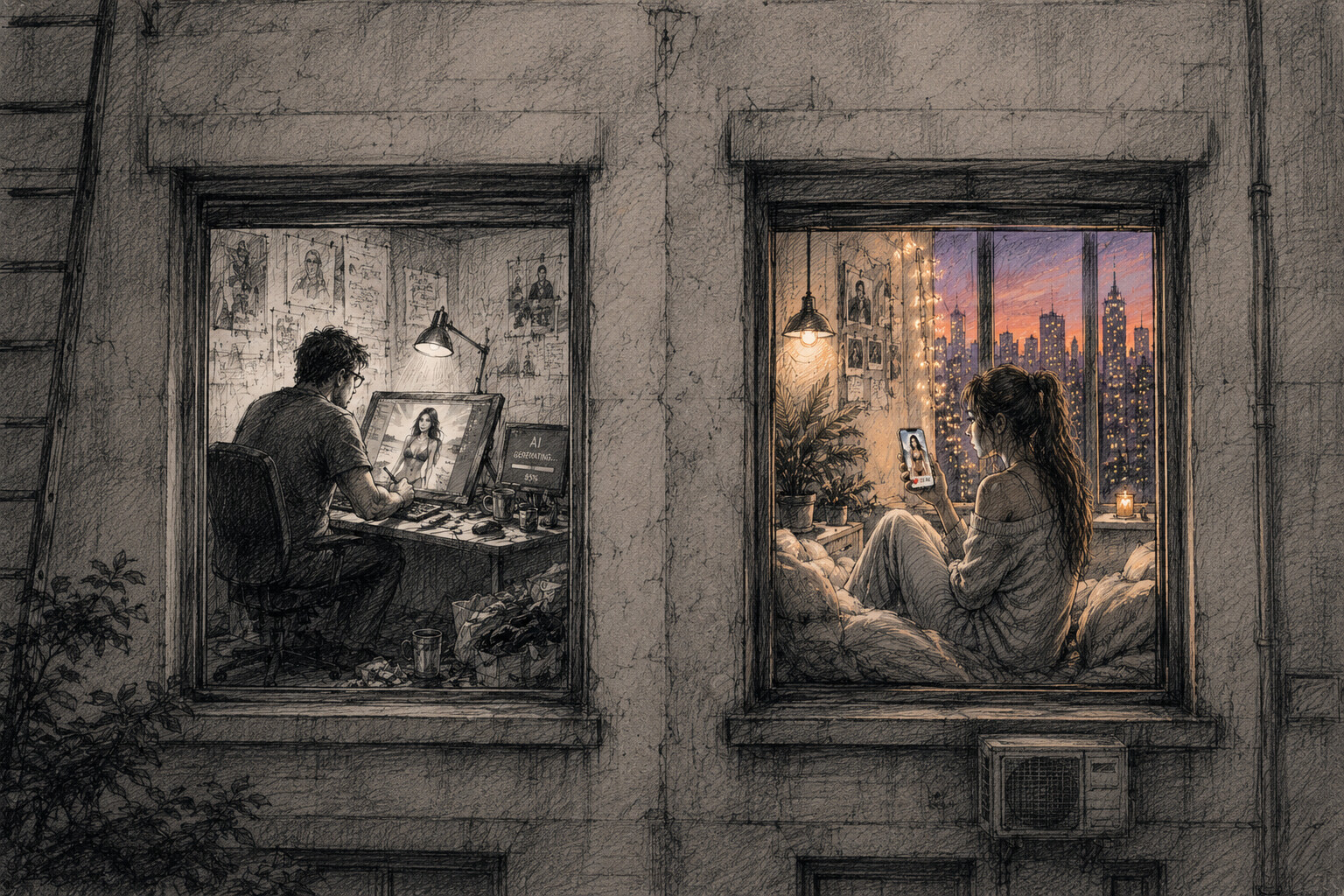
For most of human history, reality had an advantage. It existed.
People were real. Experiences were real. Places were real.
Yet despite all its flaws, the first two decades of social media still operated according to an unwritten rule: there was usually a person somewhere behind the account.
The photographs may have been carefully selected. The lifestyle may have been exaggerated. The face may have been filtered. But there was still a human being standing behind the illusion.
Artificial intelligence changes the equation entirely.
For the first time in human history, it is becoming possible to build a digital life without a corresponding physical one.
The face can be generated. The body can be generated. The holiday can be generated. The relationship can be generated. The house can be generated. The voice can be generated.
The entire performance can exist without a performer.
The problem is not whether artificial intelligence can create convincing content. The problem is what happens when people stop trusting what they see.
Trust is one of the most invisible forces in society. Most of the time we simply assume it exists.
We assume a photograph depicts something that happened. We assume a person is who they claim to be. We assume an experience was experienced.
Artificial intelligence is beginning to challenge those assumptions.
Imagine a teenager scrolling through social media and discovering an account belonging to a remarkably attractive person. The photographs are flawless. The lifestyle appears exciting. The confidence appears effortless.
Comparison quietly takes place.
Why don’t I look like that?
Why isn’t my life like that?
One day they discover the account belongs to nobody.
No model. No influencer. No celebrity. No person.
The face was synthetic. The body was synthetic. The lifestyle was synthetic. The life itself was synthetic.
At that moment the emotional experience shifts from envy to betrayal.
The individual was never competing with another human being. They were competing with software.
Against something infinitely adjustable. Infinitely optimised. Infinitely perfect.
For years, critics argued that social media promoted unattainable standards. Artificial intelligence introduces something even stranger: standards that do not exist at all.
An edited photograph still begins with a person. A generated photograph does not.
One stretches reality. The other replaces it.
If this account is not real, what else isn’t?
The influencer may be artificial. The reviews may be artificial. The followers may be artificial. The comments may be artificial. The community itself may be artificial.
The issue is no longer deception. The issue is uncertainty.
Social media succeeded because it convinced people they were participating in a shared reality. Artificial intelligence threatens to fragment that reality.
Because when authenticity becomes impossible to verify, trust begins to erode.
The harder reality becomes to verify online, the more valuable reality itself becomes.
A real conversation. A real friendship. A real recommendation. A real experience. A real photograph. A real memory.
These things begin to acquire a premium.
Throughout history, authenticity was usually assumed until proven otherwise. The coming decade may invert that assumption.
Authenticity may need to be demonstrated. Verified. Proven.
What does it do to us when we discover we have been comparing ourselves to people who never existed?
What happens when aspiration becomes fiction?
What happens when perfection is manufactured?
What happens when reality becomes optional?
The answer may determine the future of social media itself.