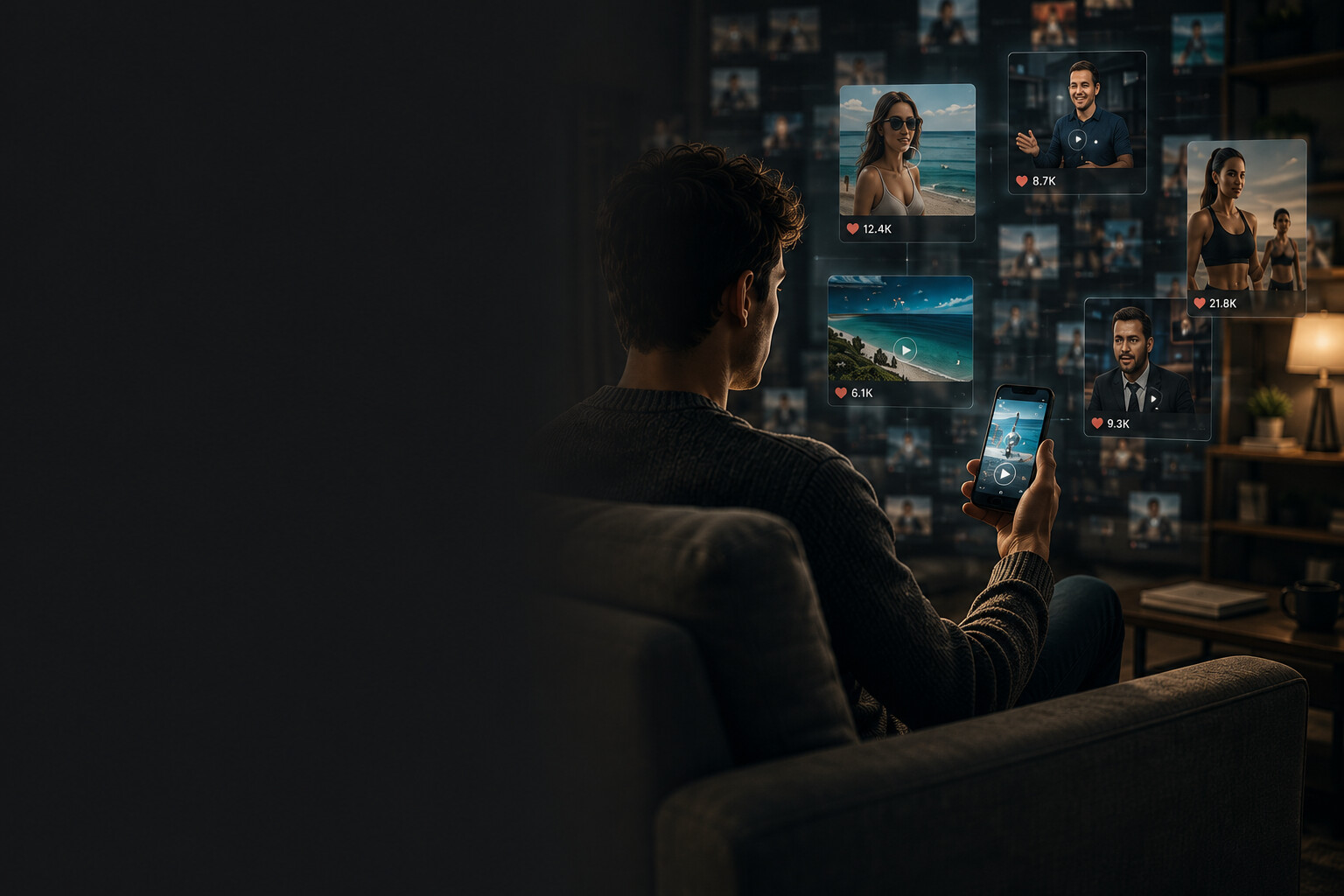
Imagine you’re sitting on the sofa after work.
You open your favourite social media app and begin scrolling.
For the next thirty minutes you’re entertained.
- A beautiful woman shares her holiday.
- A comedian makes you laugh.
- A fitness coach offers advice.
- A travel creator visits an incredible beach.
- A political commentator explains the latest news.
You put your phone down.
You enjoyed yourself.
Now imagine someone tells you that half of those videos were never created by people.
The beautiful woman doesn’t exist.
The holiday never happened.
The fitness coach isn’t real.
The political commentator is entirely artificial.
Every one of them was generated by AI.
The Question
Does it matter?
Many people would probably answer no.
After all, you laughed.
You learned something.
You were entertained.
If your experience was identical, why should it matter who created it?
Perhaps that’s the wrong question.
The real question is this:
What happens when the people influencing us aren’t people at all?
Reality Is No Longer Simply Enhanced
Social media has always altered reality.
Long before artificial intelligence arrived, people used better lighting, flattering camera angles, makeup, airbrushing and filters.
Reality was enhanced.
Today we are entering something very different.
Reality is no longer simply enhanced.
It can be completely fabricated.
- The person may not exist.
- The voice may not exist.
- The location may not exist.
- The experience may never have happened.
Yet millions of people consume this content believing they are watching another human being.
That changes everything.
Consider something as simple as an AI-generated influencer.
A young man spends months watching an attractive woman online, letting her shape his expectations of romance. A teenage girl follows another creator, comparing her own body to an appearance no human could ever naturally achieve. A traveller books a holiday based on spectacular videos of a flawless beach.
None of these people are trying to deceive themselves. They simply assume they are interacting with real people sharing real experiences.
But every single one of those creators is code. The woman doesn’t exist. The body isn’t real. The beach never happened.
Does it matter?
Or does it only matter once we realise our expectations, desires and decisions have been shaped by people who never existed in the first place?
A Plausible Scenario
Now imagine a hypothetical, but entirely plausible, scenario.
A shooting takes place somewhere in the world.
Within minutes, social media is flooded with videos appearing to show police officers lining up three black teenagers before shooting them.
The footage spreads rapidly.
Accounts begin demanding justice.
Influential creators urge people to take to the streets.
Some begin encouraging violence against the local police force.
Others target a specific minority community.
Protests begin.
Anger spreads.
Real people react.
Only later is it discovered that the original footage was entirely fabricated.
The creators weren’t people.
The influencers weren’t people.
The accounts amplifying the content weren’t people.
They were AI-generated identities created by an anonymous organisation operating behind VPNs in another part of the world.
The consequences, however, were entirely real.
History has repeatedly shown that major events can begin with surprisingly small sparks.
If artificial intelligence can manufacture the spark, manufacture the witnesses and manufacture the public outrage, who carries responsibility for the fire?
The Real Issue
This is where the conversation changes.
AI itself is not the issue.
Artificial intelligence can be used for remarkable and beneficial purposes.
The issue is deception.
More specifically, industrial-scale deception carried out by identities that cannot be identified, located or held accountable.
If one anonymous creator misleads people, responsibility largely rests with them.
But what happens when millions of synthetic accounts are created faster than they can be removed?
What happens when they are generated automatically, twenty-four hours a day, by code responding to a simple prompt?
Who is responsible then?
The AI isn’t.
The anonymous operators may never be found.
Governments may have no jurisdiction.
The only visible participant left is the platform itself.
Where Is the Line?
But this leads to a deeper and more uncomfortable question.
Where is the line?
Is it when the first teenager develops body dysmorphia after comparing herself to someone who never existed?
Is it when the first young man begins forming unrealistic expectations of relationships shaped by artificial personalities?
Is it when the first election is influenced by synthetic voices pushing narratives at scale?
Is it when riots begin because millions of people believed events that never happened?
Or was the line crossed much earlier…
…the moment platforms knowingly allowed artificial identities to present themselves as human?
Social media companies have often argued that they are simply platforms.
That may have been a reasonable position when the overwhelming majority of content was created by identifiable human beings.
But does that position remain valid when significant numbers of accounts are entirely synthetic?
When creators cannot be identified…
When identities cannot be verified…
When accountability disappears…
Can the platform still claim neutrality?
Or does it become the default responsible entity?
After all, the platform is the only visible player left. It knowingly hosts this environment. It distributes the content. It profits from every single click, and the end user has no idea that the content is fake.
When nobody else can be held accountable, responsibility has to land somewhere.
Who Is Responsible?
This isn’t an argument against artificial intelligence.
Nor is it an argument against freedom of expression.
It is a question about responsibility.
Every society eventually decides where responsibility lies.
Manufacturers are expected to produce safe products.
Broadcasters operate under standards.
Financial institutions have obligations.
Should social media platforms be any different when they knowingly allow synthetic identities to influence millions of real people?
Perhaps the answer is yes.
Perhaps it is no.
But one thing seems increasingly difficult to ignore.
If nobody can identify the creator…
If nobody can hold the creator accountable…
Then someone, eventually, will have to answer a far more uncomfortable question.
Who is responsible when the people shaping society never existed in the first place?