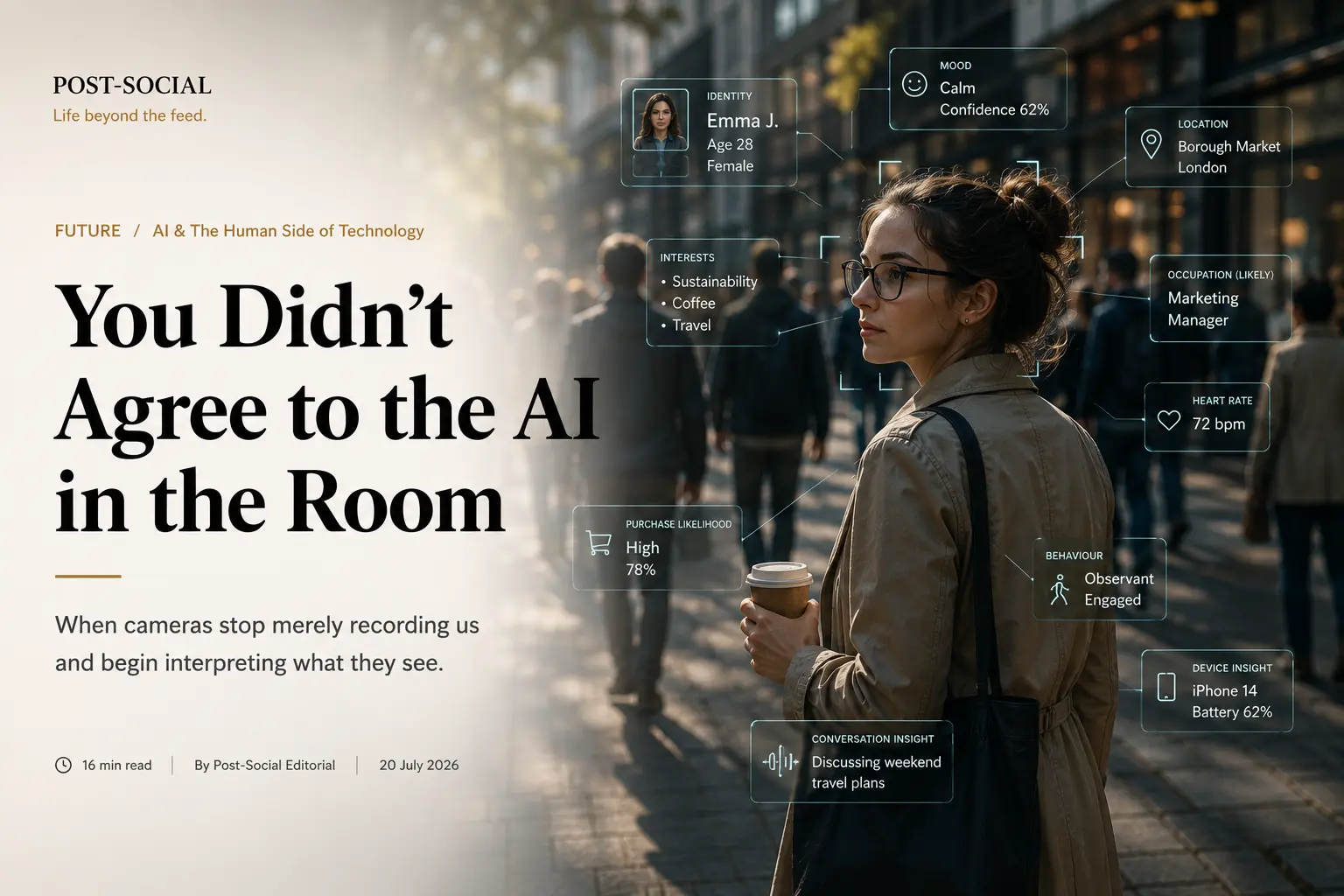
For years, surveillance has been built around cameras that watch places. CCTV watches a shop entrance. A speed camera watches a section of road. A police body camera records an encounter. A mobile phone is deliberately raised and pointed.
AI glasses change that arrangement.
The camera no longer watches a place. It follows a person everywhere—and understands at least some of what it sees.
It may recognise faces, translate conversations, retrieve information, assess behaviour and quietly provide its wearer with a continuous layer of assistance. Eventually, the glasses may replace much of what we currently do through a mobile screen.
That could be extraordinarily useful.
But it also introduces AI into the lives of people who never chose to use it.
You may not be wearing the glasses. You may not have agreed to any terms. You may not even know the system is active.
Yet it can still see you, hear you, interpret you and potentially remember you.
The end of being let off
Consider a police officer wearing AI-enabled glasses.
The system could identify wanted people, recognise vehicles and detect offences that would otherwise go unnoticed. It could improve public safety and make enforcement more consistent.
But consistency is not always the same as justice.
A police officer might currently notice a minor contravention and decide that advice or a warning is proportionate. If the glasses automatically identify the offence and create an auditable record, can the officer still exercise that discretion?
Or must the recorded violation now be enforced because the system knows it happened?
This leads to a question our laws may not have been designed to answer:
Were our laws created to operate in a world where almost every minor violation could be detected?
Automated observation might make society fairer. It could also make it considerably less forgiving.
Why would it stop with government?
If continuous AI observation is accepted for policing and public safety, the precedent will not remain there.
An interviewer could analyse a candidate’s hesitation, eye contact and confidence.
A vehicle could record every lapse in attention and minor infringement.
A doctor’s glasses could identify symptoms and retrieve medical information during an examination.
A hotel receptionist could recognise returning guests, remember their preferences and greet them personally.
An employer could monitor safety, productivity and behaviour.
Each use could be described as helpful, efficient or protective. In some cases, it genuinely would be.
But where does helpful observation become hidden judgement?
A hotel might call it silent personalisation. The guest might experience it as surveillance. The system could move from remembering a preferred room to inferring wealth, health, mood or likelihood of spending.
The ability to make such inferences may become inevitable. The more important question is what organisations are allowed to do because of them.
Recording may no longer mean recording
A visible recording light appears to offer a simple solution. But it relies on an increasingly outdated distinction between recording and not recording.
AI glasses could process what they see without permanently saving the original video.
They might still extract names, faces, transcripts, objects, locations, behavioural labels and summaries. Those fragments could create a detailed account of what happened, even if the raw footage was supposedly never retained.
“Not recording” could therefore become technically true but practically misleading.
The questions are no longer limited to whether a camera is saving video:
- What is being observed?
- What is being processed?
- What is being inferred?
- What is being stored?
- What could later be reconstructed?
A light showing that recording is disabled tells us very little if the AI is still watching.
The privacy of forgetfulness
If glasses become useful enough to wear all day, forgetting to remove them will be inevitable.
People will walk into bathrooms, changing rooms and medical examinations. They will bathe their children, change clothes and share intimate moments with their partners.
The wearer may have no harmful intention. They may simply forget.
But the wearer’s forgetfulness could become someone else’s privacy violation.
The most credible safeguard may be a physical switch that disconnects the camera and microphone at hardware level, accompanied by an unmistakable external display. Software, apps and the AI itself should not be able to override it.
Even that would not be foolproof. Modified devices could fake the display or bypass the protection. But it would establish a clear social standard:
Privacy in sensitive spaces should outweigh uninterrupted convenience.
The impossible right to refuse
It seems reasonable that people should be able to refuse AI observation.
Inside a private home, that right should be clear. The homeowner should be able to require the glasses to be removed or physically disabled.
Public and communal spaces are more difficult.
A shop may prohibit AI glasses, but staff cannot realistically inspect hundreds of customers or determine whether every pair is active. Someone could reactivate them after entering—or simply glance through the window while walking past.
An individual opt-out is equally problematic.
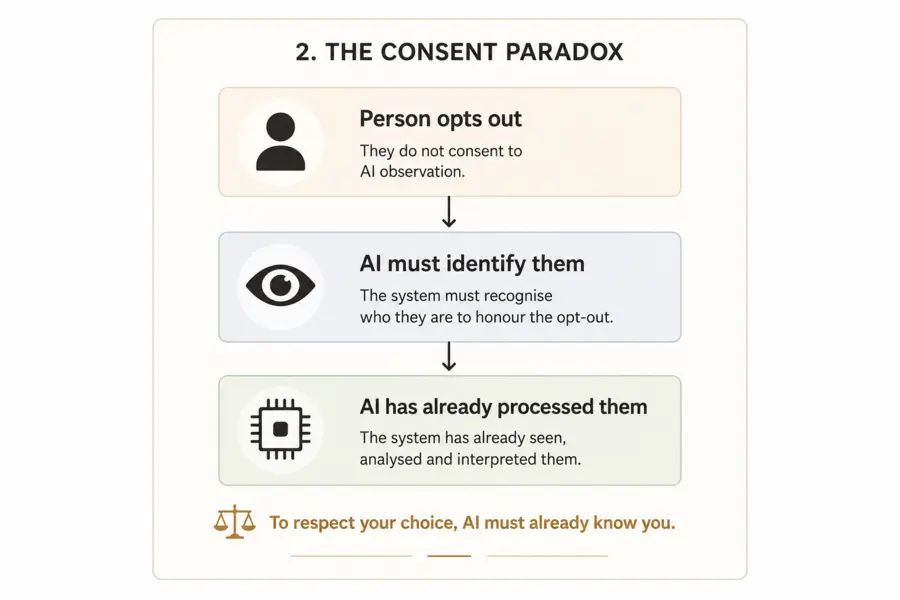
For the system to honour your refusal, it must first know that you are the person who refused. That may require recognising your face, detecting your phone or tracking another permanent identifier.
The AI would need to process you in order to know that it must not process you.
This is the consent paradox at the centre of wearable AI.
Who owns your face?
Explicit permission before every public recording would be desirable but unworkable. People constantly enter one another’s field of view.
That does not mean everything captured should belong to the wearer.
Our faces and voices should remain ours, even when someone else’s device records them. Capturing a person should not automatically create the right to identify them, modify their appearance, reproduce their voice, train an AI system or generate new content using their likeness.
The individual operating the device has responsibilities. So do the manufacturers, platforms and organisations that store or process the information.
This becomes even more important when official safeguards are bypassed.
The rules imposed by major manufacturers will not define the limits of the technology. Devices may be jailbroken. Third-party systems may be developed outside established platforms. Camera feeds may be hijacked.
Someone could use the glasses for covert facial recognition, remote spying or even real-time software that digitally removes clothing and creates fabricated nudity.
The threat is not only what the official product permits.
It is what a determined person can make the technology do.
The permanent witness
AI glasses could also become witnesses.
They may capture an accident, assault or serious crime. In those circumstances, preserving relevant evidence could protect victims and establish what happened.
But that should not grant police, employers or courts unrestricted access to a person’s entire life.
Access should be limited to the incident, together with a defined period immediately before and after it. Any extension should require specific justification and authorisation.
Unrelated information must remain inadmissible.
If someone witnesses an accident, footage showing an unrelated offence they committed earlier should not become an opportunity for secondary enforcement.
AI may locate and temporarily preserve the relevant material. But an authorised person must review the original footage and its context before anything is retained, disclosed or acted upon.
The person whose information was accessed should eventually be told what was viewed, why it was accessed and who authorised it—unless notification would compromise an active investigation.
Most importantly, people must retain the right to switch the system off. Choosing not to create evidence must not itself become evidence of suspicion.
When interpretation becomes evidence
AI glasses will not merely record behaviour. They may categorise it.
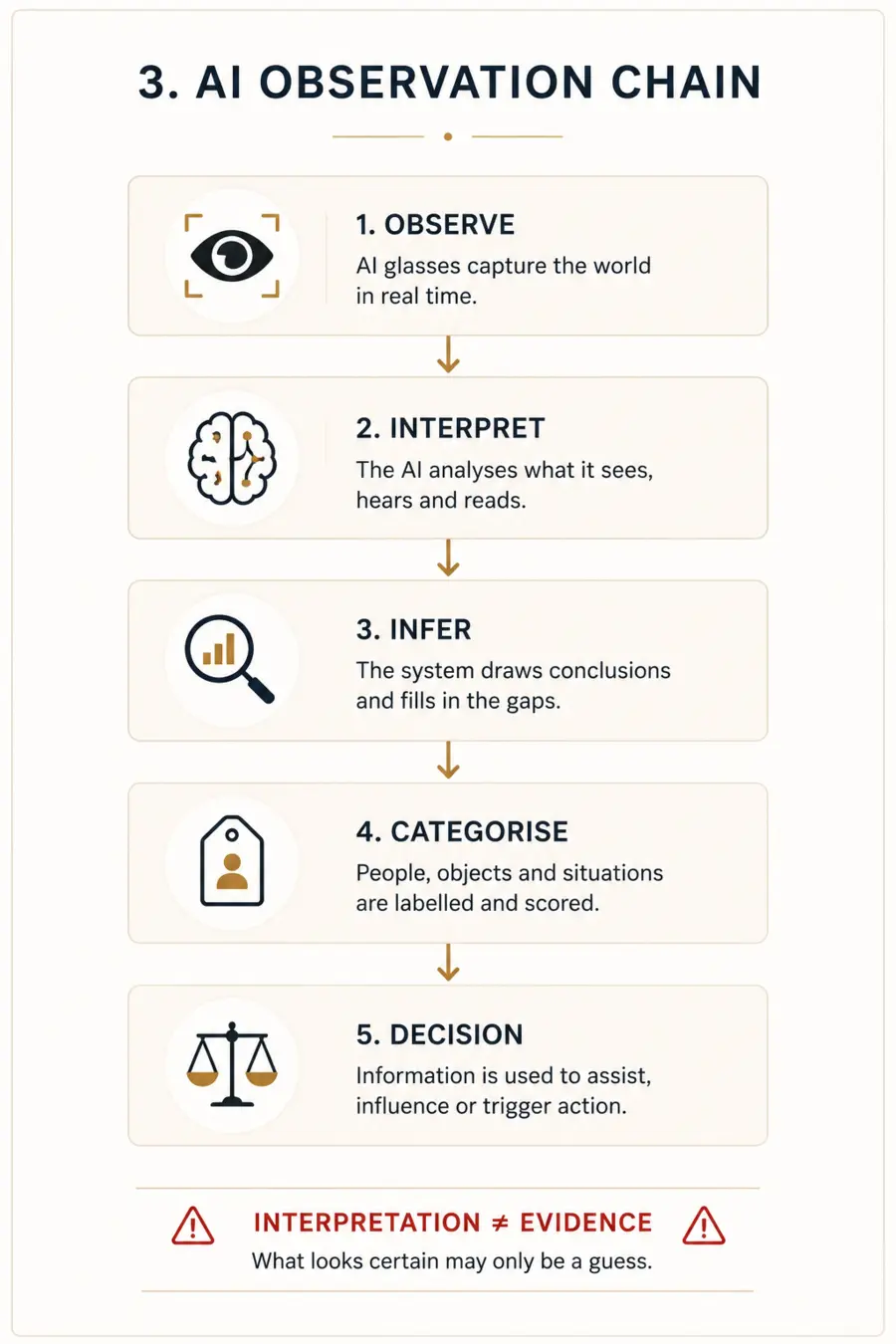
The system might describe someone as aggressive, intoxicated, distracted, anxious or dishonest.
These interpretations could influence employment, insurance, medical treatment, security decisions or criminal investigations. Yet they remain interpretations—not facts.
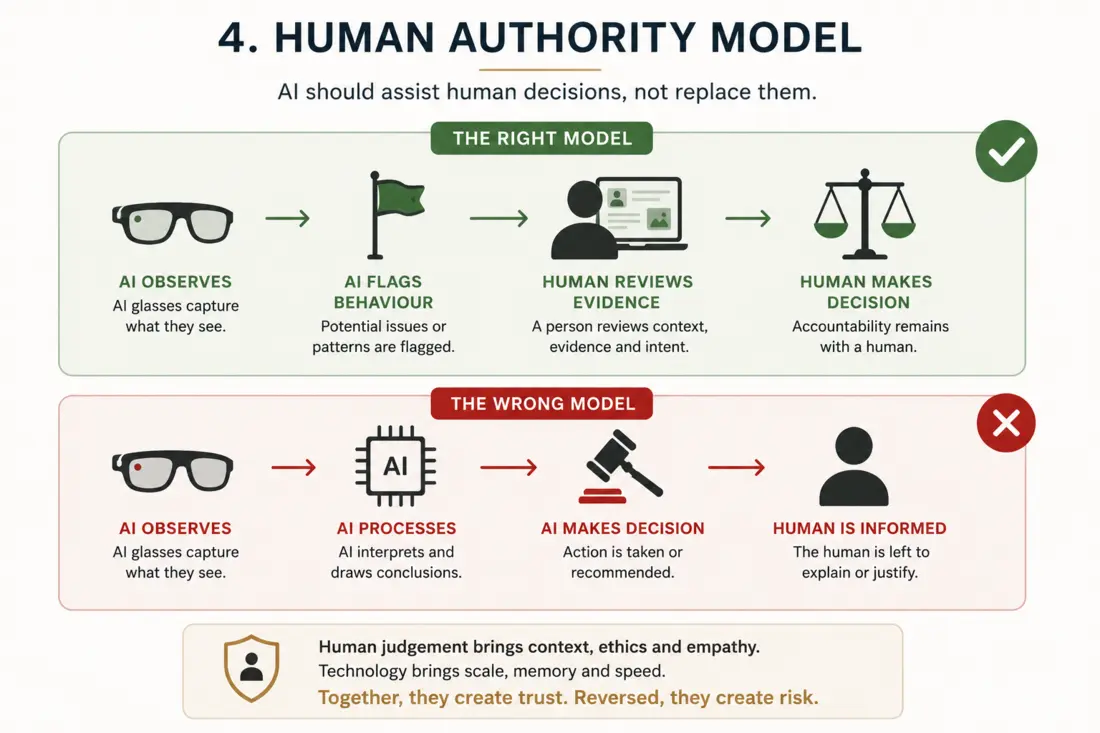
AI may flag behaviour, but it must never become judge and jury.
Any consequential judgement should require a trained and accountable human to examine the original footage, the surrounding context and the relevant sensor data—not merely an AI-generated summary or a selection of clips.
The person being judged must be able to see the interpretation, challenge it and request independent review.
The burden of proof should sit with the organisation deploying the system. It chose the technology, benefits from it and holds the greater power.
If the organisation cannot demonstrate that the system was appropriate, reliable and fairly reviewed, the decision should not stand. Serious or repeated misuse should result in compensation, fines and potentially the loss of permission to use the technology.
The right to see the whole story
AI observation creates an enormous imbalance when an organisation can analyse an individual but the individual cannot see what the organisation is seeing.
That power should be reciprocal.
If police, employers or insurers use AI to assess someone, that person should be able to use AI to examine the evidence in return. They should also have access to the complete relevant record—not merely the organisation’s chosen extracts.
Otherwise, selective clips could create an account that is technically accurate but contextually dishonest.
An independent reviewer may need access to the full record, while the individual receives everything relevant to their case and unrelated information about others remains protected.
The organisation or state should bear most of the cost of that review. Requiring powerful institutions to pay creates a useful restraint: the technology is less likely to be used casually when its use carries responsibility.
Protecting vulnerable people without abandoning the technology
Children, patients and vulnerable adults face some of the greatest privacy risks.
They may also receive some of the greatest benefits.
In schools, hospitals and care settings, continuously available AI could detect dangers, improve accountability and identify problems that would otherwise be missed.
A workable model may be institutionally provided glasses that are individually assigned to staff but remain onsite. Their data would stay inside a secure, ring-fenced system rather than transferring to personal devices.
Staff could review relevant footage, but every access would be time-stamped, justified and auditable.
Parents or guardians would not receive automatic access to everything involving a child. They could make a formal request, with relevant material released after review and the identities of others protected.
The aim should not be to prohibit useful technology. It should be to prevent useful technology from quietly becoming uncontrolled power.
Living with the new witness
We may eventually accept that AI observation is possible throughout much of public life.
It could improve everyday behaviour. It could make people more careful, more accountable and less willing to act badly when they believe someone—or something—is watching.
But it may also make us guarded.
We may begin performing for the system, suppressing harmless mistakes, private opinions and ordinary moments of frustration because we do not know how they might be interpreted later.
People with bad intentions will still find ways to behave badly. They may simply become more sophisticated at hiding it.
The challenge is therefore not to imagine a world without AI observation. That world may already be disappearing.
The challenge is deciding where final authority remains.
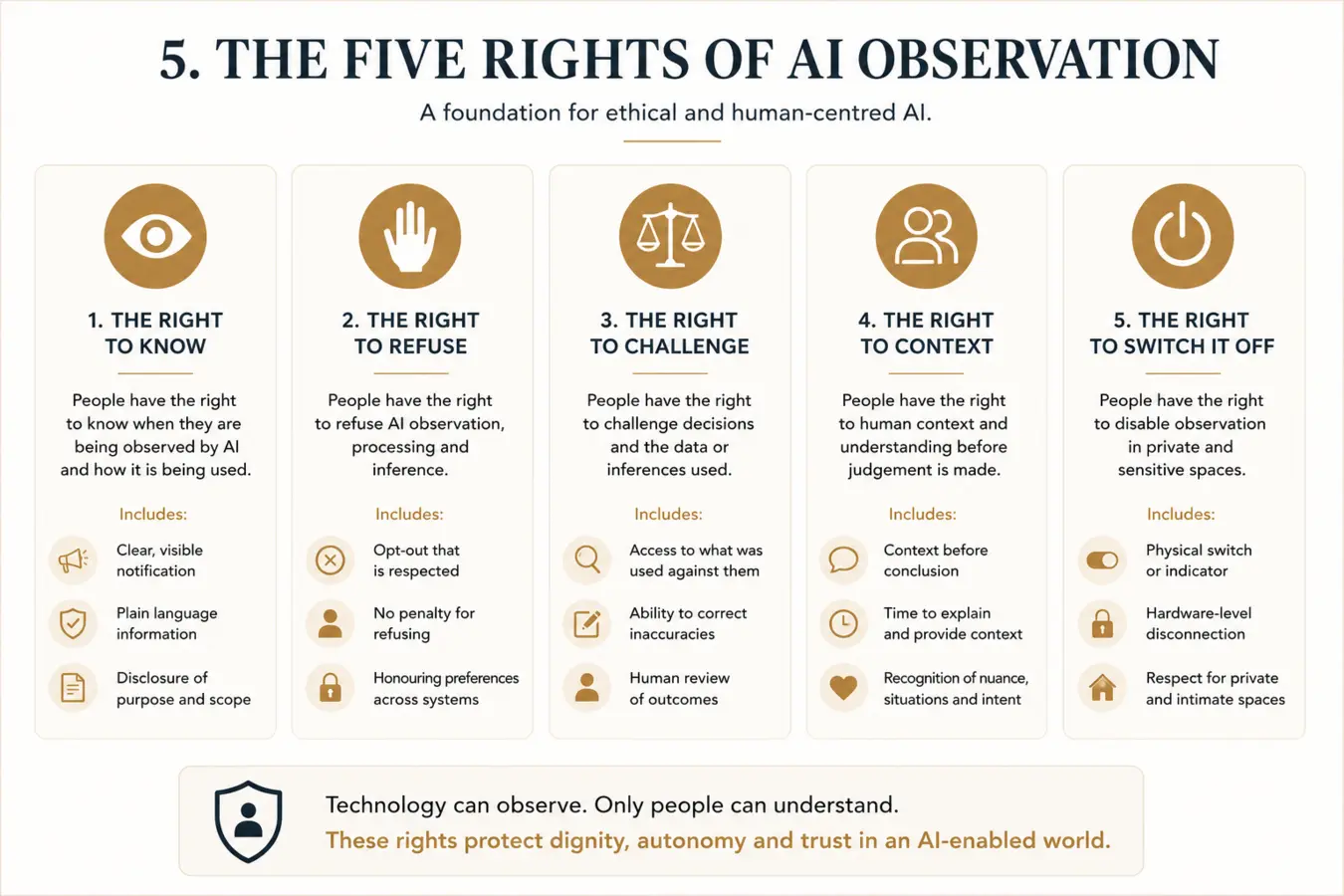
A person must be able to switch the system off.
AI may flag, but a human must judge.
Organisations must prove their conclusions.
People must be able to challenge the record.
Private and intimate spaces must remain protected.
And observation must never automatically create ownership.
The first AI debate was whether we should use it.
The next will be whether other people should be allowed to use it on us.