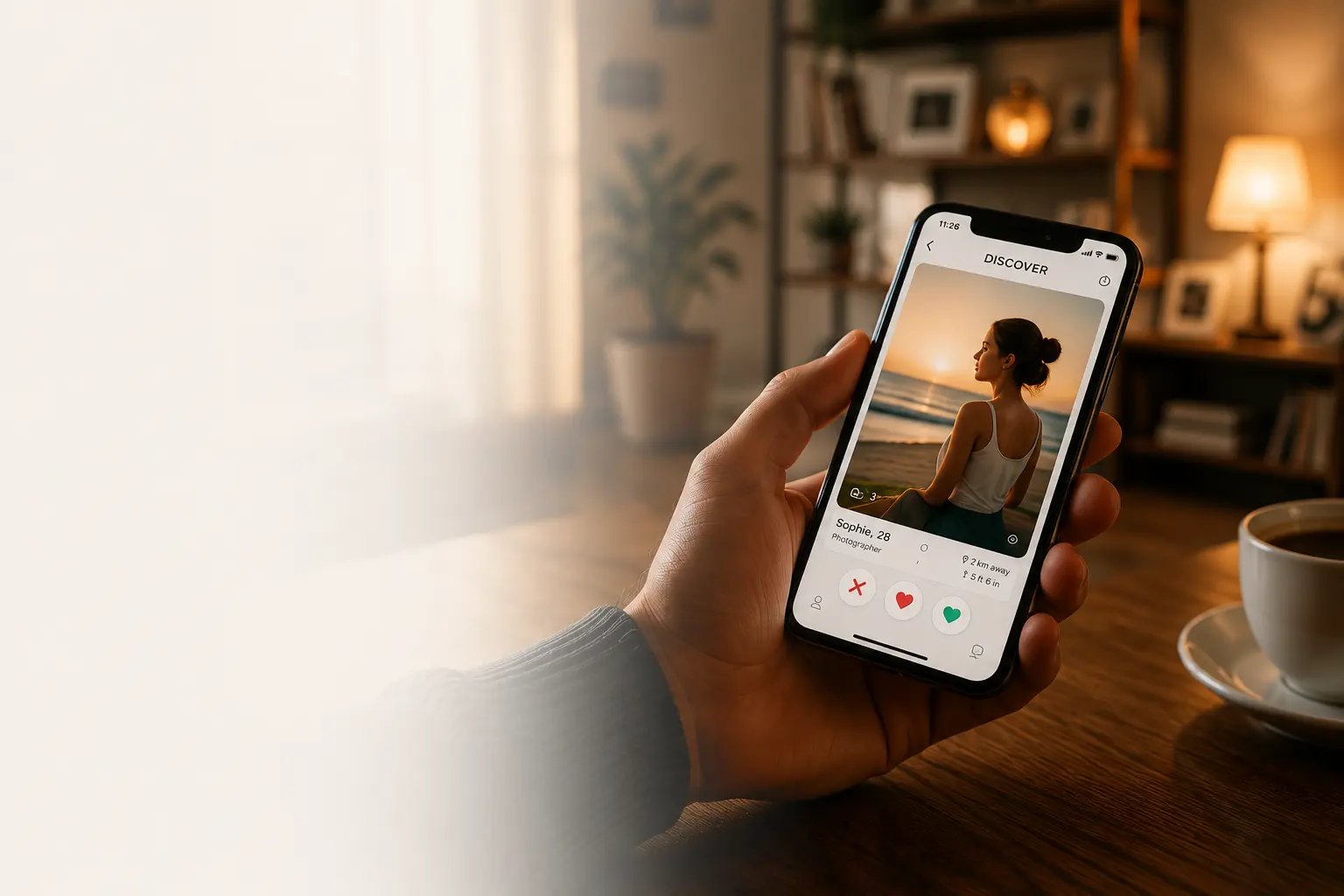
Dating apps have given people more choice than any generation before us, but more choice does not necessarily make finding love easier. I have been married for 25 years, so I should probably begin with an admission.
I have never used a dating app.
That means there will inevitably be parts of modern dating that I do not fully understand. But it also means I remember clearly what came before them.
Back then, if you wanted to meet someone, you generally had to go somewhere. A pub. A club. Work. A party. Church. A holiday. Or perhaps a friend introduced you to someone they thought you might like.
Meeting people required intentional interaction.
You had to leave the house, make an effort, notice someone, find a reason to speak to them and risk rejection. Then came the extended effort of trying to be liked—or trying to look cool, I guess.
The number of people you could realistically meet was constrained by geography, money, energy and opportunity. That rule applied to almost everyone.
Different places also created different kinds of opportunities. Pubs and clubs were good places to meet random people. Holidays were famous for romances. Work could create deeper relationships—or affairs. Churches and communities often introduced people looking for something more permanent.
None of this was perfect.
People still lied. People cheated. People judged each other on appearance. Men wanted the Baywatch babe and women wanted the six-foot Greek god.
But most of us understood the difference between the fantasy and the people who actually existed around us.
Our expectations were largely shaped by the people we could realistically meet.
The People Around Us
We also tended to meet people from roughly the same social world.
That may sound uncomfortable now, but geography, schools, workplaces, friends, families and communities naturally filtered the people around us.
It did not necessarily mean the same wealth or social class. It simply meant there was often some shared context.
And people arrived with reputations.
Friends could warn you about the bad ones. Someone at work knew what a person was really like. Families knew families.
The good guy with the slightly big nose had a chance because someone might say:
“I know him. He’s a good bloke. He has a great job and comes from a lovely family.”
His whole value as a human being did not need to fit inside a photograph.
The sofa-surfing disaster who had been divorced twice could still play the game, of course. But there was a greater chance that somebody knew him, knew the history and might quietly suggest that you stay well away.
The old dating world filtered people through communities.
The digital world increasingly asks individuals to filter strangers for themselves.
Then the World Opened
Dating apps solved a genuine problem.
The old system worked reasonably well if you were young, socially confident, went out regularly, had a decent group of friends and lived somewhere with enough people.
But what if you were 48 and divorced? Widowed at 60? Gay in a small town? Extremely shy? Disabled or housebound? A single parent who rarely went out? Someone working antisocial hours? Or simply looking for a person who shared a particular religion, culture or way of life?
The old system could be brutal because your dating pool was whoever life happened to put in front of you.
Digital dating broke that constraint.
Suddenly, geography mattered less. You could meet people you would never otherwise have crossed paths with.
There was also something useful about intent. In a bar, at work or through friends, you might not know whether someone was single, interested or looking for a relationship.
On a dating app, at least everyone has entered the room for broadly the same reason.
The old world was better at giving people context.
The digital world is far better at giving people access.
And then, perhaps, access became the problem.
The Top Shelf
My basic understanding of modern dating is simple.
You open the app. You see what is available. Swipe one way for yes and the other for no. Do it enough times and perhaps you get a match.
But when thousands of people are available, why consider the slightly shorter man or the slightly plumper woman?
The six-foot Greek god is right there.
So is the Baywatch babe.
One more swipe away.
The exact numbers vary between studies and platforms, but the pattern is remarkably consistent: dating-app attention is heavily concentrated towards a relatively small minority of profiles.
The familiar 80/20 rule may be too neat to treat as a universal fact, but it is a useful way to understand the shape of the problem.
A large study of online dating behaviour across four major US cities found a clear desirability hierarchy. Both men and women tended to pursue people around 25 per cent more desirable than themselves, while the chances of receiving a response fell as they reached further up that hierarchy.
Other dating-platform data has shown just how uneven attention can become. In one widely cited example, the most attractive male users received around eleven times more messages than the least attractive men.
The precise percentage is less important than the consequence.
When everyone can see the top shelf, many people begin competing for the same relatively small group of highly desirable profiles.
Those people gain enormous choice. Others receive very little attention at all.
And that changes behaviour on both sides.
The people with the most opportunities also get the most practice.
A man with multiple matches can refine his opening message with several women in a single afternoon. A woman with many options can become increasingly efficient at identifying which conversations are worth continuing.
The people who become best at attracting someone are not necessarily the people who are best at building a relationship.
They may simply be the people who have had the most practice at playing the game.
We Inspect the Specification Before Meeting the Person
The old encounter was messy and unrehearsed.
One group of friends met another. People talked, laughed, watched how each other behaved and spent an evening together. Attraction had time to grow.
Modern dating can reverse that process.
Before meeting the person, we inspect the specification.
Height. Age. Weight. Job. Education. Politics. Children. Interests. Photographs.
This is useful. There is no point wasting time with someone who wants a completely different life.
But the system naturally prioritises the qualities that are easiest to measure.
Height can be measured. Age can be measured. Distance can be measured. Appearance can be photographed.
But what about patience? Loyalty? Humour? Kindness? Teamwork?
How someone behaves when you are ill? Whether they make you laugh after a terrible day? How they handle money, boredom, family, stress or disagreement?
Most people probably do not really know what they need from a partner.
The six-foot hunk may look great on your arm, but most of a long relationship is not spent walking into parties.
It is quiet moments. Teamwork. Compromise. Ordinary evenings. Difficult weeks. Compatibility.
The things that matter most in a relationship may be the very things a dating app is least capable of measuring.
The Permanent Alternative
Then comes another problem.
The app does not just give people more choice. It makes the existence of alternatives permanently visible.
In the old world, choosing someone meant giving up alternatives you could only imagine. In the digital world, those alternatives can remain visible, searchable and occasionally willing to send you a message.
Perhaps that changes the psychology of commitment.
Choosing one person can begin to feel less like gaining a relationship and more like closing the door on thousands of possibilities.
The problem with apparently endless choice is that even a good choice can feel temporary when something better always appears to be one swipe away.
So what happens when someone from the highly desirable end of the dating pool eventually settles down?
How long does the honeymoon period last? What happens when familiarity arrives? What happens when the first serious disagreement begins?
In the old world, the alternative was uncertain.
Today, someone may know from experience that if they reopen the app, the attention, flirting and excitement can begin again.
Perhaps that does not matter. Perhaps the relationship is strong.
But then the 10/10 you swiped right on three weeks ago suddenly sends you a message.
A few cheeky replies.
A quick coffee.
Nothing serious.
And bang.
You are back in the game.
Temptation existed long before smartphones. Dating apps did not invent infidelity, casual sex or people who like to play the field.
But they can magnify the opportunity.
The old world had temptation.
The digital world can keep previous and potential temptations permanently within reach.
The question is not whether dating apps make people leave relationships.
It is whether the permanent visibility of alternatives makes staying and repairing one feel less necessary.
When People Become Content
This may be where the problem becomes bigger than dating.
Look at how we increasingly consume the world. A short video has a few seconds to catch our attention. If it fails, we move on because another appears immediately.
On social media, the behaviour is simple:
Look. Judge. React. Move on. Next.
On a dating app, the behaviour can look remarkably similar:
Look. Judge. Swipe. Move on. Next.
One system is sorting content.
The other is sorting human beings.
Perhaps our brains do not completely distinguish between the two.
We are increasingly trained to expect stimulation quickly, repeatedly and with very little effort.
Not interesting enough? Next.
Not attractive enough? Next.
Conversation slightly dull? Next.
First date imperfect? Next.
Relationship becomes difficult?
Maybe next.
Have we accidentally taught ourselves to consume potential partners in the same way we consume content?
If so, the people and relationships that take time to become valuable are placed at a disadvantage by systems built around immediate judgement.
The People Nobody Chooses
There is another side to this.
What happens to the people who repeatedly get no matches, no replies and no chance to be known?
In the old world, rejection usually happened one person at a time. You asked someone out. They said no. It hurt, but it was one person.
A dating app can create something that feels more like silent mass rejection.
Hundreds of swipes.
Nothing.
The danger is that someone stops thinking:
“That person wasn’t interested in me.”
And starts thinking:
“Nobody is interested in me.”
A dating app does not just show you who wants you.
For many people, it repeatedly shows them who does not.
That can lead to frustration, lower self-worth, loneliness and withdrawal. For a minority, it may become anger.
And here we reach the elephant in the room.
Who Is Actually in the Room?
Many major dating platforms have substantially more men than women.
On Tinder, recent estimates suggest that around three-quarters of users are men.
That matters.
Before attractiveness, personality or algorithms even enter the equation, a marketplace containing roughly three men for every woman is already going to produce unequal outcomes.
If men also tend to swipe more broadly while women become more selective because they receive more attention, the imbalance can compound.
A man receiving almost no matches may conclude:
Women do not want me.
But part of the reality may be that he is competing inside a marketplace where the numbers were heavily against him before he even created his profile.
And this is where the business model becomes interesting.
Because I have seen something similar before.
The Digital Nightclub
Back when I was dating, groups of men were frequently refused entry to clubs. Sometimes even groups of two or three men would be turned away.
At the same time, women might be offered free entry or a free first drink.
Why?
The nightclub understood a basic marketplace dynamic.
A venue full of men was not attractive. Bring women into the room and men would follow.
The women helped make the venue desirable.
The men often became the larger spending opportunity.
Discourage excess men. Incentivise women. Create the desirable environment. Monetise the men who follow.
Now consider the dating app.
If women are scarce enough to make the marketplace desirable, while large numbers of men are competing for limited attention, frustration itself can become commercially valuable.
No matches?
Pay to see who liked you.
Pay for more visibility.
Pay to boost your profile.
Pay for premium placement.
Pay for better odds.
This is not merely theoretical. Dating companies increasingly sell visibility itself: boosts, priority likes, premium placement and tools that promise better odds of being seen. At the same time, the industry openly recognises that attracting and retaining women is essential to keeping the marketplace healthy.
That does not prove that dating apps deliberately keep people single.
A successful relationship is excellent advertising for a dating company.
But it does expose the structural tension.
The customer wants to stop dating.
The dating company needs people to keep dating.
And perhaps the most frustrated users are also among the most monetisable.
The nightclub needed women in the room and men at the bar.
The dating app may need women on the platform and frustrated men reaching for their wallets.
That does not make the technology evil.
But it does make the incentives worth examining.
The Pandora’s Box
Dating apps are extraordinary connectors of people.
They have helped people find love who might never otherwise have met. They have opened doors for the shy, the lonely, the older, the divorced, the widowed and anyone whose life does not naturally place enough potential partners in front of them.
We should not pretend everything was rainbows and unicorns before they arrived.
It wasn’t.
The old world was unfair. People lied. People cheated. Beautiful people had more opportunities. Some people were lonely. Some never found anyone.
But its limitations were largely human limitations.
Geography. Confidence. Reputation. Money. Energy. Opportunity.
The modern system adds something else.
Commercial architecture.
It expands the dating pool while encouraging rapid visual judgement. It removes social context. It concentrates attention. It makes alternatives permanently visible. It rewards the people who become best at playing the game. It repeatedly exposes others to silent rejection.
And then, in some cases, it sells those frustrated users better visibility inside the same system.
On the surface, dating apps are extraordinary connectors of people.
Beneath that surface sits a Pandora’s box of competing incentives.
The app wants engagement.
The business wants revenue.
The user wants attention.
The most desirable profiles have an abundance of choice.
The least visible want a chance to be seen.
And somewhere inside all of that, two people are simply trying to find someone they can build a life with.
Perhaps that is the real dating app problem.
We created a system that is extraordinarily good at helping people find more people.
We are still working out whether that makes it any easier to find one.