ATTENTION
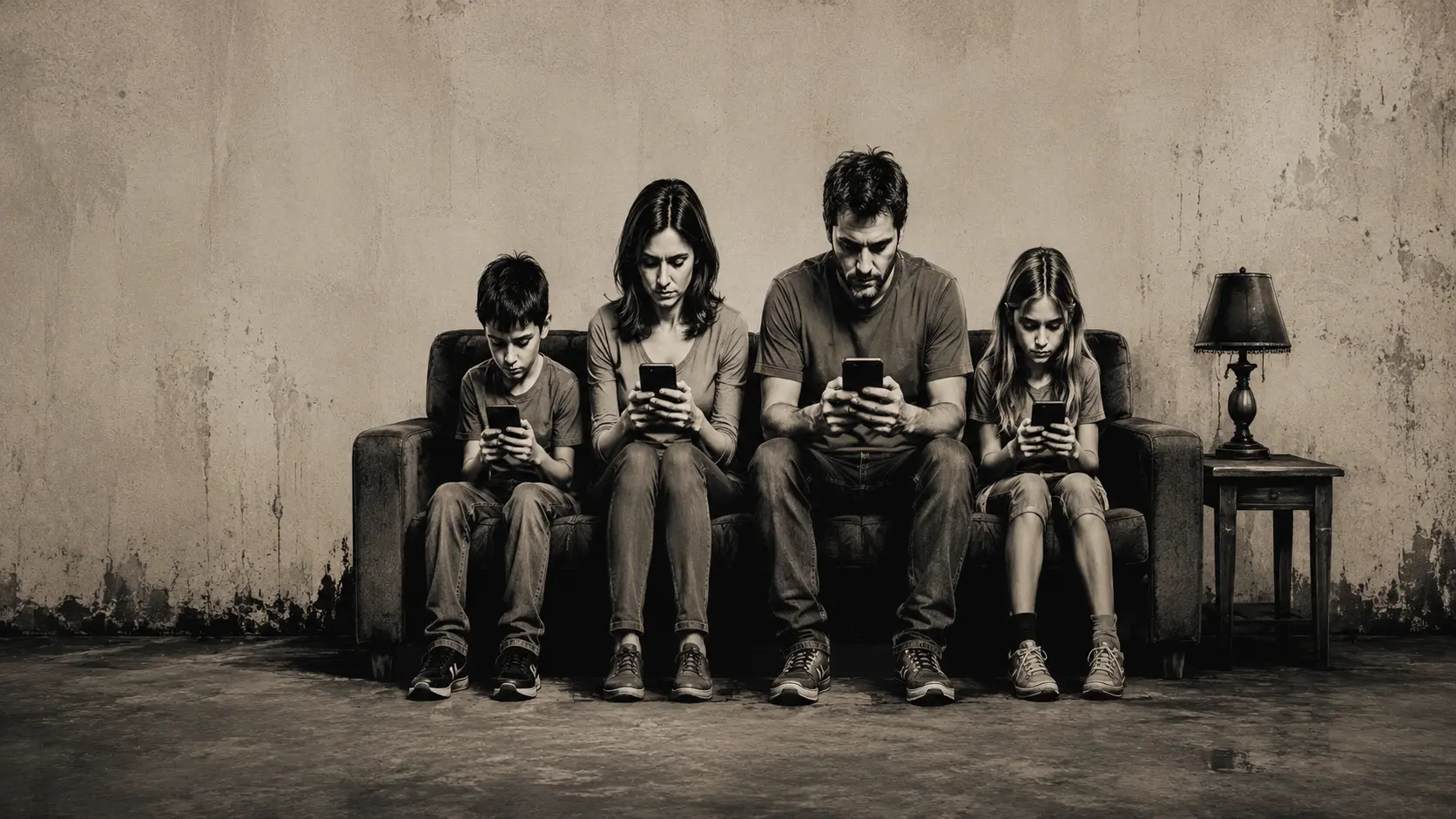
Nobody in this picture is alone. Yet nobody is truly together.
Four people sit on the same sofa. They share the same room, the same evening and, presumably, the same life. A generation ago, the image would have looked strange. Today, it barely attracts attention at all.
That may be the most revealing thing about it.
The habits that shape a society rarely arrive with fanfare. They arrive quietly. They settle in around the edges of everyday life until eventually they become invisible.
One day, somebody checks a message during dinner. A few years later, everybody does.
One day, families gather around a screen together. A few years later, families gather around separate screens apart.
Nobody sat down and decided that family life should become more fragmented. Yet here we are. Connected to everything. Available to everyone. And often distracted from the people sitting closest to us.
But perhaps there is a deeper question hiding beneath the obvious one.
Do we actually want to be together? Or do we simply like the idea of togetherness?
It is easy to blame technology for pulling us apart. It is harder to admit that genuine connection has always required effort.
Conversation requires patience. Relationships require compromise. Family life requires tolerance. Love requires attention.
A screen offers something different: a quick reward, a burst of novelty, a perfectly tailored experience. No disagreement. No awkward silence. No emotional labour. Just stimulation on demand.
Perhaps what we are witnessing is not simply distraction. Perhaps it is substitution.
The replacement of meaningful connection with the feeling of connection.
The replacement of experience with the appearance of experience.
The replacement of life with a simulation of life.
The modern world has achieved something remarkable. It has made boredom optional.
Yet many of the most meaningful parts of life happen in precisely those unstructured moments. Conversations rarely begin with intention. Stories emerge unexpectedly. Children ask questions without warning.
Memories are often created in the gaps rather than the plans.
We increasingly consume representations of life instead of life itself. We watch travel videos instead of travelling. We watch people fall in love instead of risking our own hearts. We watch families, friendships and adventures unfold through a screen while remaining safely detached from the uncertainty of reality.
For a moment, consumption feels like experience. For a moment, watching feels like living. But only for a moment.
Researchers often describe attention as a finite resource. Time passes regardless. Attention is a choice.
Where we place it ultimately determines how we experience our lives.
We do not remember everything that happens to us. We remember what we notice.
The moments that stay with us are often the moments to which we gave our full attention.
Yet modern culture increasingly encourages us to fall in love with ideas rather than realities: the idea of friendship, the idea of romance, the idea of adventure, the idea of family.
We become attached to what life looks like rather than what life feels like.
Reality contains boredom. Reality contains conflict. Reality contains disappointment. Reality contains effort.
The very things edited out of the images we admire.
Many years from now, few people will remember a random evening spent scrolling through content. They will remember the people, the conversations, the stories, the feeling of being together — if they were truly present for them.
Technology is not the villain in this story. The issue is not the existence of technology. It is the absence of boundaries.
What deserves our attention? What deserves our presence? What deserves to be remembered?
And perhaps an even more uncomfortable question.
Do we want the reality? Or do we merely want the feeling associated with the reality?
One requires participation. The other requires consumption.
One creates memories. The other creates stimulation.
What we pay attention to becomes our experience. What we ignore slowly fades away.
Which brings us back to the image.
Four people. One sofa. One home.
Nobody alone. Nobody together.
Each person connected to a world of endless possibilities. Each person disconnected from the reality directly in front of them.
Not because they chose isolation. But because isolation increasingly arrives disguised as entertainment. Disguised as connection. Disguised as experience. Disguised as life itself.
And a simple instruction hidden in plain sight.
Don’t look up.
Or perhaps, for the sake of everything that matters, do.