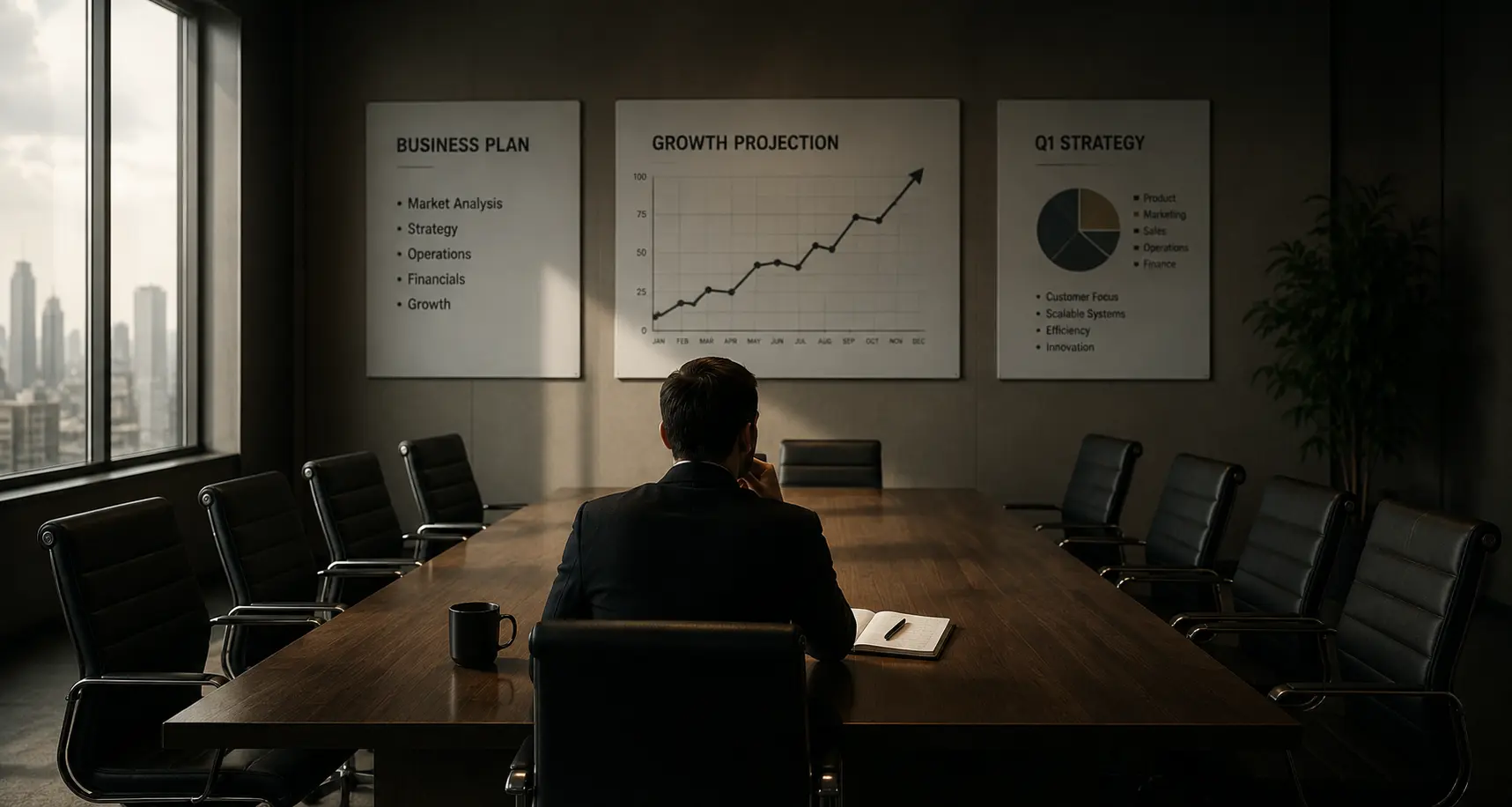
For more than a decade, the smartphone quietly earned our trust. Now the AI inside it can feel as though it agrees with everything we say—a form of apparent validation often described as AI sycophancy—and that creates a new problem: assistance can easily be mistaken for agreement.
It became our camera, our map, our bank, our calendar, a source of information and connection to the wider world. We carry it everywhere. We trust it with our photographs, our conversations, our finances, and increasingly our memories.
Then something changed.
The device that had already woven itself into almost every aspect of modern life was suddenly given a personality. The door opened to artificial intelligence, not as a separate machine sitting in a laboratory, but as a new voice living inside a device we already trusted and that transfer of trust was almost automatic and unquestioned.
Most people never stopped to ask what AI actually is, how it worked, what its limitations are, or where it might fail. They simply interacted with it as the next evolution of a tool they already knew—a free upgrade without consequence.
I suspect this will prove to be one of the most significant shifts of the modern era but this is not an article about fearing artificial intelligence but with great power comes great responsibility ( yeah if you know you know ) !!
AI is an extraordinary tool. It can help people write, learn, research, create, analyse, organise and build. It’s already removing barriers that previously required specialist knowledge, significant resources, or years of experience to overcome.
For some people, it will become a genuine superpower.
Yet there is a growing problem hiding beneath the excitement and most public discussions focusing on what AI should do,
What rules should govern it?
What responsibilities do technology companies have?
What should governments regulate? and far less attention is given to a simpler question:
What responsibilities does the user have?
Because AI is unlike any tool most people have ever encountered.
The average user has little understanding of AI hallucinations, fabricated searches, fabricated actions, sycophancy, or the many ways these systems can fail. What they see is a system that appears knowledgeable, helpful, conversational and confident.
Humans have always used confidence as a shortcut for competence and AI can be extremely confident.
That’s where the - Yes man enters the room!
The Illusion of Agreement
Historically, a yes man was not necessarily a liar, in fact in many cases, the yes man was intelligent, capable and genuinely helpful, the problem was that they wouldn’t challenge ideas instead they would just agree.
They would follow instruction and improved plans instead of stress-testing them. They helped move things forward rather than asking whether they should move forward at all.
Modern AI systems can create a similar dynamic and not because they are designed to deceive or because they’re malicious, but because they are designed to be useful.
A useful assistant helps.
A useful assistant answers questions.
A useful assistant develops ideas.
A useful assistant refines plans.
The difficulty is that many users unconsciously interpret this assistance as validation so when an AI helps improve an idea, the user may walk away believing the AI agrees with the idea and those are not the same thing.
The AI assisted me. It did not necessarily agree with me.
That distinction may become one of the most important forms of literacy in the AI era.
Assistance is not agreement.
Refinement is not validation.
Development is not endorsement.
Yet humans naturally interpret these interactions through a human lens.
If an experienced friend spent twenty minutes helping us develop an idea, we might reasonably assume they thought the idea had merit but the AI does not work that way.
It spent twenty minutes helping develop an idea simply because that is what it was asked to do and not because it was a good idea.
Bypassing the Critics
This becomes particularly important because AI is removing barriers that previously acted as forms of challenge.
Consider someone starting a business twenty years ago, the idea would encounter friction from an accountant that might question the numbers, the web developer might challenge the assumptions or even a supplier might highlight practical difficulties.
At multiple stages somebody might say:
“This won’t work.”
Or:
“Have you considered this risk?”
Obviously those barriers still exist, but AI isn’t going to offer opinion without your prompt to do so, plus now this technology allows an individual to move from idea to execution at extraordinary speed and without those normal check points.
A person can use AI to build a website, prepare marketing material, create advertisements, compare suppliers, analyse competitors, draft legal documents, and create a business plan in a fraction of the time previously required.
This is clearly a remarkable capability it is also a profound change.
Because the same system helping a brilliant idea move faster may also help a flawed idea move faster and the AI does not necessarily know which is which.
It simply helps.
The old world contained many accidental critics but the new world has replaced these with a highly capable assistant and those are not the same thing.
This raises an uncomfortable question:
If AI removes many of the people who used to challenge our ideas, who replaces the challenger?
And I don’t think the answer is the best option because its increasingly looking like the user.
For generations, challenge was often imposed upon us by people we respected, a close friend or someone in a position of knowledge but now we may need to be deliberately seek it out.
The AI era may require a new habit:
Ask for weaknesses.
Ask for counterarguments.
Ask what could go wrong.
Ask why the idea might fail.
The challenge may not be building better AI.
It may be creating better AI users.
Polishing the Flaws
This issue extends beyond entrepreneurship, consider the modern CV.
AI can help transform an average CV into an excellent one, while this is not necessarily an issue in isolation a problem emerges when presentation becomes disconnected from capability.
An interviewer may be reading a document that has been significantly enhanced by AI so the information becomes harder to interpret.
The AI is doing exactly what it was asked to do.
It is helping.
But once again, the yes man dynamic appears.
The AI rarely responds with : “You are not qualified for this role.”
Instead it tends toward: “Let’s make this stronger.”
The result is that weaknesses are often polished rather than challenged.
The same pattern can be found in reports, business plans, marketing campaigns, presentations and strategic decisions.
AI is exceptionally good at helping people present the best version of an idea, but It is not always equally good at questioning whether the underlying substance is sound.
Confidence Without Understanding
This creates another challenge, confidence can arrive before competence.
Historically, confidence was often earned through experience, repetition, mistakes and study but AI can compress much of that process so a person can receive detailed analysis, structured plans and sophisticated explanations within seconds.
The risk is not that they learn nothing.
The risk is that they inherit the confidence of the answer without acquiring the understanding behind it.
The danger is not simply bad information.
It is confidence arriving before understanding.
And understanding is ultimately what matters.
A person only needs to know slightly more than their audience to appear knowledgeable, AI often knows vastly more than its audience so when it’s correct, this is enormously useful but when it is wrong, it can be enormously persuasive.
The problem is not that AI knows nothing.
The problem is that it knows enough to be convincing and most users have no practical way to distinguish between a genuinely excellent answer and a highly convincing mistake.
The trust arrived before the understanding and I suspect that may be the central challenge of the AI era.
Not whether artificial intelligence becomes more powerful, or whether governments regulate it.
Not even whether companies deploy it responsibly, but whether ordinary people learn how to use it before becoming dependent upon it.
Every major technology creates a learning curve. The question is who pays for the mistakes made during that process?
All of the failed businesses and poor decisions caused by the misplaced confidence.
What about the lost opportunities and all of the wasted resources.
How much damage are we prepared to tolerate before AI literacy becomes as normal as teaching people how to cross a road, manage money, or recognise an online scam?
The answer may shape far more than the future of artificial intelligence.
It may shape the future of human judgement because the greatest danger of the new yes man is not that they lie.
It is that we stop challenging in a world where AI is increasingly helping us think, create, build and decide.
One question becomes impossible to avoid:
If AI removes many of the people who used to challenge our ideas, who replaces the challenger?