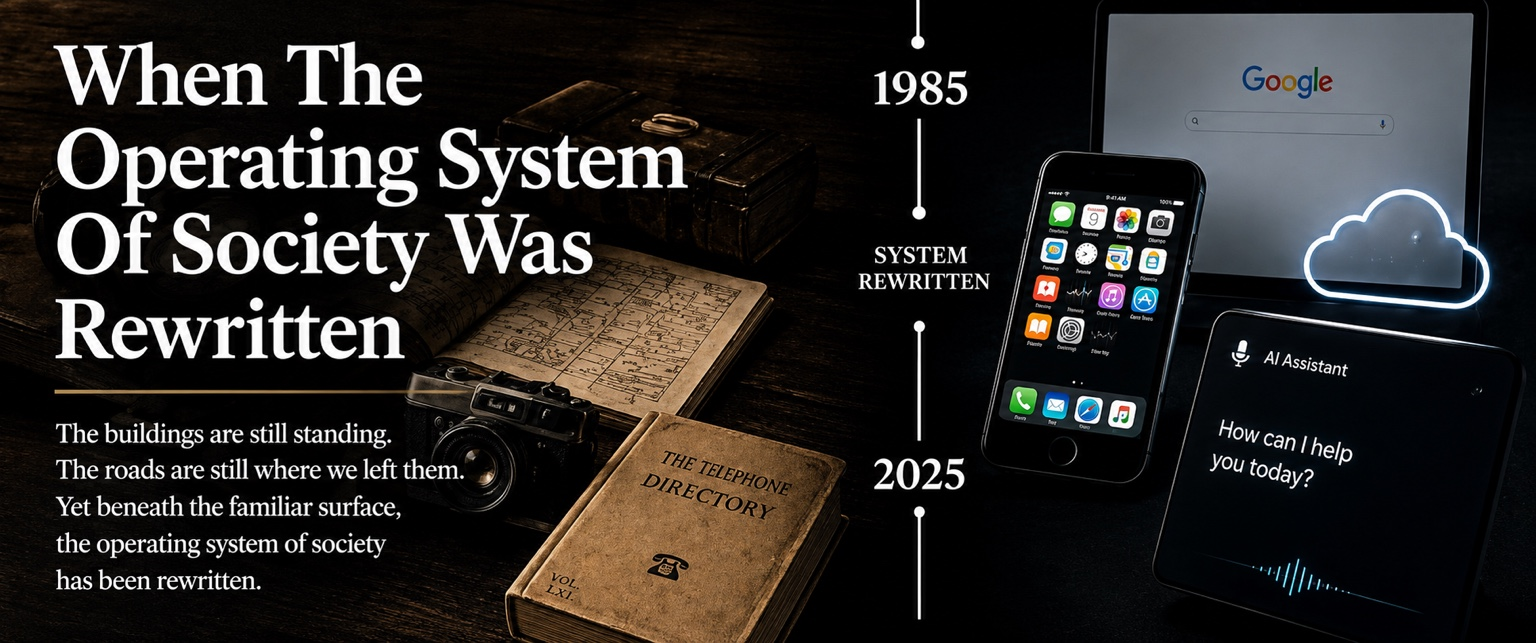
The Familiar World
Between 1985 and 2025, technology changed everyday life so extensively that many of the skills, systems and expectations needed to function in society were quietly rewritten. If someone from 1945 stepped out of a time machine into 1985, they would instantly recognise the world.
But if someone from 1985 stepped into 2025, would they?
At first glance, the answer seems like an obvious yes.
The physical landscape hasn’t vanished. The buildings are still standing. The roads are right where we left them. People still head into work, raise their families, pick up groceries, flip on the TV, head out on holiday, and complain about the rain.
Yet beneath that familiar surface, a quiet tectonic shift has occurred.
The operating system of society has been rewritten.
This didn’t happen because of a single breakthrough invention.
It wasn’t spearheaded by one massive tech company.
It wasn’t even the work of a single generation.
It was the compounding, overwhelming weight of dozens of technological shifts crashing into our lives within a single human lifespan.
For the vast majority of modern history, human society evolved at a manageable pace. New inventions popped up, sure, but the baseline skills you needed to simply exist and function remained remarkably steady.
That is why a person living in 1945 would find life in 1985 entirely familiar.
The television set had gained a splash of colour and a remote control.
The cars were a bit sleeker and faster.
Commercial flight had turned from a luxury into a standard way to travel.
Yet the core mechanics of getting through the day hadn’t changed.
People still navigated their road trips using paper maps.
They still sat down to write letters by hand.
They still pulled physical cash out of their wallets to pay for things.
They still tracked down information using books, newspapers, and local experts—remember libraries?
And they still anchored their social lives deeply within physical, geographic communities.
The tools got a little better, but human behaviour stayed entirely recognisable.
Then, something snapped.
Right around 1985, society entered a hyper-acceleration loop unlike anything humanity had ever experienced.
It was driven by two distinct forces hitting us at the exact same time: Skill Demand and Systemic Impact.
Skill Demand measured the actual mental friction required to learn a completely new tool.
Systemic Impact measured how deeply that tool went on to shatter the infrastructure of everyday life.
We didn’t just upgrade our gadgets. We were forced to climb a steep ladder of escalating cognitive demand.
Radio and television required zero effort; we adopted them passively.
Calculators and video recorders forced us to learn simple, predictable tools.
Then GPS and online shopping arrived, shifting our daily behaviours.
Suddenly, the internet, email, and search engines landed, demanding that we understand entirely new information systems and digital logic.
Before we could even catch our breath, social media and smartphones showed up to rewrite our entire social operating system.
The Rewrite Timeline
Look at the sheer speed of the roll-call:
- The home computer arrived.
- Then the internet.
- Then email.
- Then search engines.
- Then mobile phones.
- Then digital photography.
- Then GPS.
- Then online shopping.
- Then social media.
- Then smartphones.
- Then cloud services.
- Then digital payments.
- And now, artificial intelligence.
Taken one by one, each new innovation felt like a manageable milestone.
But when you take a step back and look at them together, they represent a total, systemic overhaul of human existence.
The way we talk to one another changed.
The way we find our way across a city changed.
The way we absorb information changed.
The way we store memories changed.
The way we shop, work, date, and entertain ourselves changed.
The operating system itself changed.
What makes this chapter of history so fascinating is that different generations experienced this rewrite through entirely different lenses.
A person born in 1945 lived through an era of immense technological change, but the core foundations of their career, habits, and lifestyle were already deeply hardcoded before the digital wave hit. They learned to interact with the new world as visitors.
On the other side of the spectrum, a child born in 2000 inherited this entire digital infrastructure as the default baseline. To them, smartphones, search engines, and algorithmically driven feeds aren’t innovations—they are the ambient environment. They never had to consciously migrate from one operating system to another because the new one was already running when they arrived.
The Bridge Generation
3 The Bridge Generation
Born roughly between 1970 and 1985, this is the only generation that fully learned the old operating system before being asked to master the new one.
| Before | After |
|---|---|
| Paper Maps | GPS |
| Telephone Directory | Search Engine |
| Film Camera | Smartphone |
| Letters | Instant Messaging |
| Cash | Digital Wallet |
| The Quiet of a Library | The Firehose of Search |
But those born roughly between 1970 and 1985 find themselves in a truly unique position.
They are the Bridge Generation.
They are the only people alive who fully learned the old operating system before being asked to master the new one.
They have actual, lived muscle memory of using paper maps before GPS existed.
They remember using massive paper telephone directories before search engines.
They remember the careful curation of a film camera before the endless scrolling of a smartphone.
Letters before instant messaging.
Cash before digital wallets.
The quiet of a library before the firehose of unlimited search.
This isn’t a badge of honour or a claim of generational superiority.
It is a statement of perspective.
Unlike the generations that came before or after them, they lived inside the transition itself.
Not as passive observers or historians, and not as young children.
They were active participants.
They were trying to build careers, navigate relationships, raise families, and forge identities at the exact moment the floor beneath society was being pulled up and replaced in real time.
Because the real story here isn’t the technology at all.
It’s the human toll of adaptation.
Human beings are remarkably resilient, and we have always adapted to change.
But rarely in human history has a single group of people been asked to adapt to so much structural change, so blindingly fast, during the most critical decades of their adult lives.
The Adaptation Burden
4 Adaptation Burden Curve
Individuals born around 1975 appear near the centre of the adaptation curve because they encountered the largest concentration of high-impact technological shifts during influential years of career, family and identity formation.
When we map out these major technological shifts, a very clear mathematical pattern emerges.
The sheer cognitive burden of this era didn’t hit everyone equally.
Those born before 1970 felt the ripples, but the most disruptive changes arrived safely after their foundational life patterns were already set in stone. Those born after 1990 didn’t have to migrate at all; they were digital natives.
But if you look at someone born around 1975, they sit dead centre in the impact zone.
They stepped into adulthood precisely when the internet went mainstream.
They built their first resumes just as email was rendering physical mail obsolete.
They learned to navigate the workforce while search engines replaced libraries.
They watched their simple mobile phones transform into all-consuming smartphones.
And they had to navigate the rise of social media, cloud computing, and digital commerce during the very years they were making their most important life decisions.
They didn’t just watch the rewrite happen.
They carried the weight of it.
They are the only generation to deeply understand both physical scarcity and digital abundance within a single lifetime. They mastered one way of living, only to spend the next thirty years migrating to another.
Which brings us to the uncomfortable question we all try to avoid:
Has this massive rewrite actually made life better?
The initial, superficial answer seems obvious. Just look around us. Modern life is completely overflowing with raw capability.
Capability vs Utility
5 Capability vs Utility
Capability and utility are not the same thing.
01
Capability
The Ferrari represents raw capability: incredible potential and extraordinary engineering, built for the track.
02
Utility
The Mini represents real-world utility: simple, reliable and accessible, built for everyday life.
But capability and utility are not the same thing.
We love to measure human progress through capability.
A single smartphone now packs more raw computing power than entire global organisations possessed a generation ago. We have immediate access to the sum of human knowledge, instant global communication, unlimited streaming entertainment, frictionless marketplaces, and satellite navigation systems that can guide us to any pinpoint on the planet.
On paper, 2025 wins by a landslide.
But capability and utility are a dangerous paradox.
Think about the difference between a Ferrari and a classic Mini.
The Ferrari can scream down a track at 200 miles per hour. The Mini tops out at 70.
But if the speed limit on the road you are driving is strictly 70 miles per hour, how much actual, real-world utility does that Ferrari give the average driver?
We have to ask the same thing about the frantic pace of modern life: what is the speed limit of the human capacity to actually process and appreciate these upgrades?
We have more raw information at our fingertips than any civilization in history. But has genuine human understanding increased at that same scale?
We have more communication tools than ever before. But are we actually communicating with each other more effectively?
We have access to more entertainment than our ancestors could have dreamed of. But are we genuinely enjoying ourselves more?
We have thousands of ways to connect instantly. Do we actually feel more connected?
These questions are deeply uncomfortable because they refuse to yield clean, comforting answers.
The modern world has undeniably delivered miraculous, life-saving gains. People are living longer lives. Medical care is lightyears ahead of where it was. Global knowledge is open to anyone with a connection. Travel is accessible, opportunities are vastly broader, and many of the brutal physical hardships that defined previous generations have been entirely erased.
Yet in solving those old problems, we managed to create an entirely new species of crisis.
Scarcity to Abundance
6 Scarcity → Abundance
Scarcity Era
Old Operating System- Limited film
- Letters that took days
- Libraries with finite shelves
- Shared cultural moments
- Trusted, editorial sources
- Scarcity of information
- Scarcity of communication
- Scarcity of choice
- Scarcity of noise
Abundance Era
New Operating System- Infinite content
- Infinite information
- Infinite communication
- Infinite choice
- Infinite connection
- Abundance of information
- Abundance of communication
- Abundance of choice
- Abundance of noise
The physical constraints that used to anchor and shape our daily lives have vanished.
When you only had twenty-four shots on a roll of film, you were forced to practice curation.
When long-distance communication was expensive and slow, it required deep intention.
When entertainment options were limited, it created massive, shared cultural experiences that unified us.
When information was hard to find, we relied on deeply trusted, vetted sources.
When choice was limited, decision-making was simple.
Abundance solved our primitive problems of scarcity.
But abundance brought its own heavy cost:
- Information abundance.
- Choice abundance.
- Content abundance.
- Communication abundance.
- Connection abundance.
The greatest threat facing modern society isn’t starvation or scarcity anymore. It is informational obesity.
We are trying to survive in a world where our technological capability is expanding exponentially faster than our biological ability to meaningfully process it.
This is precisely why our cultural conversations have become so bitter and deeply polarized.
One side looks out at the world and sees the spectacular, near-magical capabilities available to the average citizen.
The other side looks out and sees a devastating rise in loneliness, ambient anxiety, chronic distraction, and fractured communities.
The truth is, both sides are looking at something entirely real. They are just observing different components of the exact same system.
The Question
Perhaps the real question we should be asking isn’t whether life was better or worse back in 1985.
Perhaps the question is whether our technological capability has outpaced our psychological wellbeing.
And maybe that question feels impossible to answer right now because we are still trapped in the middle of the transition phase.
History is always a lot cleaner when you read about it in retrospect.
The people who lived through the brutal disruptions of the early Industrial Revolution didn’t walk around consciously knowing they were reshaping human history. The people living through the dawn of the internet didn’t have a manual telling them they were experiencing a total rewrite of society’s operating system.
They were all just waking up every day and adapting to the next thing.
And the next thing.
And the next thing after that.
Which leaves us with one final, haunting possibility.
Perhaps the world we are living in right now isn’t the final destination at all.
Perhaps this era is just another messy, volatile transition point—a strange, uncomfortable historical moment suspended precariously between physical scarcity and digital abundance. A brief period where humanity has unlocked god-like capabilities, but is still clumsily learning how to use them with an ounce of wisdom.
If that turns out to be true, then future generations won’t look back on our era as a golden age of digital prosperity. They will look back on us with pity, viewing this time as the agonizing growing pains of a society trying to figure out how to live with its own creations.
And perhaps the people who feel the most deeply conflicted about the frantic pace of modern life aren’t backward-looking luddites resisting progress at all.
Perhaps they are simply the last remaining people on Earth who still remember what the old operating system felt like.
Supporting Chart: Adaptation Burden Curve
First-pass model based on the working framework developed in discussion: relative exposure to major adaptation waves across selected birth years.
Working Scoring Framework
| Parameter | Working scale |
|---|---|
| Impact score | 1 = Incremental; 2 = Significant; 3 = Operating System Rewrite |
| Skill demand | 1 = Passive consumption; 2 = Tool operation; 3 = Behavioural adaptation; 4 = Information systems; 5 = Social operating systems; 6 = Cognitive operating systems |
| Age relevance | 0-9 = 0; 10-14 = 1; 15-24 = 3; 25-39 = 2; 40-59 = 1; 60+ = 0.5 |
Birth-Year Model Summary
| Birth era | Technical status | Cognitive reality |
|---|---|---|
| Born 1945 | Visitors | Foundations were analog; digital tools are treated as optional layers. |
| Born 1975 | The Bridge | Learned physical curation; forced to execute systemic digital migration. |
| Born 2000 | Natives | Zero memory of structural scarcity; ambient adaptation only. |
Appendix: The Societal Migration Index Dataset
The Adaptation Burden Curve is plotted by calculating the total adaptation score for each birth year.
Formula: Burden = (Skill Demand × Systemic Impact) × Age Relevance Factor
| Item / Technology | Start Year | Skill Demand | Systemic Impact |
|---|---|---|---|
| Radio | 1945 | 1 | 2 |
| Telephone | 1945 | 2 | 2 |
| Letters | 1945 | 2 | 2 |
| Paper Maps | 1945 | 3 | 2 |
| Television | 1950 | 1 | 2 |
| Calculator | 1970 | 2 | 1 |
| Home Computer | 1980 | 4 | 3 |
| Internet | 1995 | 4 | 3 |
| 1995 | 4 | 3 | |
| Search Engines | 1998 | 4 | 4 |
| Mobile Phone | 1998 | 3 | 3 |
| Digital Photography | 2002 | 2 | 2 |
| GPS | 2005 | 3 | 2 |
| Online Shopping | 2005 | 3 | 3 |
| Social Media | 2005 | 5 | 4 |
| Smartphone | 2008 | 5 | 4 |
| Streaming | 2010 | 2 | 1 |
| Cloud Storage | 2012 | 3 | 3 |
| Digital Payments | 2012 | 3 | 3 |
| AI Prompting | 2023 | 5 | 4 |
Age Relevance Factor
| Age Range | Relevance Weight |
|---|---|
| 0–9 | 0 |
| 10–14 | 1 |
| 15–24 | 3 |
| 25–39 | 2 |
| 40–59 | 1 |
| 60+ | 0.5 |
Interpretation
The model suggests that the burden of technological migration was not evenly distributed. Individuals born around 1975 appear near the centre of the adaptation curve because they encountered the largest concentration of high-impact technological shifts during the most influential years of career formation, family formation and identity development. The result is an estimate of adaptation burden.