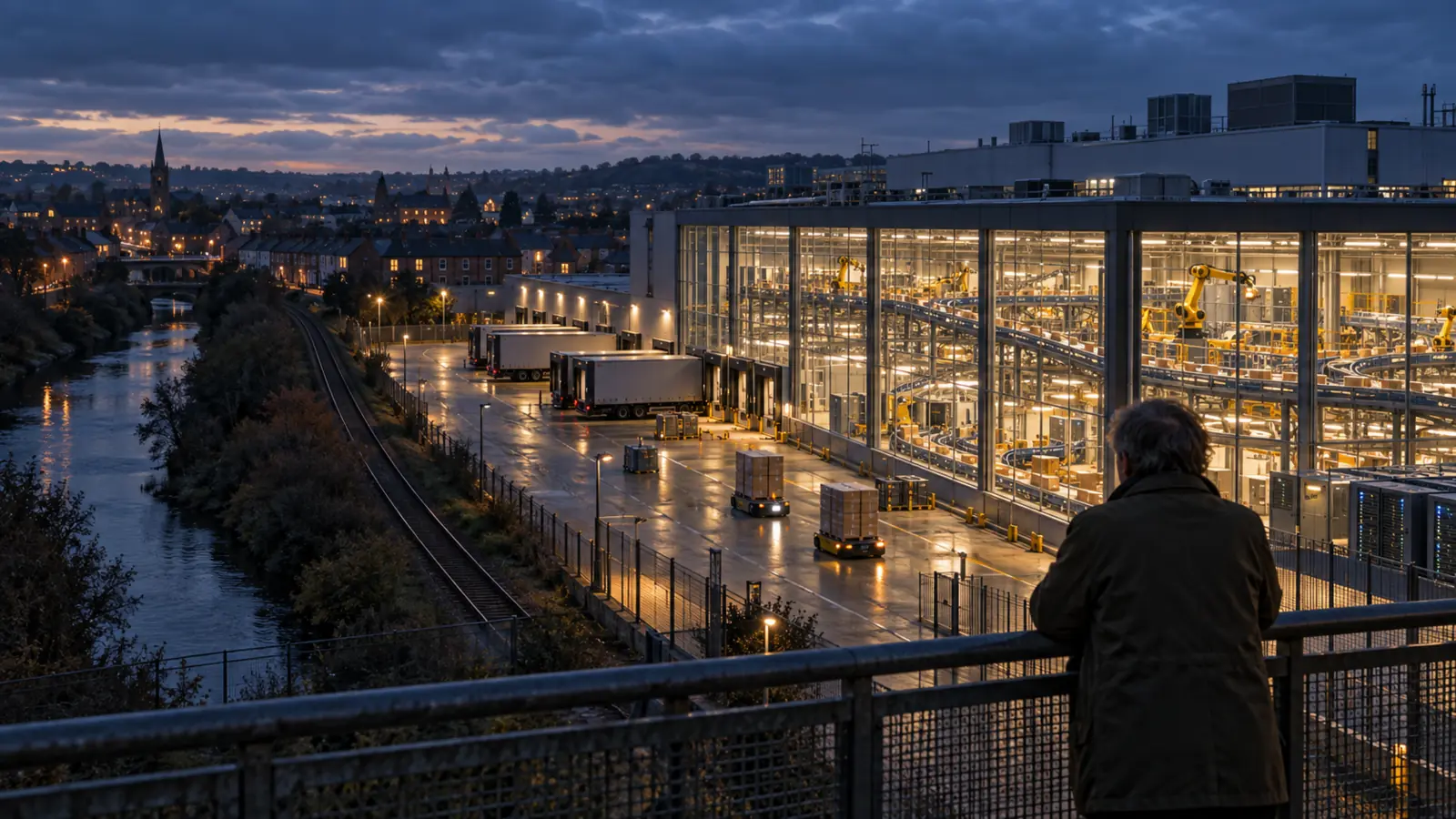
For most of economic history, there has been a human being somewhere near the centre of the transaction. Someone wanted something, someone made something, someone sold it, and someone ultimately paid.
Technology has repeatedly changed the speed, scale and complexity of that process. The internet made shopping faster, discovery easier and money simpler to move. Beneath it all, people still had needs, businesses tried to meet them and human decisions gave the activity its purpose.
Now consider an economy in which machines perform more of what happens between one human intention and another. They compare suppliers, commission work, negotiate prices and purchase services. A request passes from system to system, with no person handling each intermediate step.
The question is no longer only whether artificial intelligence can do our work. It is what happens when it begins organising more of the economic activity around that work too.
We Started With the Worker
In Part One of this series, we examined a tension underneath the AI revolution. Companies have an incentive to automate work when software can perform it more cheaply, quickly or reliably. But workers are also consumers. What looks like a saving inside one business can become a loss of income inside somebody else's household.
The scale of the potential change is substantial. McKinsey estimated in 2026 that 58 per cent of current working hours across ten European countries could theoretically be automated using existing technologies. That is a measure of technical capability, not a forecast that 58 per cent of jobs will disappear. The same research emphasises that many human skills will continue to be needed, often in combination with machines.[1]
That distinction matters. Automating tasks can make a person more productive, change their job or remove the need for their role. The outcome depends on how employers reorganise work and how demand responds.
Part Two followed AI to the other side of the transaction. The Last Human Customer examined agents comparing prices, switching providers and making purchases on our behalf. Delegation does not make the human consumer unnecessary. You still need the product, even when your machine orders it.
These are separate changes with a shared consequence: fewer human interventions may be required between producing something and buying it. If they continue, more of the economy's everyday coordination could become a conversation between machines.
That Stage Has Already Started
In March 2026, Stripe introduced the Machine Payments Protocol, co-authored with Tempo, to let agents and services coordinate payments programmatically. Mastercard announced Agent Pay for Machines in June, designed to support permissioned, high-frequency transactions between automated systems.[2][3]
Those announcements do not establish that an autonomous economy is inevitable. They do show that the infrastructure for one is being built. Payments are a practical obstacle: an agent that can identify a useful service is far more capable if it can also purchase access within an authorised budget.
The commercial expectations are large. Gartner projects that spending on agentic AI software could reach $985 billion by 2030.[4] A forecast is not a result, and software spending is not a measure of jobs displaced. But it indicates how seriously businesses are considering agents as part of their operations.
The important development is less dramatic than the language surrounding it. Software is being given defined ways to act, pay and coordinate across organisational boundaries. We may notice the convenient outcome long before we notice how many decisions have moved behind it.
Imagine a Company With One Employee
Consider a small online business in 2030. Its owner creates the product and establishes the commercial strategy. Much of the administration is delegated.
One agent monitors demand and recommends pricing. Another manages routine marketing. A procurement agent watches stock levels and requests quotes when supplies run low. Supplier systems respond with prices, delivery dates and contractual terms. Within limits set by the owner, the agent selects an offer and initiates payment.
The supplier schedules production. A logistics system finds available transport. Inventory updates, accounts reconcile and cash-flow forecasts adjust. At the end of the day, the owner receives a summary:
Revenue: £18,420. Gross margin: 31%. Stock replenished. Three supplier contracts renegotiated. Advertising allocation adjusted. Two exceptions require your attention.
Those figures are illustrative. So is the degree of delegation. The point is the possible relationship between the size of a business and the number of people directly administering it.
The exceptions matter too. A damaged shipment, disputed contract or unfamiliar customer complaint may still need judgment that the owner cannot safely delegate. Nor does one employee mean no human labour: suppliers, delivery networks and infrastructure may depend on many people elsewhere.
Even with those limits, the change could be significant. Hundreds of routine decisions might occur without the owner making each one. The company becomes easier for one person to operate because software handles more of the coordination that previously required a team.
A conveyor belt automates a defined physical process. Here, the ambition is to delegate parts of economic judgment: deciding which offer meets an objective, when to buy and which service to commission next.
The Market May Not Be Open
The internet we know presents commerce through homepages, menus, photographs and checkout screens. An agent may need something simpler: structured information about price, availability, specification, delivery, returns and reliability.
Businesses already exchange information and payments through software. Agents could extend that arrangement by interpreting a customer's objective and choosing among services, rather than merely following a fixed sequence. The customer-facing website remains one entrance. Another is built for machines.
But there is a weakness in the optimistic version of this story. It assumes the agent can reach the whole market.
In September 2026, Amazon blocked Meta's Muse from shopping on its platform. Reporting on the dispute described Amazon's objections over authorisation, transparency and customer data.[5] Those concerns deserve consideration. They also expose a commercial reality: an agent's usefulness depends partly on where it is permitted to operate.
If one marketplace excludes an outside assistant while another gives privileged access to its own, the agent is comparing the options available to it, not necessarily all the options available to you.
The same issue reaches into operating systems. The European Commission has issued binding measures under the Digital Markets Act addressing competing AI services' access to Android functionality.[6] Access to the device can influence what an assistant is capable of doing before it even reaches a shop.
Apple controls an operating system. Google controls Android and search. Amazon controls a major marketplace. Payment providers control important routes through which transactions move. Each has reasons to protect security and customer experience. Each also has commercial interests in how outside agents use its infrastructure.
Your AI may follow your instructions faithfully and still operate within a restricted view of the market. A cheaper or better option cannot influence its recommendation if it never gets to consider it.
The contest therefore extends beyond who builds the smartest assistant. It concerns who controls access, who can refuse it and whether customers can understand what their agent has been unable to see.
When Companies Become Customers
Agents will not only buy things that people directly consume. They may purchase services needed to complete other tasks.
A research agent could buy access to a specialist dataset. A software agent could rent computing capacity. A marketing system could commission an image, while a logistics system purchases route information. Some transactions might be tiny, repeated frequently and completed without a person approving each one.
The modern economy already contains automated trading, advertising auctions and software-controlled supply chains. What agents could add is greater flexibility across tasks: interpreting a goal, identifying a missing resource and deciding how to obtain it within permitted limits.
That could make work easier to divide between specialist services. A small company might buy precisely the capability it needs rather than maintaining a department or committing to a large contract. Transaction costs could fall, and services previously too fiddly to purchase separately might become practical.
But a chain of machine payments is not a new source of money simply because machines execute it. Someone supplies the budget, bears the risk and receives any return. A thousand intermediate purchases do not, by themselves, create a thousand independent sources of final demand.
The agent is still acting within an economic relationship established by people or organisations. Describing it as a participant helps explain its behaviour; it should not obscure who owns the resources or remains responsible for the outcome.
That is where the apparently technical story returns to a familiar human question: who benefits?
Machines Do Not Need Salaries
A software agent does not finish work and go to a restaurant. It does not pay for childcare, save for a house or book a holiday because it feels exhausted. It has operating costs, but it does not need an income to sustain a human life.
If a company replaces ten administrative roles with software, the wages attached to those roles stop reaching those employees. It does not follow that the money disappears from the economy. Some may pay for computing and other services. Some may become profit, investment, tax revenue or lower prices.
Those routes matter. Cheaper goods can increase people's purchasing power. Investment can create work elsewhere. Profits can support pensions as well as wealthy shareholders. New businesses may emerge because capabilities that were once expensive become affordable.
None of this guarantees that the people who lost their wages receive an equivalent benefit. The savings and the losses can reach different households, in different places, at different times. A family whose income falls sharply cannot necessarily make up the difference through slightly cheaper purchases.
The concern is therefore not that every pound removed from payroll vanishes. It is whether enough of the resulting value returns to households through wages, ownership, public services, transfers or lower living costs. If those routes fail to keep pace, productive capacity can grow while economic security deteriorates for many people.
This tension predates generative AI. In its May 2025 update, the International Labour Organization reported that the global labour income share fell from 53.0 per cent in 2014 to 52.4 per cent in 2024. Had the share remained unchanged, it estimated that labour income in 2024 would have been around $1 trillion higher.[7]
That does not establish AI as the cause, nor predict what happens next. It shows why the distribution of gains deserves attention alongside their size.
GDP could rise while many households experience weaker bargaining power, less secure employment or fewer routes into a profession. That would not mean output had become meaningless. It would mean that growth alone was an incomplete account of how people were living.
Ownership Becomes More Important
Imagine two people in the same highly automated economy. One owns shares in businesses operating thousands of agents. The other depends almost entirely on selling their labour.
If automated systems become more valuable while demand for the second person's work falls, they experience technological progress differently. For one, machines work constantly. For the other, machines compete constantly.
Many people occupy both positions through savings and pensions. But the scale of ownership matters. A modest pension holding does not necessarily compensate for losing a salary years before retirement.
This is why the question of ownership keeps returning. Who owns the models, computing capacity, intellectual property and businesses? Who receives the income they generate? And how easily can somebody without substantial capital gain a meaningful stake?
There is an optimistic possibility. AI may reduce the cost of starting and operating a company. An individual could assemble research, design, administration and customer support that once required an organisation. Families could run small businesses serving markets they previously could not reach.
Those gains would be real. They could also be uneven. Starting a viable business still requires customers, judgment, time and some ability to bear risk. Access to the same software does not give everyone the same opportunity to succeed. And an entrepreneur using somebody else's model, marketplace and payment system may remain dependent on prices and rules they do not control.
The one-person company is a useful possibility, not a universal answer to displaced employment. Its wider significance is that more people might own productive businesses, provided entry remains affordable and the routes to customers remain open.
The question shifts from simply whether AI will replace a job to whether the person affected can share in the value created by that replacement.
Humans May Move Upstream
Perhaps more of our participation becomes a matter of setting intentions. Machines calculate, organise and execute; people decide what they are trying to achieve.
You define financial goals rather than administer every transaction. A business owner establishes a strategy rather than coordinate every task. A customer explains their preferences rather than compare every offer. That could release an enormous amount of time and attention.
But setting an objective is not automatically a paid occupation. The displaced employee does not receive an income merely by becoming better at instructing an agent. They need a role somebody values, ownership that produces a return or another reliable claim on the economy's output.
Moving upstream may describe how some work changes. It cannot, by itself, explain how everyone earns a living.
It also raises a question about whose intentions count. A machine cannot determine what “best” means without an objective. Cheapest, fastest, most profitable and most environmentally sustainable can point towards different decisions. Someone chooses the priorities, establishes constraints and decides what happens when they conflict.
Those choices do not cease to be human because software applies them. They may simply become harder to inspect. An apparently neutral recommendation can contain judgments about cost, convenience, fairness and whose interests deserve preference.
Giving people more control over their time would be a substantial gain. Giving a small number of providers more control over everyone else's options would be a different outcome. Both are possible within the same technology.
The Distribution Problem
If labour becomes less central to production, societies will need to consider whether wages alone remain an adequate way to distribute purchasing power. The aim should be straightforward even where the mechanisms are contested: people need reliable access to the prosperity being created, including those whose work is no longer required on the same terms.
Universal basic income offers a regular payment independent of employment. A negative income tax offers support that tapers as income rises, including for people with no earnings. Both raise questions about funding, adequacy and how cash support interacts with essential services. Neither makes housing, care or energy available merely by changing the payment system.
Consider a business that once spent £1 million a year on wages. Imagine it can now do the same work with £400,000 in wages and £200,000 in software costs. That leaves £400,000. It might become lower prices, investment or extra profit. The money has not vanished, but it no longer reaches the same people in the same way.
That matters for the public purse too. Less paid work can mean less tax collected from earnings, while the people who lose those earnings may need more support. Higher profits could generate tax revenue elsewhere, but how much, and where, depends on who receives them and how they are taxed.
So “tax AI” skips the real question. Do we tax the tool a business buys, or more of the gains it produces? Taxing the tool could make useful improvements more expensive. Taxing the gains requires being able to identify and collect them, including when they flow abroad. The aim is to share the benefits of doing things better without making it harder to do things better in the first place.
Broader ownership offers another route. Public investment funds, employee shareholding and other forms of shared capital can allow more people to receive returns from productive assets. They also require decisions about funding, governance and risk. Employee ownership alone cannot reach everyone if fewer people become employees in the first place.
Reduced working hours may share some productivity gains as time rather than additional output. Where circumstances allow, doing less work for an adequate income would be a considerable improvement. It will require choices about pay, bargaining and how work is organised; it does not follow automatically from installing software.
There is unlikely to be a single answer. But a useful test runs through all of them: does the arrangement give people a dependable share of rising productivity, or leave them waiting for benefits that may arrive elsewhere?
Human labour has survived repeated technological revolutions. New occupations emerge, demand changes and people find uses for technology that earlier generations did not anticipate. There is good reason to take those possibilities seriously.
There is also reason to examine the pace of this transition. A system that learns additional cognitive tasks may affect some of the new work created around it. That does not prove mass unemployment. It makes confidence that enough suitable work will always appear a proposition to investigate, rather than a sufficient plan.
The Economy After Us
The most unsettling future may be one in which artificial intelligence succeeds spectacularly.
Imagine 2040. Manufacturing is more automated, scientific discovery has accelerated and routine services are easier to obtain. Personal agents negotiate purchases, small teams operate capable businesses and software coordinates tasks that once consumed entire working days.
There would be much to welcome. Less tedious administration. More productive individuals. New businesses. Potentially cheaper goods and more time for the parts of life we actually want to live.
The question is what makes that prosperity available to the people living alongside it. The 18-year-old still needs a route into an independent life. The person displaced after thirty years of work still needs security. Neither can pay the bills with the knowledge that the economy has become more efficient.
That brings us back to the title of this series. An economy without consumers is not the literal destination. Humans remain the source of the needs and experiences that make much of this activity worthwhile. What may change is how directly we participate in producing, choosing and buying, and how we acquire a claim on what is produced.
For centuries we built machines to participate in our economy. We may now be beginning to build an economy in which we increasingly participate through machines.
Its success will depend on more than how well those machines work. It will depend on whether the institutions around them connect their productive power to ordinary lives: through worthwhile work, wider ownership, affordable essentials and a dependable share of the gains.
We could become extraordinarily good at making, negotiating and transacting while leaving millions of people uncertain of their place in the system. Or we could use that capability to give people more security, time and freedom.
An economy is not successful merely because it produces more. It is successful when the people living inside it can participate meaningfully in the prosperity it creates.
The machine can become more capable. What that capability is for remains our decision.
Sources
[2] Stripe, “Introducing the Machine Payments Protocol”, 18 March 2026. stripe.com
[4] Gartner, “Forecast Analysis: Agentic AI Spending in Software Markets”, 2026. www.gartner.com
[5] Axios, “Amazon boots Meta's Muse in fight over AI shopping”, 21 September 2026. www.axios.com