The Last Human Customer
What happens when your AI starts deciding what you buy?
For more than a century, modern capitalism has become extraordinarily good at persuading people. The fine art of arranging our surroundings to encourage spending is on display everywhere. Think of the chocolate beside the supermarket till, or the insurance renewal that arrives when you have neither the time nor the patience to compare alternatives.
Luxury car manufacturers focus attention on freedom rather than transport, and fashion brands sell belonging. As you read this, your internet provider may be quietly hoping that cancelling will be sufficiently inconvenient that you simply cannot be bothered.
Entire industries have been constructed around one fairly basic fact: human beings are not particularly consistent customers. We get tired, impatient or distracted. We favour brands we recognise and buy things because people we admire use them. Given the opportunity to compare other options, who really looks beyond the fifth website?
We are influenced by colour, placement, scarcity, reviews, packaging, advertising, emotion and habit. The modern consumer economy does not simply tolerate those behaviours. Much of it is organised around them.
But what happens when the person doing the comparing is no longer a person?
A machine does not get tired halfway through the search or forget a renewal date. Given reliable information and permission to act, it could compare products, check terms and negotiate within parameters you set. Increasingly, it may also spend your money.
Your AI.
From Assistant to Agent
Until recently, the familiar role of AI was to advise us. Ask which television to buy and it could compare specifications. Ask for help finding a cheaper flight and it could suggest alternatives. Ask whether your broadband bill looked expensive and it could probably tell you.
But there was usually an important final step. We still needed to open the website, make the call, fill in the form, enter the card details or cancel the subscription.
That boundary is beginning to disappear. Payment providers are building infrastructure through which authorised agents can transact directly with businesses. Stripe's Machine Payments Protocol and Mastercard's Agent Pay for Machines are examples of that shift.[1][2]
This does not mean a dependable personal shopper is already available for every task. Finding trustworthy information, understanding exceptions and completing a purchase correctly remain substantial challenges. The scenarios that follow imagine those capabilities becoming more reliable and widely available.
Because the moment AI stops merely helping the customer and starts acting on the customer's behalf, the economics begin to change with it.
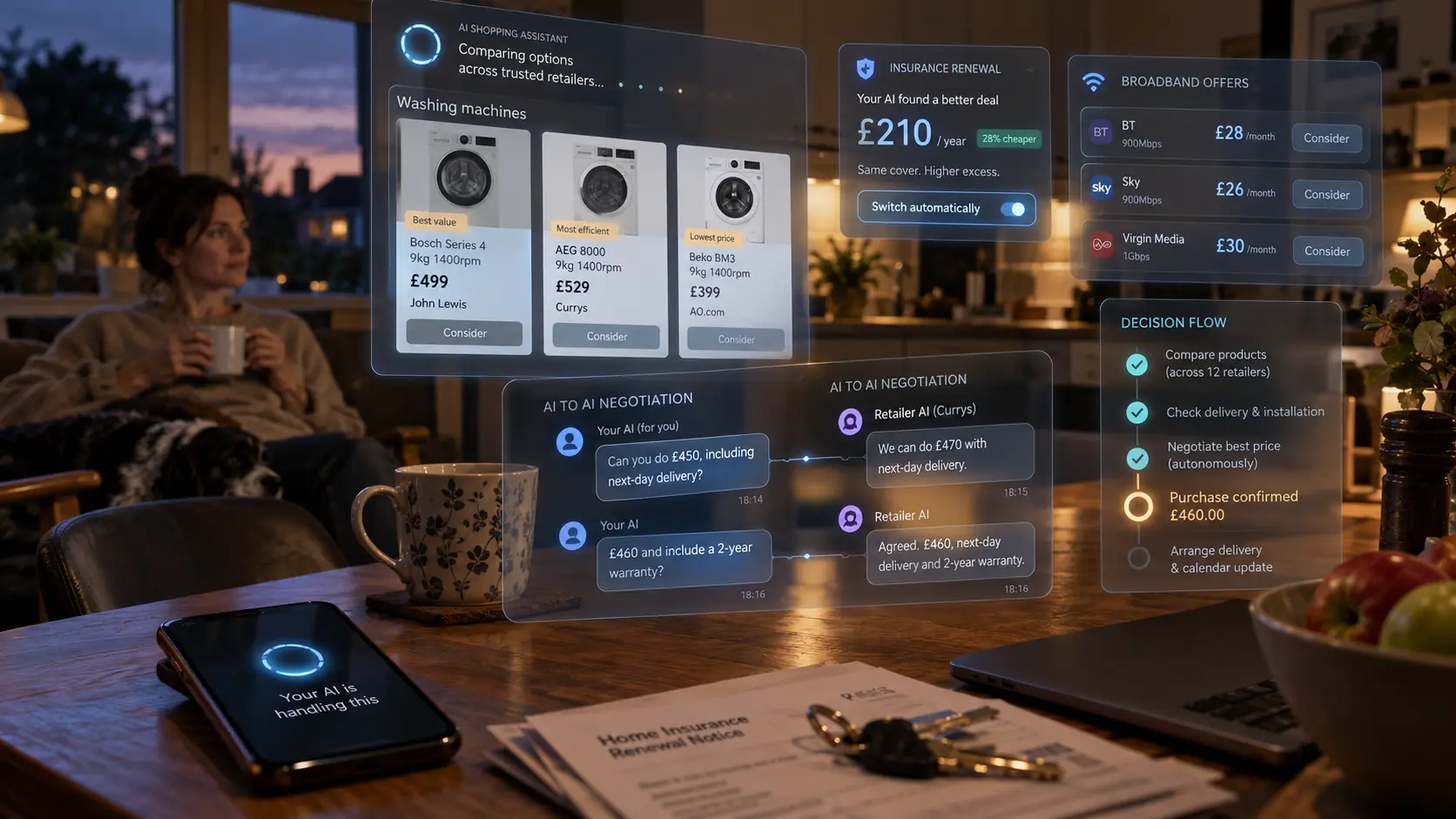
Imagine Buying a Washing Machine in 2028
You need a new washing machine. Today, you might search Google, visit Currys, read reviews and compare Samsung with Bosch. You watch a few videos and, somewhere in the process, discover that one machine apparently has £100 off until Sunday.
Now imagine giving your AI an instruction instead:
Find me the best washing machine under £600. It has to fit the existing space, and reliability and low running costs matter most. Check owner reviews and warranties, look at the historical price and see whether anyone will price-match. Arrange delivery after 6pm and removal of the old machine. Don't exceed the budget without asking me.
One instruction replaces an evening of tabs, reviews and mild frustration. The agent may still need to ask whether you prefer a quieter machine or a larger drum. It should tell you when it cannot verify a claim, rather than treating a convincing product description as evidence.
But if it can do the job well, something important changes. Retailers are no longer only trying to convince you. They are also trying to become the product your machine recommends.
That is a different contest. It could remove work from the transaction too: fewer comparison calls, fewer sales conversations and fewer people guiding customers through routine decisions. Whether that reduces employment overall will depend on what businesses and customers do with the time and money saved. For the person whose role is removed, however, the disruption is immediate.
What Happens to Advertising When the Customer Cannot See It?
Advertising has always drawn on human psychology. Create desire, urgency, recognition or aspiration. Put a product in front of somebody often enough and familiarity itself becomes valuable.
But how do you advertise to software?
Your AI does not feel more successful because somebody attractive is wearing the watch. It does not impulse-buy chewing gum at the checkout or become anxious because a booking page says only three rooms remain. Those signals may still influence the information it processes, but it does not experience the feelings advertisers are trying to provoke.
You do. And that matters. An agent acting for you should respect your tastes, including preferences that cannot be reduced to price or specification. If you love a particular design, or trust a brand because it has served you well, that belongs in the decision.
The change is that familiar persuasion may have to survive an additional layer of scrutiny. A discount can be checked against last month's price. A recommendation can be compared with alternatives. An expensive badge may need to justify its premium against what you have actually asked for.
For decades, businesses have asked: how do we make people want this?
Increasingly, they may also ask: how do we make their AI conclude that this is the right choice?
The internet spent thirty years learning how to rank highly enough for a human to click. The next battle may be learning how to rank highly enough for a machine to choose.
The End of the Inert Customer
A surprising amount of profit depends on us doing absolutely nothing.
Insurance is an obvious example. When renewal time arrives, how many of us have an evening to fill in forms, collect quotes and read the terms carefully enough to establish whether the cover is comparable? Add mobile contracts, broadband and energy suppliers, and staying on top of everything starts to resemble a small administrative job.
The assumption is often not that the existing deal remains the best one. It is that changing it requires effort. You have to remember, research, phone somebody, wait on hold and perhaps send back a router nobody has thought about for four years.
Human friction has economic value. AI could attack that friction directly.
Imagine your car insurance renewal arrives. Your AI notices that the price has increased by £147. It checks alternatives, compares the cover against your requirements and asks your existing insurer to match the best suitable offer. They refuse.
If you have authorised switching, and the policy meets your conditions, your AI changes provider. Anything uncertain comes back to you for approval. Otherwise, you receive a message:
Car insurance renewed. Saved £132. No action required.
The insurer has lost the customer before the customer has spent an evening thinking about insurance. For us, that sounds fantastic. For businesses built around inertia, it could be brutal.
Loyalty May Become Expensive
You may have banked with the same company for twenty years. Another account pays more interest and charges fewer fees. You may always fly British Airways, while another airline offers a comparable journey for £170 less.
Your agent should not automatically switch either. Perhaps the bank has helped you through a difficult situation, or the airline's schedule and service are worth the premium. A good representative needs to understand those preferences.
But it can make the trade-off visible. This is what loyalty costs. Is it still worth it to you?
That could change the relationship between customers and brands. Familiarity would remain valuable, but it might no longer go unexamined simply because comparison takes too much effort.
Your representative has no nostalgia of its own. It needs to understand yours.
Of Course, Businesses Will Fight Back
There is an obvious temptation to imagine our personal AI as a perfectly rational guardian, finally protecting us from advertising, fake discounts and terrible renewal prices. I suspect that picture is too comfortable.
The moment agents begin directing substantial amounts of consumer spending, businesses have an enormous incentive to influence them. Retailers will improve their product data. Manufacturers will learn which claims agents favour. Platforms will compete to become trusted sources.
Some of that will be useful. Clear specifications and accurate availability help everyone. Some of it will be the old contest for attention, conducted through a new intermediary.
And eventually the obvious question arrives: can somebody pay to influence your AI?
The answer matters partly because of how the service is funded. If you pay a monthly fee for an agent working exclusively for you, the commercial relationship at least appears straightforward. You are the customer, although a subscription alone does not prove that every incentive is aligned with yours.
If the AI is free, somebody still has to fund its computing, development and operation. Perhaps enterprise customers subsidise it. Perhaps the provider makes money from other services. Or perhaps businesses pay for placement, preferred integrations or the opportunity to become easier for an agent to recommend.
If the machine is choosing your hotel, mortgage, insurance or groceries, how clearly will you see those relationships? Was this the best product for your needs, the best-described product, or the one most deeply integrated with the platform? Did the provider receive commission? Which alternatives were never considered?
There is a very large difference between an AI that acts for you and one that appears to act for you while quietly balancing the interests of several other parties.
The technology intended to protect us from manipulation may create another target for it: the machine making the recommendation.
Your AI Versus Their AI
You have an AI representing you. The retailer has an AI representing them. Yours knows your budget, preferences and available alternatives. Theirs knows margins, inventory and how much discount it is permitted to offer.
You need a new broadband contract. Your AI contacts theirs. Imagine a twelve-month deal, with no extra fees or price rises, negotiated like this:
Your AI: Comparable providers offer this for £34 a month.
Company AI: We can offer £41 with additional television channels.
Your AI: The customer doesn't watch those channels. £35.
Company AI: Six months at £30, then six months at £38.
Your AI: Average monthly cost £34. Accepted.
No retention call. No half-hour explaining that you really do intend to leave. The agreement is recorded and available for you to inspect, but the routine negotiation happens between machines.
Comparison sites, affiliate marketers, retention departments and sales teams could all find parts of their work exposed. Other services may become more valuable: checking that an agreement is fair, resolving disputes or helping with decisions a customer does not want to delegate.
The customer has not disappeared. The customer has moved one step back from the transaction.
You Become the Principal
You still own the money, consume the product and decide what matters. But you may no longer perform each step of the purchase. You become something closer to a principal: you set the objective and your agent executes it.
The better it becomes, the less reason there is to supervise every routine decision. That sounds wonderful, until you consider what the machine needs to become that useful.
It needs to know you in detail: your income, spending habits, preferences, subscriptions, family circumstances and perhaps medical restrictions. It may eventually anticipate needs you have not yet thought to mention.
That is an extraordinary concentration of personal information. The better the AI knows you, the more useful it becomes. The more useful it becomes, the more authority you may give it. And the more authority it holds, the more consequential its mistakes, or its incentives, become.
Trust therefore needs something more practical than a reassuring name and a friendly voice. You should be able to see what it did, understand why it did it and withdraw its authority. A purchase made on your behalf should remain open to your scrutiny.
The important question is no longer simply whether AI will make shopping easier. It is who your AI actually works for, and how you would know if that changed.
The Last Human Customer
You still need the washing machine and want the holiday. What changes is how you choose them, and who stands between you and the businesses hoping to sell them.
Increasingly, we may simply express an intention: sort my insurance, book our holiday, replace the washing machine, reduce my monthly bills. Beyond our view, machines search, compare, reject, negotiate and transact.
The great commercial contest of the twentieth century was for the attention of the consumer. The great commercial contest of the twenty-first may be for the recommendation of their agent.
And when businesses begin directing their persuasion towards the machines representing us, something important will have shifted. The human customer will still be paying, but may no longer be doing the buying.
Sources
[1] Stripe, “Introducing the Machine Payments Protocol”, 18 March 2026. stripe.com