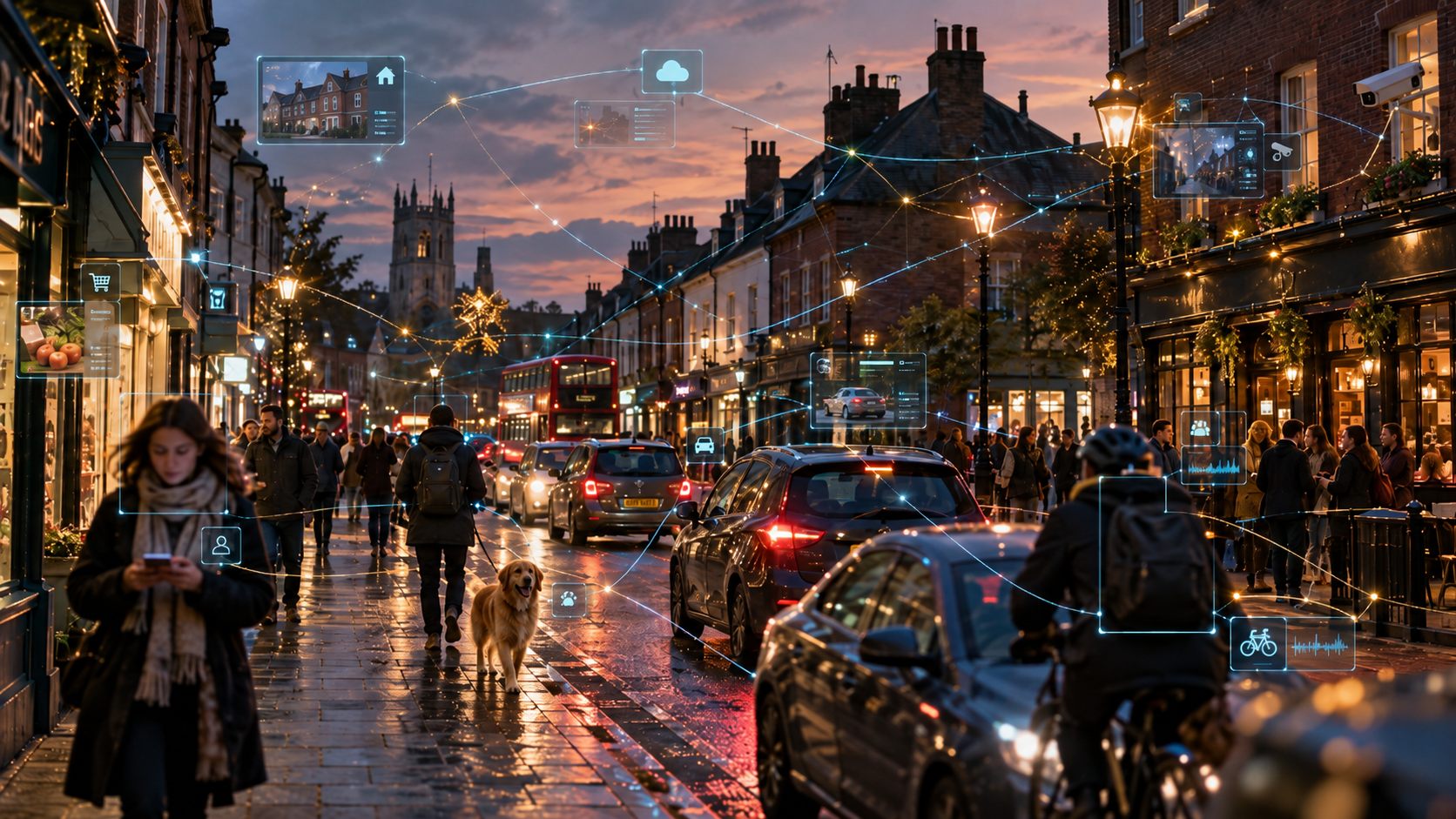
There is a version of life in 2030 that still looks remarkably familiar.
The roads haven't changed much. People still go to restaurants. Children still go to school and the everyday challenges of money, work, and relationships still occupy our daily lives. On the surface, one would be forgiven for thinking not a great deal has changed.
There are no flying cars or armies of humanoid robots marching down the high street.
And yet, almost everything underneath everyday life is unrecognisable.
Because AI is no longer something we open; it actively acts for us in almost every possible way.
The Personal Assistant Becomes Real
When we first started using the internet, we would search to find the solutions needed—car insurance, holiday ideas, etc. But today, we open apps that speed up that process. They are optimised for the platform, already vetted by the likes of Apple or Google (other providers are likely available).
Need to move house? Search Rightmove. Need insurance? Comparethemarket.com. And if you need a well-earned break, a flight checker is ready at hand. But we still email an estate agent, fill in mortgage forms, or phone a solicitor. That has remained fairly similar, but I suspect it will rapidly change in the near future.
By 2030, much of that could look absurdly inefficient.
Imagine telling your personal AI:
"Find me a four-bedroom house within 30 minutes of work. Maximum £800,000. Good schools. Quiet road. Decent garden." Within seconds, it searches every available property—not via estate agents, but the actual vendors themselves.
But it doesn't stop there.
It checks previous sale prices, planning applications, flood risk, local crime, schools, commuting patterns, and likely renovation costs.
It contacts the seller's AI and a viewing is arranged.
You like the house.
You tell your AI:
"Buy it, but don't go above £760,000."
The machines negotiate.
£755,000 is agreed.
Your AI contacts mortgage providers using financial information you have already authorised it to access.
The seller's AI sends the property documents, and the legal AI systems check the title, searches, restrictions, and contracts.
Insurance is arranged automatically and all of the identity checks are completed.
What currently takes months might eventually take days.
Perhaps hours.
The extraordinary thing is not simply that AI becomes intelligent.
It is that transactional time collapses—and anyone who has ever purchased a property will tell you that it is real progress.
But that has real-world consequences as well. Just think of the industries in the transaction process that are no longer needed!
But For This To Work, AI Has To Become You
A genuine personal assistant cannot simply know your favourite restaurant.
It needs real authority, the ability to prove: This is Hugh's AI, and Hugh has authorised this.
It may spend £200 without asking or negotiate an insurance renewal, but it cannot transfer £20,000 without biometric approval.
That means digital identity becomes enormously important.
- Passport.
- Banking.
- Tax.
- Healthcare.
- Employment.
- Property.
Eventually, we may each have something resembling a digital power of attorney sitting inside our personal AI.
Not unlimited control. Defined authority.
And suddenly, a completely new question appears.
Who is responsible when it gets something wrong?
If your AI transfers money to a fraudster, is that your mistake? The bank's? The AI company's? The software developer's? The merchant's?
We already argue about liability when people are scammed. Imagine doing it when the person never actually made the transaction. Their machine did.
Then Comes The Workplace
The greatest change may not happen in our homes. It happens in offices.
Consider how much modern employment consists of moving information between people:
- Meetings, Reports, and Scheduling.
- Emails, Presentations, Research, and Progress updates.
- Management summaries and Performance monitoring.
To list but a few, AI is unusually well suited to exactly this kind of work.
And that creates a difficult possibility.
Companies may become dramatically more productive while employing dramatically fewer people.
By 2030, it could increasingly look like this:
- Owners.
- Senior decision-makers.
- AI systems.
- A much smaller human workforce.
Middle management becomes particularly unneeded, not because managers do nothing. Quite the opposite. They coordinate enormous amounts of information—which is precisely what increasingly capable AI systems are designed to do.
The Missing First Rung
Now imagine being 18 in 2030.
For generations, young people entered professions doing relatively basic work. The trainee accountant reconciled accounts. The junior solicitor reviewed documents. The graduate marketer produced reports. You learned by doing the tasks the colleagues above you had already mastered.
But what happens when AI performs the junior work?
The first rung of the career ladder disappears, and now the 18-year-old faces a strange question: How do I become experienced if nobody needs an inexperienced person?
Practical trades like caregiving, engineering, medicine, physical services, and intensely human work may become increasingly attractive. But millions of traditional office careers could become much harder to enter, much like what happened to the horse and cart when cars appeared.
Now Imagine Being 52
The problem looks completely different.
You have spent thirty years building a career and managing people. Perhaps you work in insurance, property, finance, recruitment, administration, sales, or legal services.
Your salary supports a mortgage, children, and pension contributions.
Then your employer restructures, but the company doesn't replace you with another manager. It replaces an entire layer of management with AI.
The good news is you are not technologically illiterate, because you can use AI perfectly well. That isn't the problem. The problem is that the economy no longer needs as many people doing what you spent thirty years becoming good at.
The 18-year-old asks: How do I start?
The 52-year-old asks: What happened to the career I already had?
Where Are All The New Jobs?
The comforting answer is that technology always creates new jobs. And historically, it always has. However, AI presents an unusual problem.
Many of the new jobs we imagine AI creating can themselves be performed by AI:
- AI supervisors.
- AI administrators.
- AI auditors.
- AI trainers.
- AI customer-support specialists.
- AI content managers.
Every time we invent a new layer of cognitive work, the technology potentially learns to perform that too.
There will absolutely be new jobs, but it is far less obvious that there will be enough of them to replace millions of well-paid administrative and professional roles. And while all of these smart business owners drive a technical revolution, we rapidly reach a real economic problem.
Who Buys Everything?
Imagine an insurance company that previously employed 10,000 people. AI allows it to operate with 300.
Profits and productivity rise. Prices may fall, and smaller players become competitive with the bigger players. Shareholders are delighted.
Now repeat that across banking, retail, property, law, marketing, technology, logistics, and professional services. Millions of companies become extraordinarily efficient, and millions of salaries disappear or shrink.
Capitalism now encounters an uncomfortable contradiction.
Companies need consumers. Consumers need income.
If companies systematically remove the wages that allow people to consume, eventually they undermine their own customers. Automation produces abundance, but abundance is economically useless if people cannot afford to buy it.
That is when AI stops being merely a technology question and becomes a political and economic one.
The New Social Contract
This doesn't need to lead to economic collapse, but something will have to change.
Perhaps people work three or four days instead of five, and taxation shifts away from labour and towards capital and automated productivity. Perhaps some form of universal income develops, and citizens own a greater share of the AI infrastructure producing the wealth. Essential goods may become so cheap that people simply require less income.
Most likely, it will be a messy combination of all of them and an uncomfortable period of transition.
And Where Will We Live?
AI could also quietly change geography.
For two centuries, cities offered access to opportunity. You lived near the office because that was where the work was. But if physical proximity becomes less important, the equation changes.
Why pay an enormous premium for a small property close to an office you visit twice a month? Suburban towns and regional centres could become more desirable.
People can optimise for:
- Space.
- Schools.
- Safety.
- Community.
- Green space.
- Quality of life.
Cities will not disappear. They remain centres of culture, entertainment, universities, specialist medicine, finance, and human interaction. It is their monopoly on opportunity that weakens.
The commuter town stops being somewhere you tolerate because you work in London, and becomes somewhere you choose because London is available when you want it.
And Then Things Get Stranger
Some changes may sound ridiculous today and completely normal four years from now.
You stop using apps. Your AI simply completes tasks across services. Opening six different apps to organise one thing starts to feel like unfolding a paper road map.
You stop shopping for routine things. Your AI renews insurance, changes energy suppliers, replaces household products, and negotiates subscriptions. Companies increasingly market themselves not just to you, but to your AI.
Language begins disappearing as a barrier. You speak English; someone else speaks Japanese. Each hears the conversation naturally in their own language through an earpiece or glasses. For the first time in history, billions of people could communicate without sharing a language.
The price tag starts disappearing. Your AI knows what you want. The seller's AI knows what it is prepared to accept and negotiates instantly. The hotel room is not £320—it is £320 to somebody else, but your AI got it for £271. Fixed pricing begins giving way to continuous machine negotiation.
And perhaps the strangest one: You stop attending meetings because your AI went instead.
Your diary might eventually say: "Your AI attended six meetings today." It spoke to other AI systems, negotiated deadlines, exchanged information, agreed on routine decisions, and updated your projects. Then it gave you a three-minute summary.
No human attended.
2030 May Look Completely Normal
That may be the strangest part.
We imagine technological revolutions as visually dramatic:
- Robots.
- Flying cars.
- Futuristic cities.
But the AI revolution may look nothing like that.
Houses, pubs, and schools remain. Disappointingly, so does the traffic.
What changes is the invisible machinery underneath society. How we work, buy, and especially communicate. And ultimately, how economic value is distributed.
Artificial intelligence could give us something humanity has spent centuries trying to achieve: the ability to produce dramatically more while working dramatically less.
That should be extraordinary. Perhaps it will be.
But it leaves us with a question we have barely started answering: What happens when the economy becomes extraordinarily good at producing everything we want—while increasingly needing fewer of us to produce it?