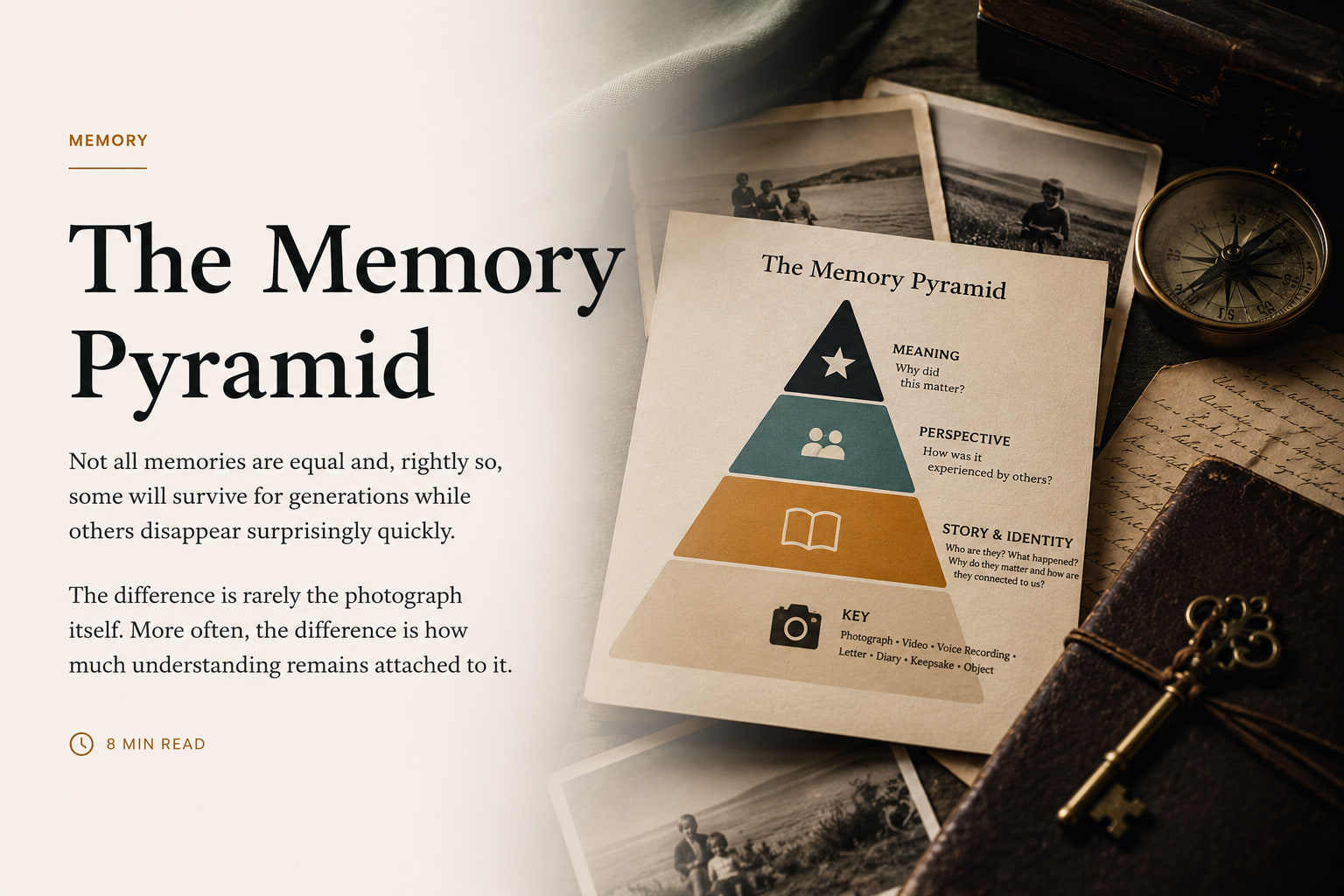
Not all memories are equal and, rightly so, some will survive for generations while others disappear surprisingly quickly.
The difference is rarely the photograph itself. More often, the difference is how much understanding remains attached to it.
Imagine clearing a family loft.
Some items immediately appear important: official documents, certificates and formal photographs. The things people intentionally preserved because they knew they mattered.
Yet the objects people often spend the longest looking at are the unexpected ones: a handwritten note, an old shopping list, a postcard or a child's drawing.
The object nobody expected to matter.
Its value was not obvious when it was created. Time gave it meaning.
Memories often behave in the same way. The moments that seem most important when they happen are not always the moments that matter most years later.
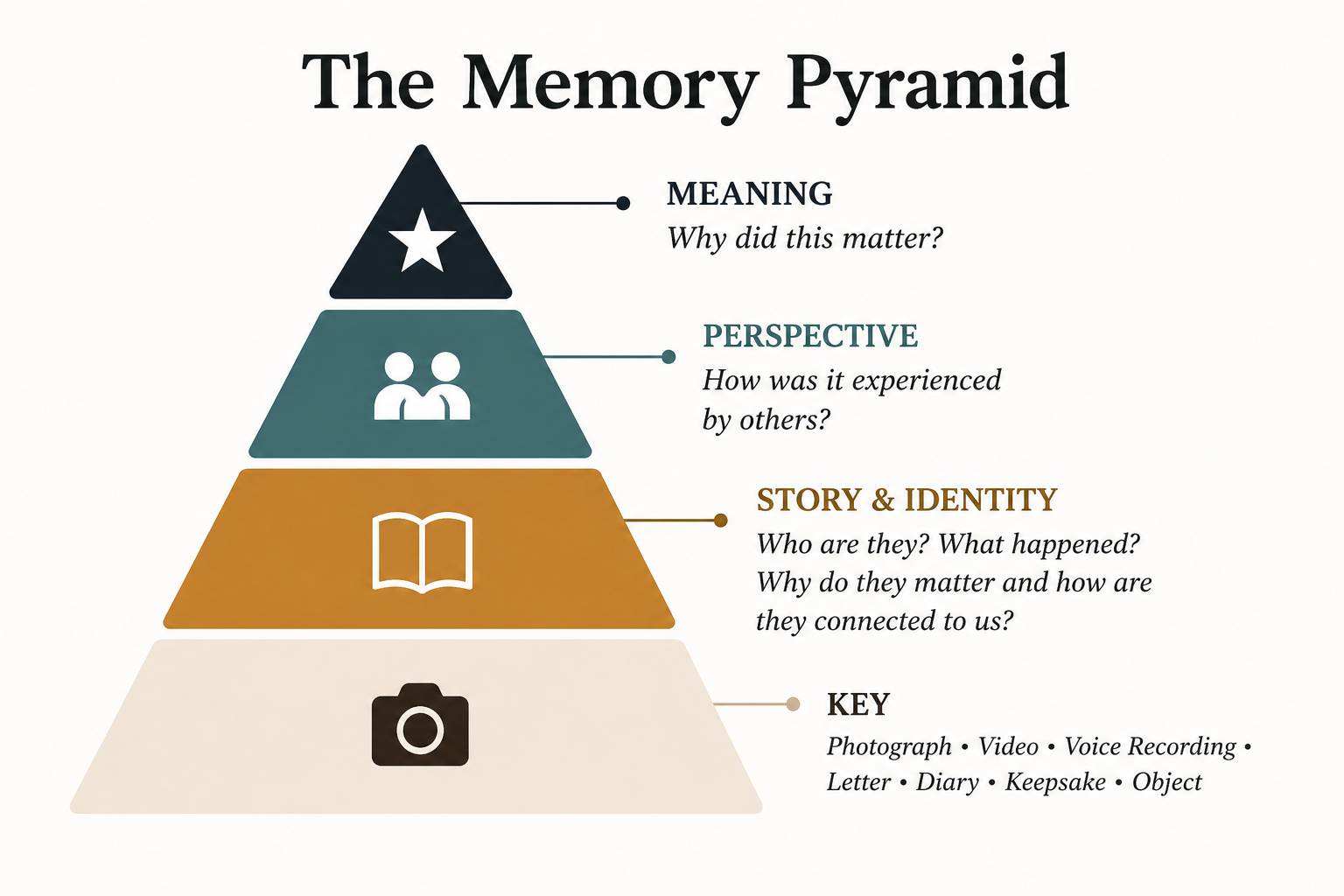
This is the idea behind the Memory Pyramid.
The stronger the layers surrounding the memory, the stronger the continuity becomes. Remove enough layers and eventually only the record remains.
The memory survives.
The understanding does not.
The Bottom of the Pyramid
At the bottom of the pyramid sits the photograph, the key if you will.
A powerful moment captured in time, it proves something existed and acts as the gateway back to the moment. But on its own, a photograph often provides very little continuity.
Imagine discovering a photograph of a stranger. You can see their face and estimate their age, yet most of the understanding is missing.
The photograph survives. The continuity is weak.
Story & Identity
The next layer is identity and story.
Who is this person?
Names, relationships, roles and background.
How are they connected to the family?
Their place in the broader story.
Why are they important?
What made them meaningful to others?
What happened before and afterwards?
The context that surrounds this moment.
A name immediately strengthens continuity because the stranger becomes a relative and the face becomes a family.
The story transforms a record into an experience. Without the story, a photograph captures a moment. With the story, it captures a memory. Yet even this is only a partial understanding.
Perspective
Perspective brings in how others experienced the moment.
How was it experienced by others?
Different eyes see different things.
Whose perspectives are missing?
The quiet voices are often the most important.
What details did they notice?
Small details seen by one may be missed by another.
How do these perspectives fit together?
Together, they create a fuller, deeper understanding.
No individual perspective tells the whole story.
Together, they create something richer.
A mother remembers one thing. A father remembers another. A sibling remembers something different again. Each perspective adds another layer. This is why continuity often becomes stronger when multiple people contribute.
Meaning
Meaning is the final layer—the reason this moment mattered.
Why did this matter?
What bigger purpose or values does it reflect?
What does it mean to us now?
How does it shape our understanding today?
What legacy does it leave behind?
What future generations can learn from it?
How does it connect to the larger story?
How does it fit into our shared human experience?
Meaning is often the last layer added and the first layer lost.
At the top of the pyramid sits meaning. Future generations will want to know not only what happened; they will want to understand why it mattered.
The Fragility of the Pyramid
The Memory Pyramid explains why continuity weakens over time.
Each lost layer weakens the structure. Eventually the pyramid collapses until only the key remains.
The key survives.
The understanding does not.
Strengthening Continuity
Most continuity work is not about creating new memories. It is about strengthening the layers around existing ones.
- Adding identity.
- Capturing stories.
- Preserving perspectives.
- Recording meaning.
The stronger the pyramid becomes, the greater the chance that future generations will not simply see a photograph.
They will understand it.
Because a photograph alone captures a moment.
A complete Memory Pyramid captures what that moment meant.