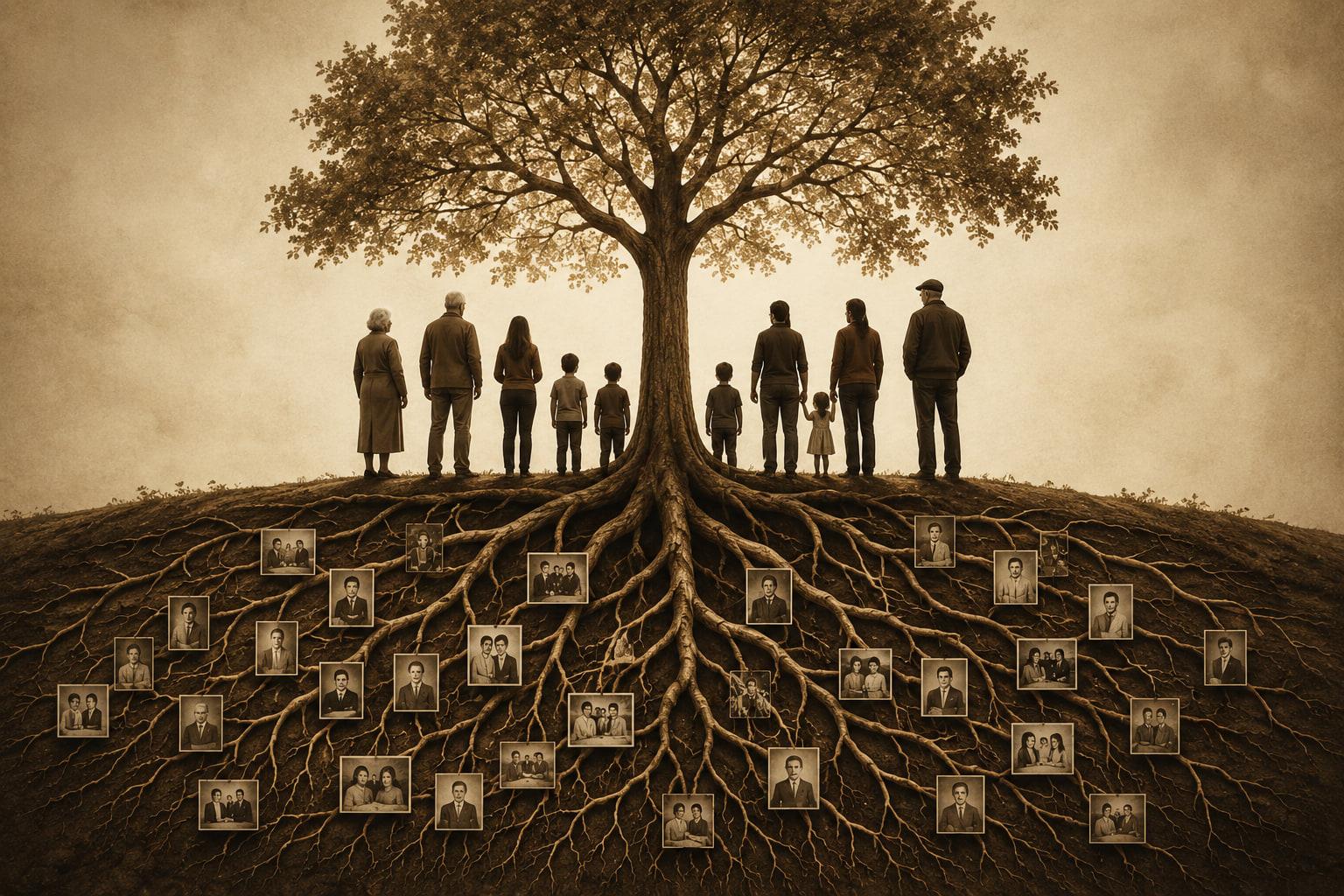
For most of human history, continuity was not something ordinary people possessed.
Most people lived their lives, raised families, worked, loved, struggled and eventually disappeared into history, leaving their children to continue the legacy. Their stories survived only through memory, song and sometimes rumour, and if those memories were not passed on, they were lost.
The vast majority of humanity left behind little more than fragments.
A name and a date in a register.
A photograph, if they were fortunate enough to live in the right era.
For most people, continuity was fragile, if it existed at all.
For the powerful, it was different.
Building Continuity
When we look at the great figures of history, it is easy to assume their stories survived because they were important.
The reality is often simpler.
Their stories survived because continuity was deliberately built around them.
The Egyptians constructed pyramids. The Romans erected monuments. Kings commissioned portraits. Nobles preserved letters and empires maintained records. Biographies were written and statues were raised. Stories were repeated, told to children in song and taught in schools.
Each layer added another piece of continuity.
The goal was not merely to remember that a person existed.
The goal was to shape how they would be understood by future generations.
The World’s First Continuity Systems
A pyramid is not simply a tomb. A monument is not simply stone. A portrait is not simply a picture. Each is an attempt to transfer understanding across time.
They are continuity systems.
Their purpose is to help future generations answer questions such as:
- Who was this person?
- Why did they matter?
- What did they achieve?
- And, perhaps most importantly, how should they be remembered?
The powerful understood something that many modern families still struggle with today.
Records alone are not enough. Meaning must travel with them.
Historians and the Human Archive
The continuity of powerful people was rarely preserved by a single source.
Historians assembled it from many sources.
Letters. Diaries. Government records. Portraits. Personal observations from friends and family members.
Each source contributed a different perspective.
No individual source told the whole story.
Historians understood this, and by bringing those perspectives together they formed a richer picture.
The more perspectives that survived, the stronger the continuity became.
This principle has not changed.
The Ordinary Family Problem
Most ordinary families never had access to these systems.
Few had professional archivists or the ability to commission biographies. Very few left behind the extensive records upon which continuity depended.
Parents told stories. Grandparents explained photographs. Relatives filled in missing details.
But what happens when they are no longer here?
The family itself became the archive.
When those people disappeared, much of the continuity disappeared with them.
Not because the family was unimportant.
Because the infrastructure did not exist.
The Great Shift
For the first time in history, that situation has changed.
An ordinary family can now create more records in a single year than many historical figures produced during an entire lifetime.
- Everyday photographs.
- Videos.
- Voice messages.
- Documents.
- Multiple perspectives.
- Multiple contributors.
- Multiple generations.
The tools that were once available only to institutions, governments and the wealthy now exist in almost every pocket.
Yet something important remains missing.
Many families have acquired the records.
They have not yet acquired the continuity.
The Opportunity
This is why Memory Continuity matters.
Not because technology allows us to preserve more.
Technology has already solved that problem.
Memory Continuity matters because it helps preserve understanding.
For centuries, continuity was a privilege enjoyed by kings, emperors, aristocrats and institutions.
Today, ordinary families possess something remarkable.
The ability to preserve not only records, but understanding itself.
Perhaps for the first time in history, continuity no longer needs to belong exclusively to the powerful.
It can belong to everyone.
Continuity no longer needs to belong exclusively to the powerful.
It can belong to everyone.