When we think about preserving memories, we naturally focus on what can be saved: photographs, videos, letters, diaries, and digital recordings.
Yet all of these physical and digital artefacts share a hidden truth.
They are not storage locations.
They are keys.
A photograph is a key. A voice recording is a key. A 200,000-photo hard drive is a key. Their true purpose is not to contain meaning, but to unlock it.
This raises a vital question: What exactly are they unlocking?
The answer is people.
Every individual is a unique storage location.
More specifically, every person is a walking, talking data centre containing a volatile, irreplaceable cache of memories, interpretations, emotions, and motivations.
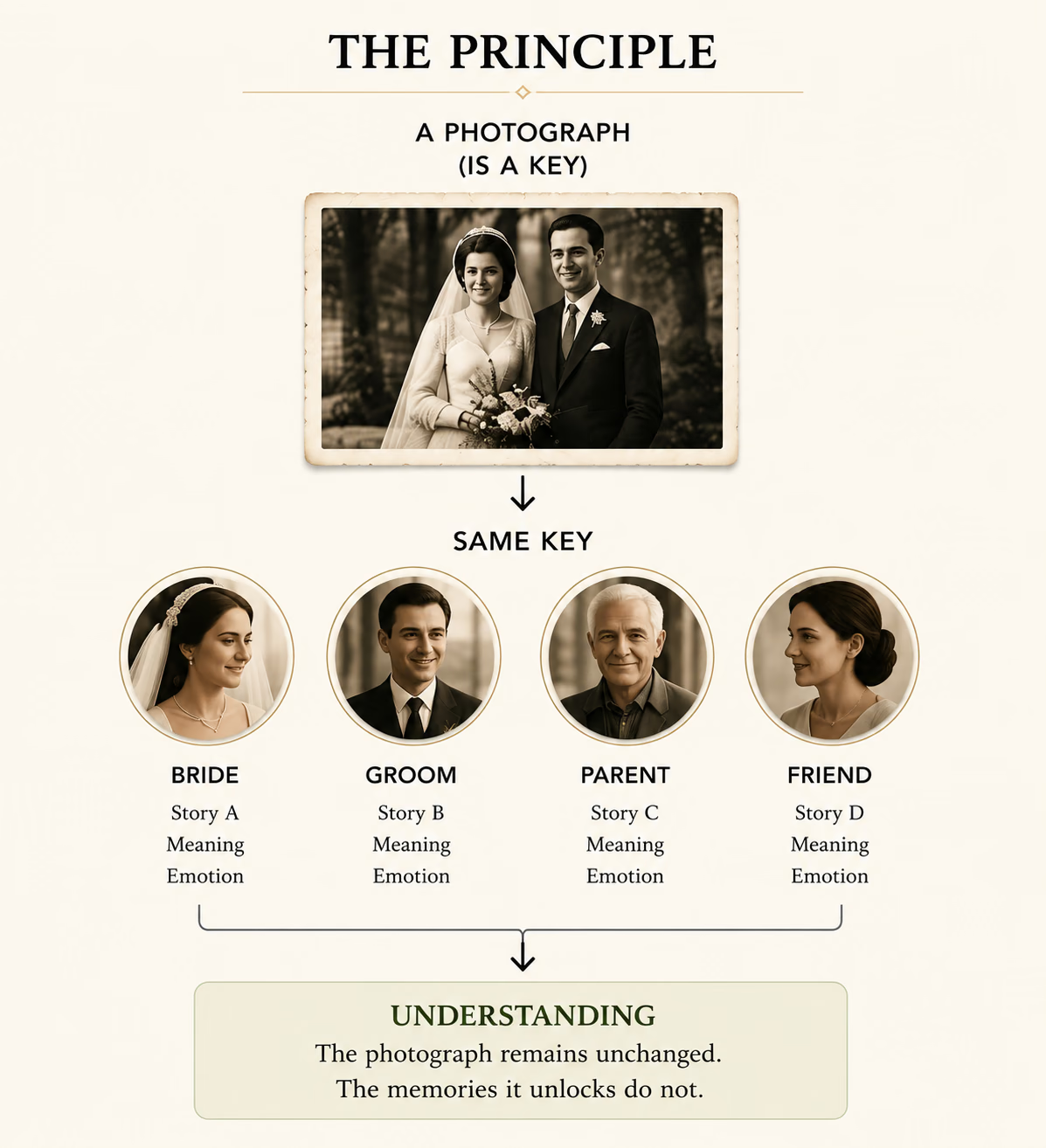
This becomes obvious when a single key is shown to multiple people. Imagine a wedding photograph.
The bride sees one story. The groom remembers another. A parent recalls an entirely different emotional landscape, while a friend remembers a fleeting conversation nobody else caught.
The photograph remains completely unchanged. The memories it unlocks do not. The exact same key can unlock vastly different human data centres, each revealing a fragmented, beautiful piece of the same history.
Two people can stand side by side during the exact same second and preserve completely different experiences of it. The event is shared; the interpretation is entirely unique.
A wedding does not actually exist inside a photograph. The photograph merely provides a pathway back to the memories connected to it. The real continuity value exists within the people themselves.
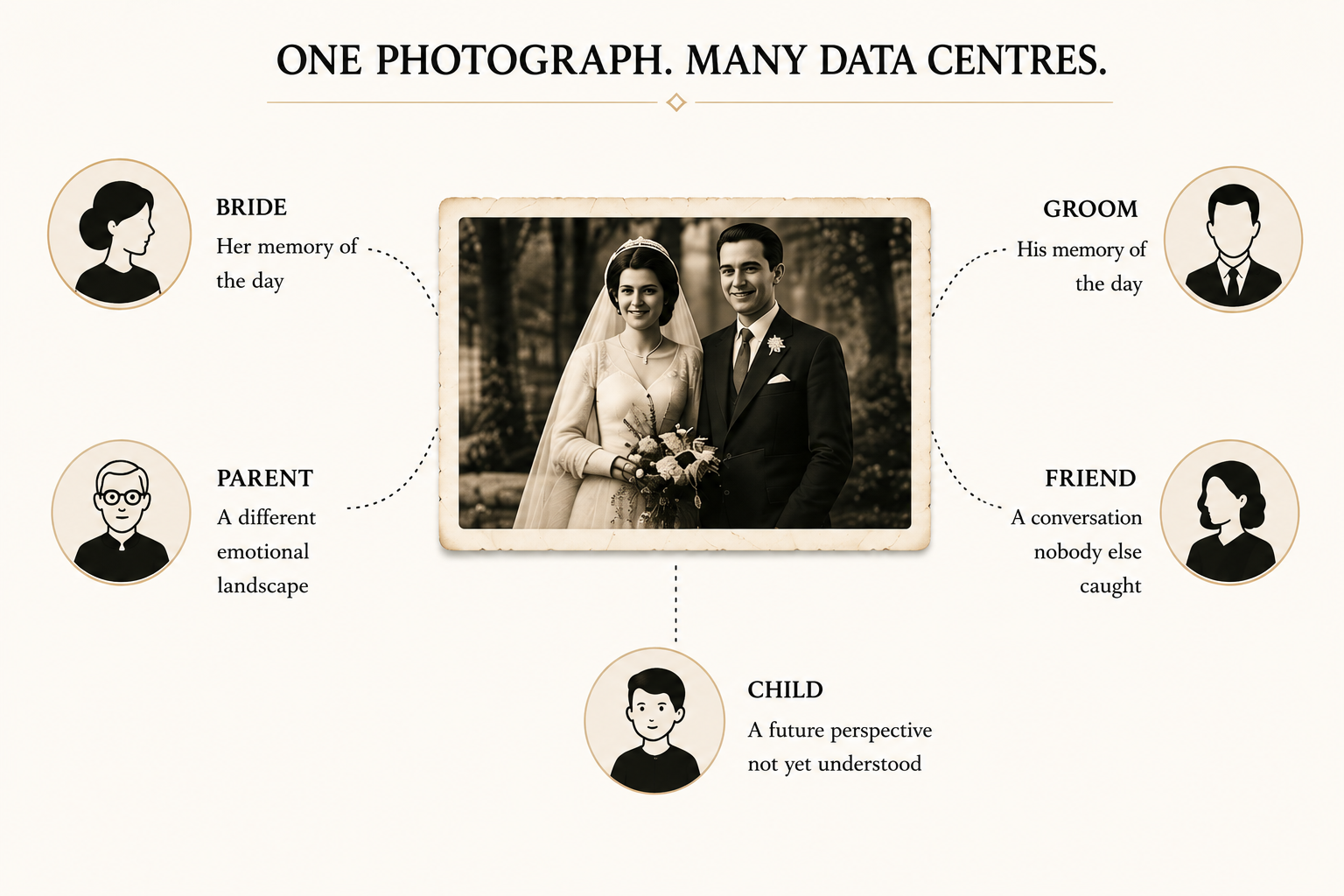
Consequently, no single person ever possesses the complete story. We store fragments—fragments of context, fragments of understanding, fragments of meaning.
The more perspectives we preserve, the richer our history becomes.
A wedding photograph connected to a single perspective preserves an event. The same photograph connected to twenty perspectives preserves a community.
This explains why some archives feel alive while others feel cold: the difference is rarely the volume of photographs, but the volume of perspectives attached to them.
A collection of raw, unpolished smartphone photos gathered from a hundred guests can reveal far more than a perfectly polished professional album. Not because the images are technically superior, but because the number of human data centres connected to the event has multiplied.
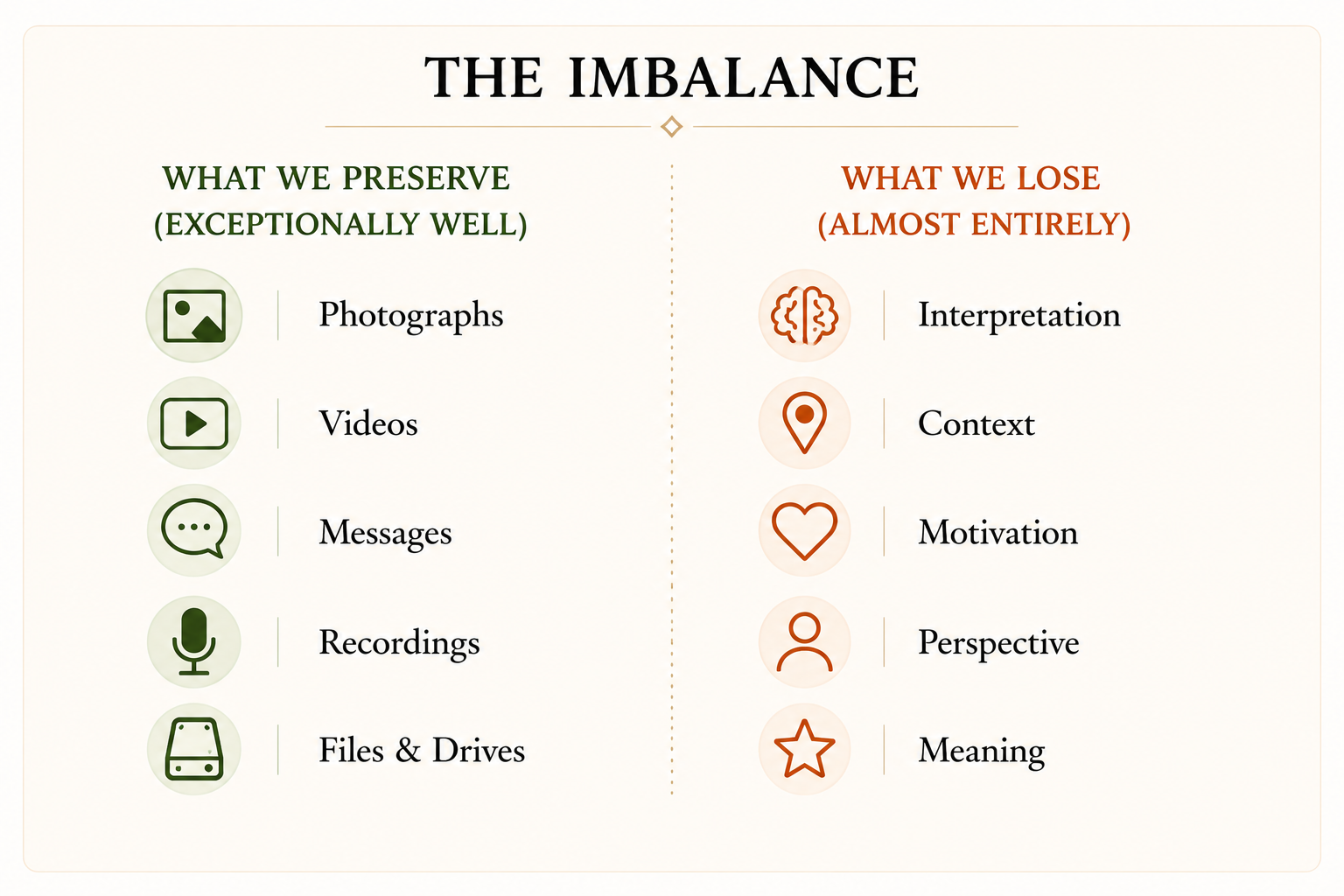
This reveals an imbalance hidden within modern technology.
We have become exceptionally good at preserving keys. We hoard terabytes of files, messages, and recordings.
Yet, we invest almost no effort in preserving the perspectives those keys are meant to unlock.
Historically, this balance was maintained through oral traditions, slow conversations, and the repetitive retelling of family lore.
Photographs were passed around physical tables; questions were asked; context was organically mapped. The key and the data centre remained tethered.
Today, we preserve the artefact while neglecting the interpretation. The file survives, but the perspective evaporates.
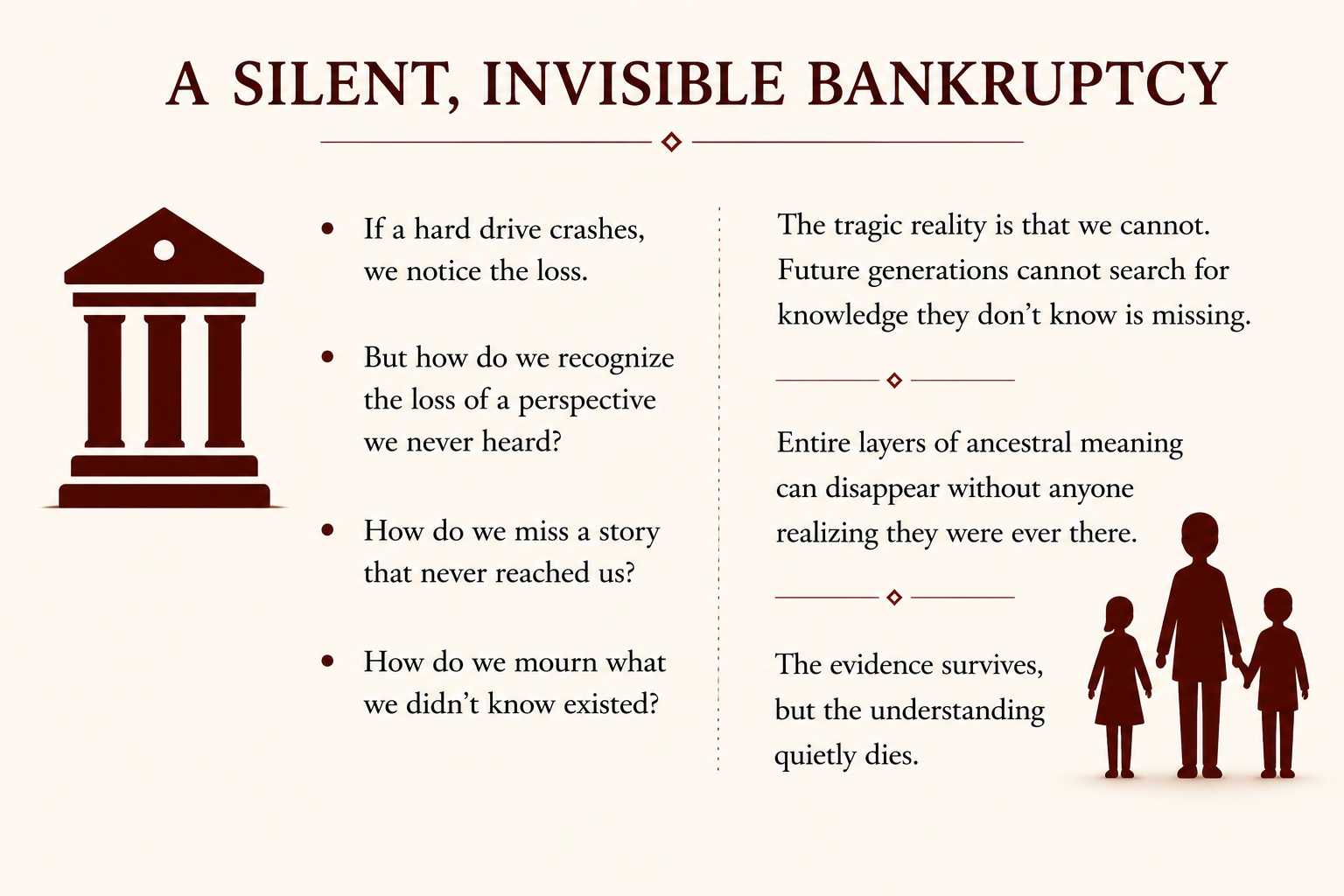
This creates a silent, invisible form of bankruptcy.
If a hard drive crashes, we notice the loss.
But how do we recognise the loss of a perspective we never heard?
How do we miss a story that never reached us?
How do we mourn what we didn't know existed?
The tragic reality is that we cannot.
Future generations cannot search for knowledge they don't know is missing. Entire layers of ancestral meaning can disappear without anyone realising they were ever there.
The evidence survives, but the understanding quietly dies.
Preservation is not simply about hoarding keys.
It is about protecting access to the human data centres those keys were built to open.
Because the richest stories are never stored in photographs.They are stored in people.