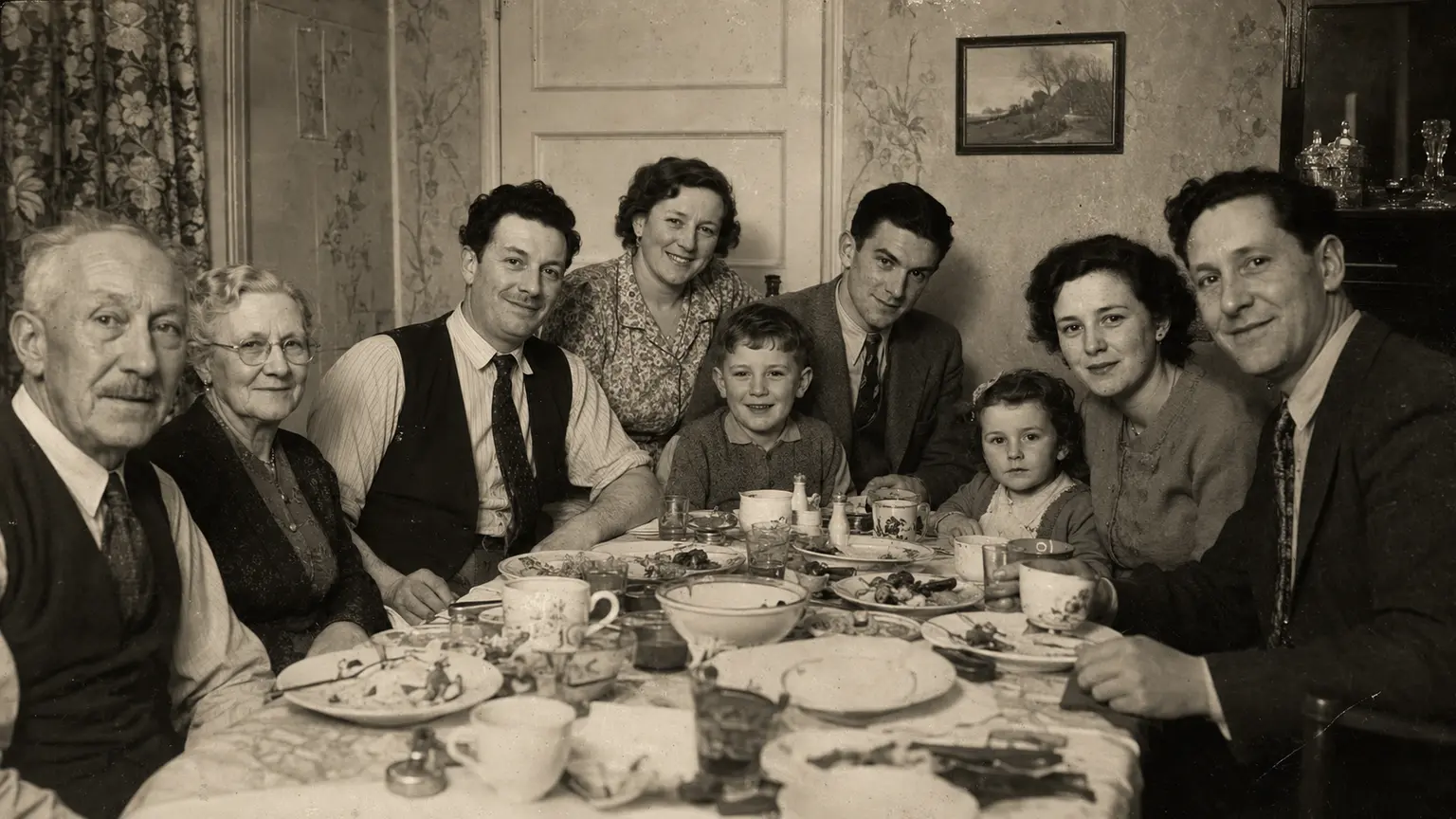
A parent assumes they will tell the story later, a grandparent assumes the family already knows and children assume there will always be time to ask.
At the time, nobody is being careless and nobody is making a conscious decision to let a memory disappear, but the loss happens through assumption.
Stories feel obvious because the people who lived them are still here.
The photograph feels self-explanatory because everyone recognises the faces.
The context feels permanent because the people carrying it are still present, but the problem is that context often lives inside people rather than records and when a photograph survives for a century, the understanding attached to it may survive only as long as the person who remembers it.
This is the dangerous illusion.
The closer we are to a memory, the more permanent it appears but, in reality, many memories are far more fragile than they seem.
Consider a Family Photograph
Everyone gathered around the table knows:
Who the people are and why they’re together, the connections between them and the moments that followed, the jokes, the significance of the occasion and, most importantly, the real relationships between them.
Nobody feels the need to explain any of it because everybody already knows.
Then time passes, the children grow up and relatives move away.
Naturally people lose contact as time creates distance and people forget.
Eventually somebody discovers the same photograph and asks a simple question:
Who is this?
The photograph survived but the understanding did not, the connections have been lost and so did the continuity and without that the whole story is incomplete.
This is the Assumption Problem.
The belief that understanding will naturally survive simply because the record survives.
History suggests otherwise.
Many continuity failures begin with a simple assumption.
Not neglect.
Not technology.
Not storage failure.
Assumption.
The irony is that the memories most at risk are often not the dramatic ones.
Major events are usually discussed, recorded and revisited.
The memories most likely to disappear are often the ordinary ones that seem insignificant, the jokes and family traditions, the moments behind photographs because everybody assumes they will always be remembered and while that may be true, the importance is not in the moment alone.
Years later, the meaning becomes central to the moment and provides future generations with the ability to relive more than the image itself.
Yet these are often the very things future generations wish they knew.
This is why continuity requires intention, not because people do not care but because caring and preserving are not the same thing.
A memory can be deeply loved and still disappear.
Not through neglect.
Through assumption.
And once the last person who carries that understanding is gone, recovering it becomes remarkably difficult.
The record may remain.
The continuity may not.