Walk into almost any family home and you will find thousands of memories.
Photographs. Videos. Messages exchanged over decades. Social media profiles. Family group chats. And then there’s all of the physical stuff.
Boxes of old photographs. USB drives and hard drives. Old laptops. Email accounts.
I could go on, but I suspect you get the picture.
The modern family possesses more recorded memories than any generation in human history.
Yet despite this abundance, something important is quietly disappearing.
Understanding.
Modern families have millions of keys, but their data centres are disappearing.
The Photo Is Not The Memory
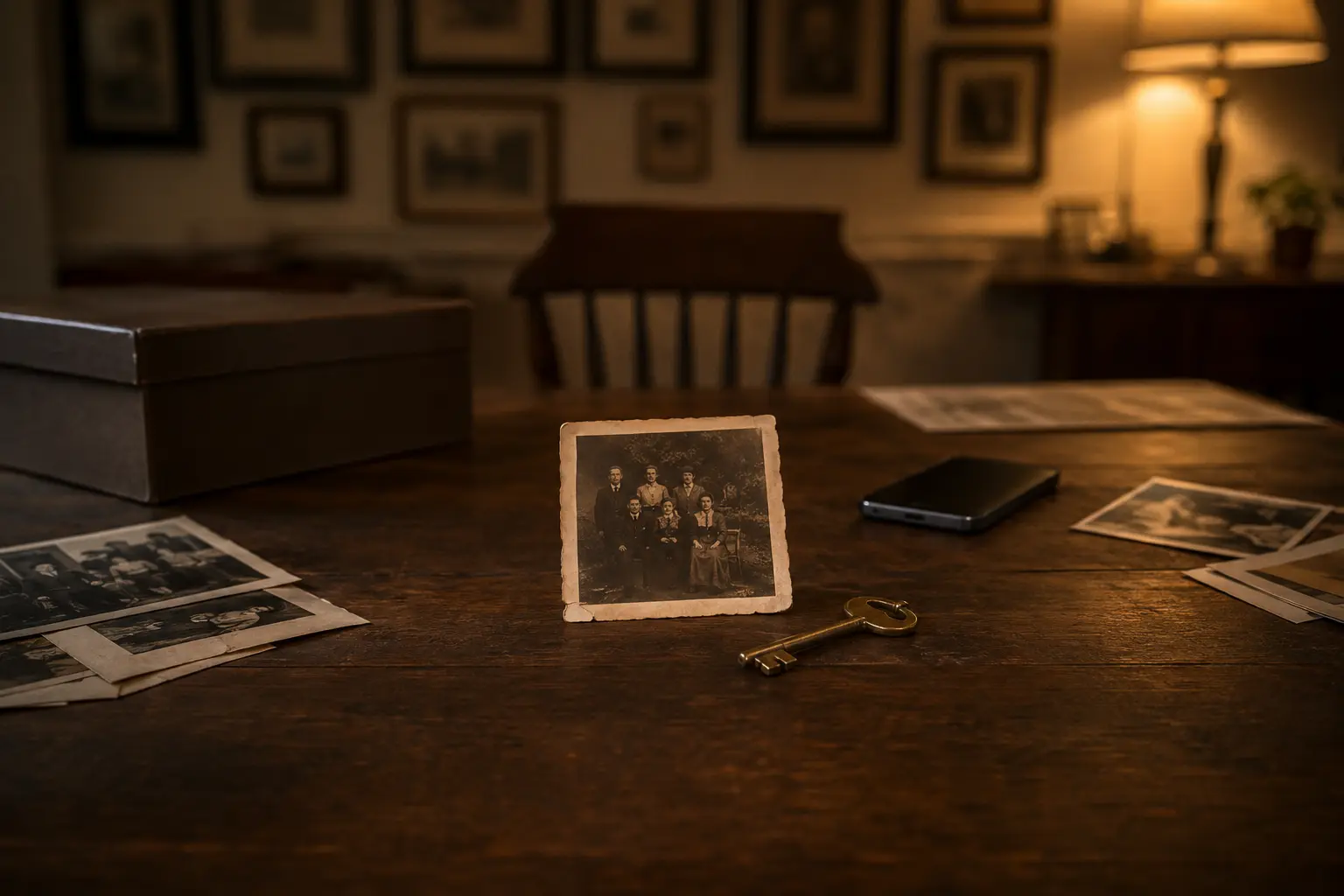
When people think about preserving memories, they often focus on photographs, and this is understandable. Photographs feel permanent. They can be copied, backed up and shared. But photographs are not memories. They are the keys. A photograph unlocks information stored elsewhere, in the data centre of the mind.
What’s really special about a photograph is that it can trigger different memories for different people. Both may be correct. Like a jigsaw puzzle, the more perspectives you gather, the more meaningful the overall picture becomes.
THE KEY
Photograph
Copied. Backed up. Shared.
THE DATA CENTRE
People
Context. Perspective. Meaning.
The key can survive while the data centre disappears.
The Family Data Centre
The place where that information is stored is not usually a hard drive. It is people. Parents. Grandparents. Aunts. Uncles. Friends. Together, they form a distributed network of understanding. A human data centre.
No single person possesses the entire archive. Yet collectively they often hold far more than any photograph ever could. But you still need the key.
The Invisible Risk
Families spend time protecting photographs. They back up phones. Pay for cloud storage. Buy external hard drives. Create albums. Print books. Yet few families spend the same amount of time protecting context.
Who is identifying the people in old photographs? Who is recording the stories behind them? Who is explaining why certain moments mattered? Who is preserving perspective?
The result is that many families successfully preserve the keys while unintentionally losing access to what those keys unlock.
The Assumption Trap
Most of the time, nobody does. As a result, continuity failures often begin with a simple assumption. Not neglect. Assumption.
What Future Generations Actually Inherit
Imagine a grandchild discovering a photograph fifty years from now. The image survives perfectly. Nothing has been lost. Yet they still ask: Who is this? Why were they important? What happened next? Why was this photograph worth keeping?
The key survived. The data centre did not.
Why This Is Happening
Technology has become remarkably good at preserving records. The challenge is that understanding has always lived inside people. And people are temporary.
Beyond Storage
The more difficult challenge is preserving enough understanding for those records to remain meaningful. This requires more than storage. More than backup. More than file survival. It requires continuity.
The Real Question
The modern family does not suffer from a shortage of memories. It suffers from a shortage of continuity.
Will anybody still understand them?
Because a photograph is rarely the memory itself. More often, it is only the key. And every year, more of the data centres disappear.