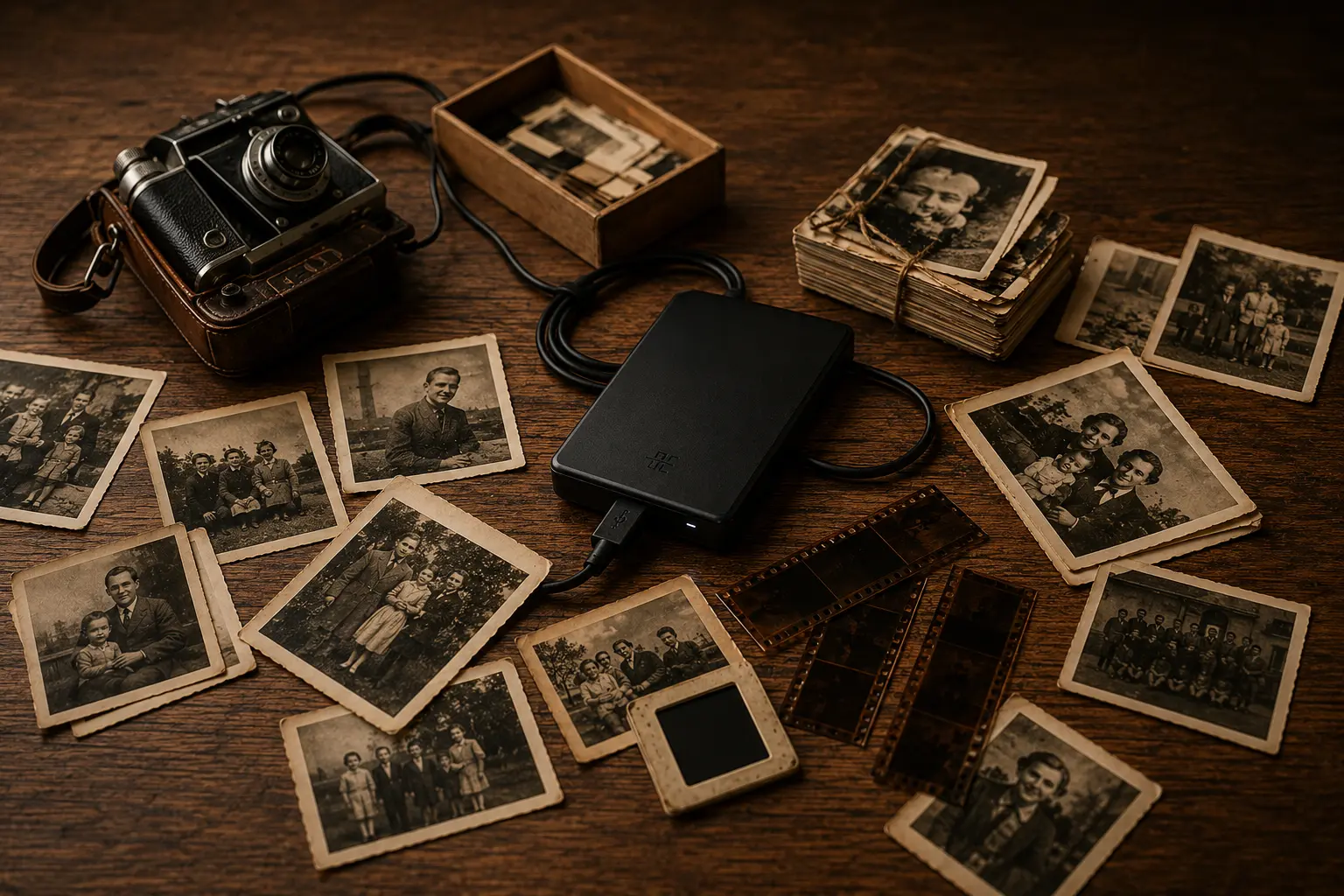
Let’s set the scene, Imagine somebody hands you a hard drive, it contains your family history.
Inside 200,000 photographs, thousands of videos, decades of documents, messages and recordings and at first this sounds like a remarkable gift.
Then reality begins to set in.
Where do you start?
Who are these people and when were these photographs taken?
Which ones are important and how do you begin discovering the stories that matter most?
What you’re actually looking at is an archive that’s survived, but understanding has not.
This is the Abundance Problem.
For most of human history, preservation was constrained by scarcity.
Photographs and film cost money.
Safe storage was difficult so as a result, selection was unavoidable. People naturally made decisions about what was worth preserving.
A photograph often represented a moment that felt important enough to keep and when names were written on the back with dates moments made more sense, stories and events could be remembered with less friction.
Today those constraints have largely disappeared.
A photograph can be taken instantly.
A video can be recorded in seconds.
Storage is abundant.
The cost of preservation is negligible and at first glance this appears to be an extraordinary victory for continuity. We can preserve more so surely we can remember more, Right?
Yet abundance has created a problem of its own.
The problem is not the quantity, it’s what quantity changed - When everything can be preserved, the need to select begins to disappear and interpretation often disappears with it.
A photograph is saved but never labelled.
A video is recorded but never explained.
A folder is created but never organised.
The moment survives, but the meaning becomes harder to find.
The burden and responsibility of interpretation has been passed from the creator to the discoverer.
The person preserving the archive no longer explains what matters and while unintentional expects the future discoverer to work it out for themselves.
That may sound reasonable but I would argue it is not. Let’s compare two collections.
The first box contains hundreds of photographs, hard drive & USB sticks, tapes recordings with no names, dates, locations or context.
The second contains a much smaller collection but photographs have names written on the back, accompanied by letters explaining relationships. The recording labels describe what they contain.
I suspect most people would choose the second collection.
Not because it contains more information but because it contains more understanding, it’s a well-presented collection that tells a story.
One invites discovery, the other creates friction, work and confusion.
This matters because discovery is a journey into another time and place.
The moment of rediscovery is trying to understand a life, a relationship or a moment in time.
They are not looking for files.
They are looking for meaning.
A photograph with a name, a date and a short message can provide a doorway into a much larger story.
A photograph without context often is a mystery.
Both are preserved but only one can be interpreted.
Technology has accelerated this problem.
The effort required to capture a moment has almost disappeared and when combined with modern habits we optimise for the present rather than also preserving enough understanding for future rediscovery.
The people viewing the photograph today already know the story.
They know who is present and what happened.
Context feels unnecessary because everybody involved already understands it.
The problem appears years later when the original audience has gone.
Future discoverers inherit the photograph but not the explanation.
Meaning exists but fails in the moment.
The effort required to uncover it has increased but not all preserved moments carry equal rediscovery value and these create clutter and friction.
Moments that possess greater gravity like, Weddings, Births and Major achievements already contain context and emotional significance and provide stronger starting point for continuity and rediscovery.
This doesn’t mean ordinary moments have no value, the challenge is to preserve meaning more effectively.
Abundance has given us the ability to preserve almost everything with the deeper meaning and in doing so the opposite has happened.
The archive has become larger but the burden of interpretation has become heavier.
And the greater the volume becomes, the more important meaning, context and storytelling become.
Because continuity is not measured by how much survives.
It is measured by how much can still be understood.