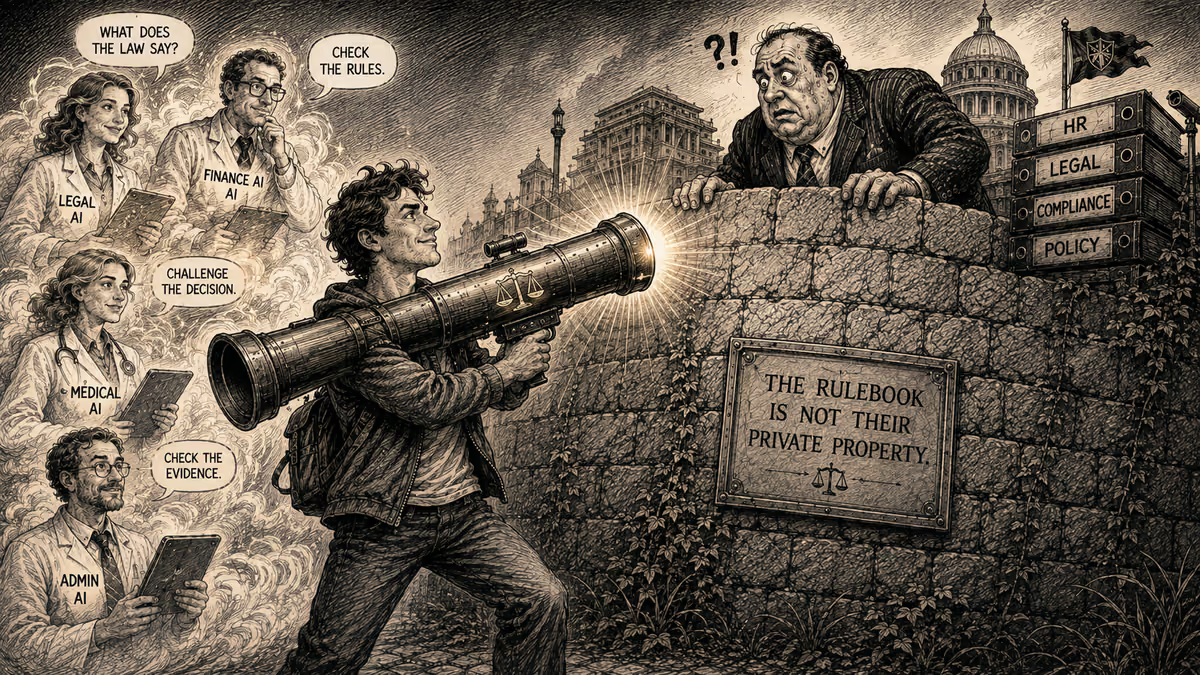
When David Got a Bazooka
AI is not changing the rules. It is changing who can understand them—and giving ordinary people access to the same rulebook as powerful institutions.
I recently used AI to challenge a parking fine, and in minutes it gave me access to regulations, policy and structured expertise that would once have required hours of research or professional advice.
Whether I win or lose is almost irrelevant.
What mattered was what happened before I pressed send.
Like most people, I consider myself reasonably capable. I am confident that I understand contracts, having spent decades in the motor industry, and I know reasonably well how companies tend to operate. Yet within minutes AI had helped me research the relevant regulations, question assumptions, identify weaknesses in the company’s position and organise my thoughts into a clear, coherent challenge.
It did not tell me I was right or guarantee success.
It simply gave me access to a level of capability that, until recently, would have required hours of research, specialist knowledge or professional advice.
As I read through the finished response, I realised something.
This was not really about a parking fine.
David had just been handed a bazooka.
For centuries, power has not simply belonged to those with money, but to those with expertise.
Large organisations employed legal departments, compliance teams, human resources specialists, consultants and advisers. Ordinary people rarely had access to any of them. Even when the law was on their side, challenging a decision often required time, confidence and resources that many simply did not possess.
Most people did not lose because they were wrong.
They lost because fighting back was too expensive.
AI quietly changes that equation.
Not by changing the law or creating new rights.
But by placing an adviser beside the individual.
For the first time, an ordinary person can ask:
“Is this correct?”
“What does the law actually say?”
“Have I misunderstood this?”
“Help me challenge it.”
That is a profound shift.
The Capability Divide
The mistake is to believe AI is making people more intelligent.
It is not.
Nor is it automatically making people more capable.
AI provides access to capability.
The individual must still recognise when something feels wrong, ask the right questions, challenge the answers and ultimately decide what to do.
AI supplies the capability, but humans supply the judgement.
That distinction matters because it suggests the next divide in society may not be wealth, education or even access to AI itself.
It may be something else.
Capability inequality.
Two people can sit in front of exactly the same AI.
One asks:
“Write my appeal.”
The other asks:
“Research the legislation. Find weaknesses in my argument. Tell me how the company is likely to respond. Challenge my assumptions before I send it.”
The technology is identical.
The outcome is not.
The Same Rulebook
At first, it feels as though David has been handed a bazooka.
A weapon powerful enough to level the playing field.
But perhaps that is not quite what has happened.
Goliath is not unsettled because David has found a bigger weapon.
He is unsettled because David finally has access to the same rulebook.
The rules were never truly hidden.
Employment law existed.
Consumer rights existed.
Regulations existed.
The problem was that understanding them required expertise that most individuals did not have.
Organisations employed specialists.
Individuals usually did not.
AI begins to close that gap.
David did not receive new rights.
He discovered the rights he already had.
That changes the balance of power.
Not because David has become more intelligent.
But because Goliath realises David no longer stands alone.
The Institutional Shift
If this continues, organisations themselves may begin to change.
Today, many decisions rely on friction.
People do not complain.
They do not appeal.
They do not understand the regulations, so they accept the outcome.
AI removes much of that friction.
An employer receives a grievance. Its own systems may conclude that the employee has a strong legal position.
An insurer receives a complaint. Its AI may identify regulatory weaknesses before the case reaches an ombudsman.
A public body makes a decision. The published policy can be examined, compared and challenged within minutes.
The question changes.
Instead of asking:
“Can we get away with this?”
An organisation may increasingly ask:
“Can we defend this?”
That is a subtle but important shift.
They had the lawyers.
HR specialists.
Compliance teams.
Above all, they had time.
The individual often had little more than instinct.
AI does not remove the need for expertise, but it gives ordinary people enough understanding to recognise when expertise should be questioned.
That raises the cost of bluff.
It raises the cost of unnecessary disputes.
And it increases the value of honesty, transparency and early resolution.
Perhaps the greatest impact of AI will not be that more people win arguments.
Perhaps it will be that many arguments never need to happen.
The bazooka changes the balance of power precisely because it may never need to be fired.
A Quiet Revolution
The consequences extend far beyond parking fines, employment disputes or insurance claims.
Every institution is built upon rules.
Governments.
Local councils.
Banks.
Healthcare.
Law enforcement.
For generations, those rules have existed, but understanding them has often required experience, training or professional advice.
AI begins to reduce that barrier.
A police officer can check the legal power they are about to exercise.
A citizen can ask whether that power has been correctly applied.
A doctor and patient can discuss treatment while both understand the relevant clinical guidance.
A councillor can explain a planning decision that can be compared against published policy.
The important point is not that AI replaces expertise.
It does not.
The important point is that both sides increasingly begin from the same foundation.
The same rulebook.
The same legislation.
The same published guidance.
History rarely changes in a single moment.
It changes when millions of ordinary people begin behaving differently.
The printing press did not change the world because paper improved.
It changed the world because knowledge spread.
The internet did not change society simply because information became digital.
It changed society because access became widespread.
Artificial intelligence may prove to be another of those moments.
Not because it changes the rules or replaces experts.
But because it distributes understanding to people who never had access to it before.
The future will not belong to those who merely possess AI.
It will belong to those who learn how to question it, challenge it and think alongside it.
That may become the next great divide.
Not wealth inequality.
Not information inequality.
But capability inequality.
If that proves true, we may look back on this decade and realise that the real revolution was not artificial intelligence itself.
It was the moment David received the same rulebook as Goliath.
And once Goliath understood that, the bazooka no longer needed to be fired.