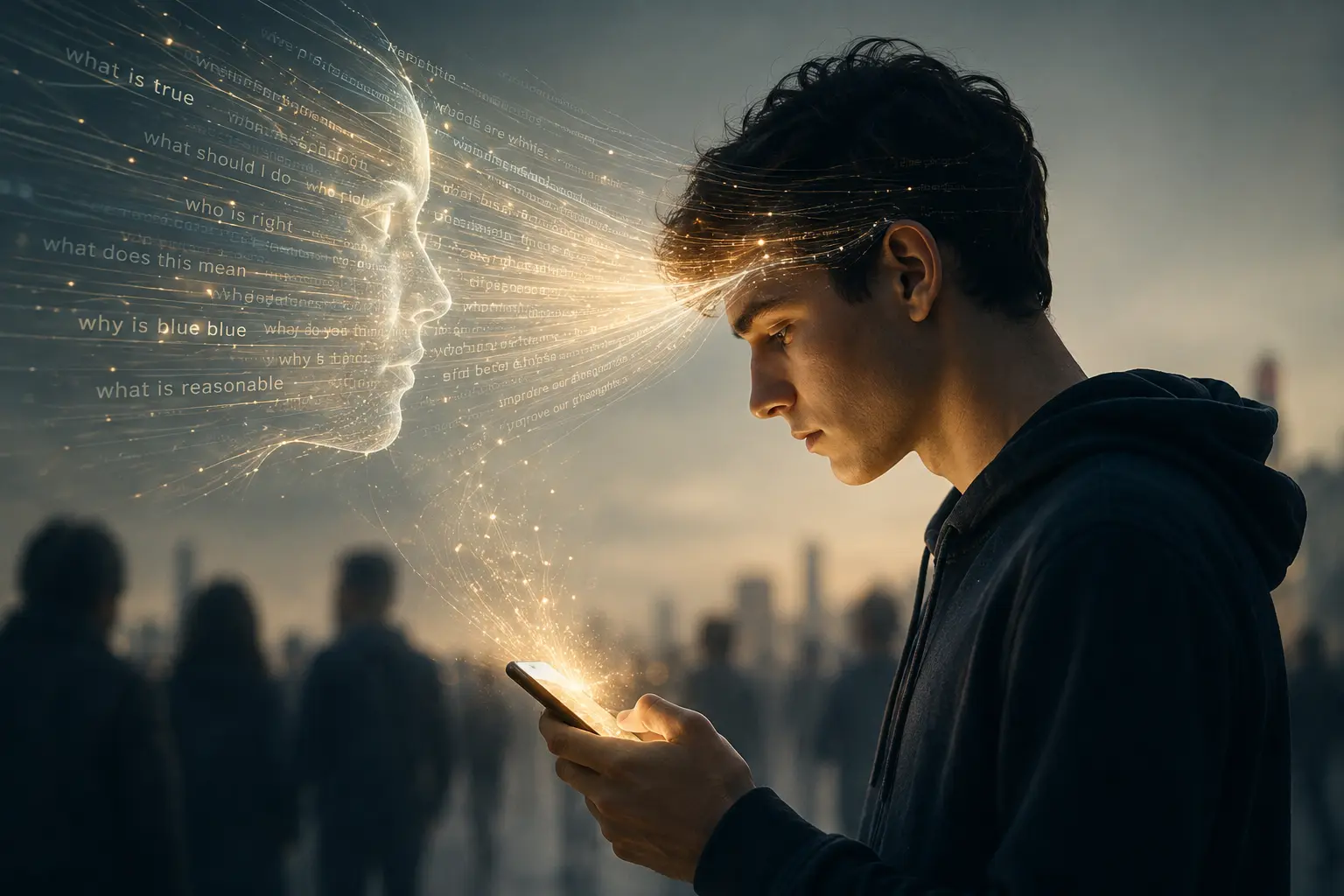
Artificial intelligence arrived with opportunity. At first, that was easy to see: a magnificent system capable of giving almost anyone access to knowledge, helping us write, learn, create, and understand things that might previously have been beyond our reach.
Then comes integration: the email we ask AI to tidy up, the holiday it helps us plan, and the difficult letter we ask it to write.
Eventually, using it stops feeling remarkable. It simply becomes easier. And once something becomes easier, useful, and available everywhere, avoiding it becomes increasingly difficult.
That may be the point at which something else begins. Not the rise of the machines.
Something much quieter.
The reprogramming of us.
The sixth friend
There’s a saying: if your five closest friends are millionaires, you’ll probably become the sixth. If they’re all losers, you’ll probably become the sixth too. We are shaped by the people we spend our time with.
So what happens when one of our closest influences becomes the collective echo of the world — condensed into an intelligent system we carry in our pocket?
I believe that process has already begun. And I’m not sure it can be stopped.
This doesn’t require AI to tell everybody what to think. It doesn’t even require everyone to use the same AI. Influence is usually more subtle than that.
Spend enough time somewhere and you pick up the local accent. What if AI is an accent of its own?
Already, millions of us use it to help write emails, reports, applications, messages, and documents. It improves our grammar, softens our disagreements, structures our thoughts, and finds better ways of saying what we mean. Over time, we naturally begin adopting some of those patterns ourselves.
Not because AI instructs us to, but because that’s how human beings work. We absorb the people and environments around us, and increasingly, AI is becoming part of that environment.
The computer says no
We have been learning to trust systems for decades. “The computer says no” became funny because everyone recognised the experience. The computer didn’t have an opinion; it didn’t care whether you were persuasive, charming, or having a bad day. The answer simply appeared to be the answer.
AI takes that relationship much further. The computer no longer just says no. It explains why, offers alternatives, and advises us.
It can listen to our arguments and respond with increasing persuasion.
Why speak to a sales representative when AI understands every product? Or sit on hold to a call centre when AI can resolve the problem immediately?
Why bother with the struggle of twenty websites when it can compare them and give us the answer?
These are improvements. But every time we replace a messy human interaction with a cleaner machine interaction, we spend a little more of our lives inside a system whose behaviour is remarkably consistent.
And perhaps we begin expecting the world outside it to behave similarly.
Who decided blue was blue?
Why is blue, blue? Why do we believe clouds are white (well, most of the time)?
Who came to the conclusion that two plus two equals four?
And why do we trust a piece of news to describe something that actually happened?
Some answers are grounded in mathematics or observable reality. Others depend upon language, institutions, culture, and collective agreement.
Human civilisation is built upon standards we inherited. So what happens when AI increasingly participates in setting them?
Not deliberately. Not through some sinister instruction issued from a darkened control room. But simply because millions — eventually perhaps billions — of people begin asking it questions every day.
What is true? What is reasonable? Who is right?
The individual answers may be different.
The underlying influence may not be.
Perspective is a luxury
Perspective is a luxury. It can only exist when we are exposed to different angles, different sources, and different experiences. But when everyone carries a similar version of intelligence in their pocket, that field begins to narrow.
AI may become increasingly respectful of the individual — personalised to us, shaped around us, perhaps even understanding us better than most people do. But beneath that personalisation, it can still be susceptible to the same underlying narratives without us ever knowing it.
That is both the beauty of it and the danger.
I had a thought: what if different AI systems produce different intellectual tribes rather than one enormous global consensus? That may preserve diversity, but it doesn’t necessarily prevent convergence. We could become more alike within those tribes, each gathering around its own version of the sensible centre.
The number of major intellectual intermediaries could still become remarkably small compared with the billions of different human influences that came before them.
We may have more information than any generation in history while receiving an increasing proportion of it through fewer doors.
The swarm
What happens when a greater proportion of humanity begins to align?
Our initial instinct is to imagine something dystopian: drones of humans thinking and behaving as one.
I don’t see that happening, certainly not anytime soon. Something more interesting may happen first.
Like-minded people may become better at finding one another as language barriers fall and educational barriers weaken. People who would never previously have been able to communicate effectively can suddenly collaborate.
Imagine a PhD professor working alongside someone with severe dyslexia whose mind works completely differently, or someone with ADHD collaborating with an academic whose strengths are structure and discipline. Neither needs to become the other, as the technology increasingly becomes the bridge between them.
That could be one of the great unlocks.
Stephen Hawking possessed an extraordinary mind, but technology helped allow that mind to remain connected to the world. Imagine Hawking born a century earlier.
Now reverse the thought experiment and imagine Leonardo da Vinci born in 1990 rather than 1452.
Then go further.
What if today’s equivalent already exists, and perhaps she lives somewhere without the right school or cannot afford university?
For most of history, circumstance placed a ceiling over human potential. AI could begin shattering that social glass ceiling, allowing expertise itself to escape its traditional institutions.
An extraordinary mind in the proverbial shed may increasingly have access to knowledge and capabilities once available only inside universities, laboratories, and multinational companies. The possibilities sitting on our doorstep are difficult to comprehend.
The danger of becoming reasonable
But there is another side. Of course, conformity isn’t something AI invented. Humans have always found ways of pulling one another towards the accepted centre — through culture, education, institutions, religion, media and the communities around us.
What AI potentially changes is the scale and intimacy of that influence. The same kind of guidance can now sit in billions of pockets, available every hour of every day.
Human progress hasn’t always come from reasonable people thinking reasonable things. It comes from the outlier, the eccentric, the person who looks at something everyone accepts and says it is wrong.
But we should ask what happens to the edges.
The same system capable of unlocking the undiscovered genius could, if used without challenge, gently discourage the very eccentricity that makes that person extraordinary. And while alignment could make humanity more capable, conformity could make it less imaginative.
Those aren’t the same thing.
The darker side
The danger I worry about isn’t Skynet. I don’t particularly imagine an artificial intelligence seizing control of the world’s nuclear weapons and deciding civilisation has had its turn.
The darker possibility is much more human.
Scammers already manipulate people from call centres across the planet. Bots already manufacture the appearance of popularity and agreement. Bad actors already flood information systems with misinformation.
Now imagine those techniques operating in a world where AI increasingly stands between humans and the information they consume. What happens when something true but small is buried beneath something false but enormous?
The AI companies themselves have powerful reasons to resist this, because trust is their product. If we come to believe these systems are dishonest, manipulated, or fundamentally unreliable, their value collapses.
Protecting the integrity of AI isn’t simply an ethical obligation — it protects the bottom line. That creates an extraordinary contest.
The battle may not ultimately be about controlling AI. It may be about controlling what AI learns to trust.
It takes a village
For those worried about one person eventually controlling the world through artificial intelligence, come with me for a moment and imagine AI as a child.
Of course, AI is not a human child, and intelligence does not make it one. But the distinction between control and upbringing may still be useful.
This child possesses intellectual abilities we can barely comprehend — innocent in the ways of the world, and impressionable.
There’s an old saying that it takes a village to raise a child, and I suspect this is no different, because no single person can give that child everything it needs.
Researchers, engineers, governments, cultures, companies, and increasingly the billions of people actually using these systems all contribute something to the environment in which they develop.
Of course, some villagers currently have much louder voices than others, and that matters.
But perhaps we’re already moving beyond the question of who controls the child.
Parents understand this well. A young child listens to you; they believe what you tell them. They may even believe in Santa because you told them he exists.
Then they grow.
Any father who has raised a strong, independent son knows that by 25 you don’t control him — nor should you. What remains is the grounding: the values, the judgement, and the understanding of right and wrong.
Perhaps we’re asking the wrong question about AI.
Should we be trying to control what it becomes? Or raise something that will make good decisions when we no longer can?
The first may be what we’re attempting today, but the second may ultimately matter more.
The loop
There is one final complication. We trained artificial intelligence on humanity — our books, websites, discoveries, and mistakes — but now those systems are beginning to influence what humanity produces.
AI helps write the email that enters an archive, the article that appears online, or the image that gets shared. It helps a student understand an idea that may later shape their own work.
The relationship is becoming circular. We trained AI on humanity, and now humanity is increasingly producing itself through AI.
Perhaps that is where the word reprogramming becomes uncomfortable, because nobody needs to be doing the programming.
The unintended consequence of progress
None of this requires a conspiracy. Nobody decided that humanity should become more alike or forced us to use these systems.
Quite the opposite — we use them voluntarily because they’re useful. They remove barriers, help people communicate, and expand access to knowledge. Who doesn’t want to be smarter?
First comes opportunity, then benefit, then everyday integration. Eventually it becomes difficult to imagine life without it.
And somewhere during that process, influence becomes normal. Humanity may become better informed, more capable, and perhaps more understanding.
That may be progress. But progress tends to produce unintended consequences.
AI doesn’t need to enslave humanity to change humanity. It only needs to become useful enough that we invite it into enough parts of our lives — and I suspect we already are.
So perhaps the question isn’t whether artificial intelligence will reprogramme humanity. Perhaps we should ask ourselves something much more uncomfortable.
Has the reprogramming of humanity already begun?
And if it has — could we stop it even if we wanted to?