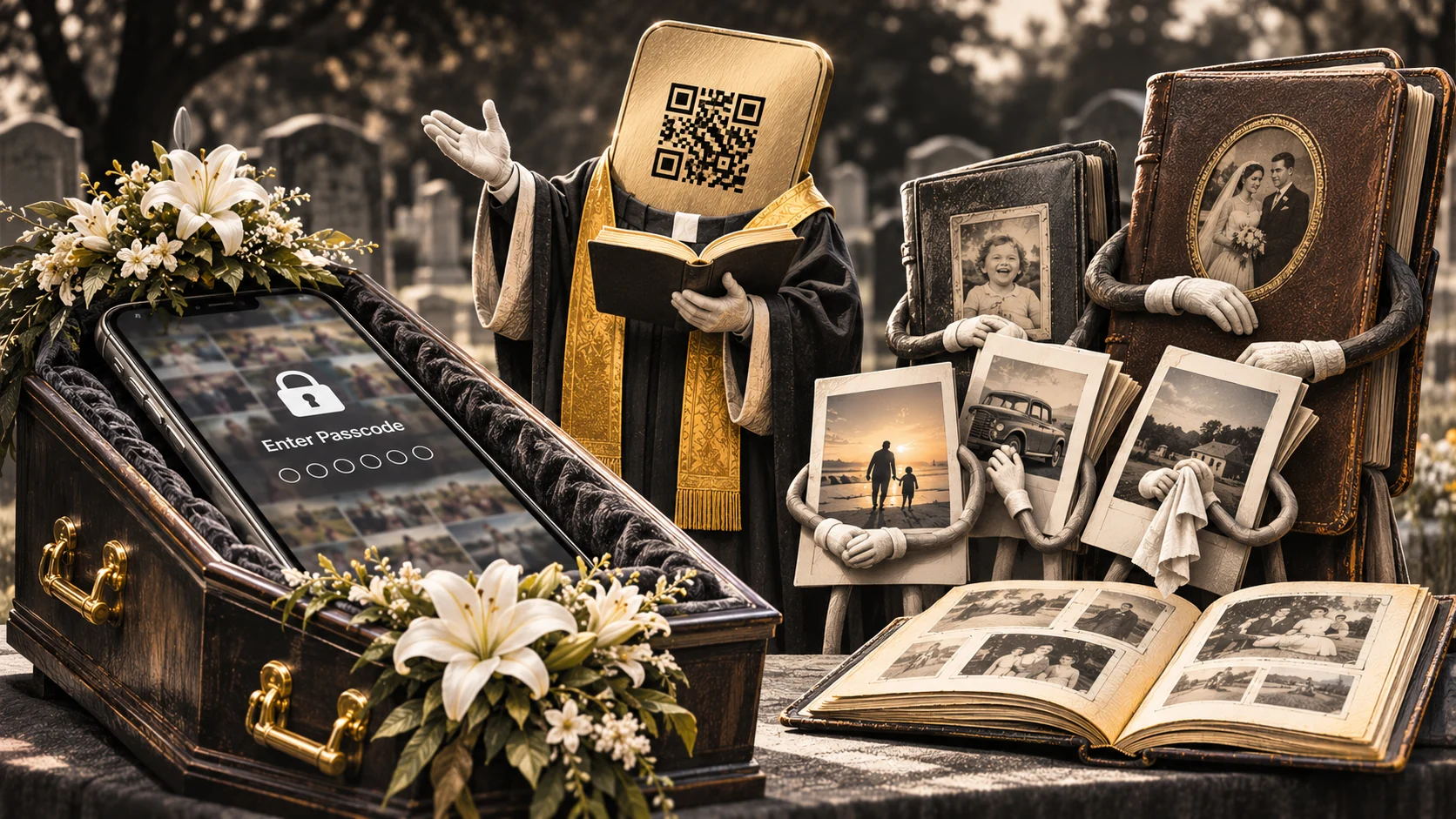
Come with me on an uncomfortable journey.
This is one of those subjects that sits alongside making a will. Something we know we should think about, but would rather put off.
Personally, I’ve spent a long time avoiding the thought that one day, my life will come to an end.
And when I think about it, that’s incredibly irresponsible of me. It’s not even in keeping with my normal character.
In everyday life, I’m organised. I like to have a plan A, and if that fails, plans B and C are already waiting in the wings.
So let’s imagine how we capture our lives in this modern, digital world.
The convenience of my mobile phone is staggering. I do almost everything on it.
But what would happen if tomorrow I was gone from this world?
That might sound like an odd question to ask, right?
But think about it for a moment.
All my photographs and memories are trapped behind Face ID. My social media accounts, emails, banking and so much of my life are protected by passwords and security systems.
Systems designed to protect me while I’m alive, but which could make life incredibly difficult for those I leave behind.
So if none of this can be accessed, what exactly do I leave behind?
In an instant, I could almost disappear from history. The people who loved me would be left trying to preserve whatever fragments of my life they could recover.
And unlike previous generations, there may be very little to physically hold on to.
We live in an increasingly digital and temporary world. Fewer physical photograph albums, fewer keepsakes, fewer things that can simply be passed from one generation to another.
We rent and subscribe to more, while buying and owning less.
Even our receipts and bank statements are digital now. So much of the paper trail that once documented our lives has disappeared into accounts and devices.
There is an obvious solution, of course.
Just give our loved ones unrestricted access to our digital devices.
Simple fix, right?
I don’t think so.
We all have a right to privacy. There are conversations, personal information and parts of our lives that we may not want to share, even with the people closest to us.
And that creates another problem.
How do we pass on the things we want our loved ones to inherit without giving them access to everything else?
How do we preserve our memories without surrendering our privacy?
The solutions can be surprisingly straightforward. But I suspect the lazy side in all of us will prevent many from actually doing anything about it.
That’s very human.
I’ve already written in detail about how we can protect our memories and digital legacy, so I won’t bore you by repeating it all here.
But perhaps I can give you a little nudge towards taking action.
Look at your partner, your children or even your grandchildren.
Now ask yourself something.
If you were no longer here to tell them, how would they even know that you had photographs worth finding?
How would they know about an insurance policy they might need, or where to find the important information you’ve left behind?
How would they know where to begin?
Perhaps you’ve been sensible enough to save everything on a hard drive somewhere in the house.
But where exactly is it? Would anyone know what to look for, or even that it exists?
And here’s one final question.
If you’ve saved thousands of photographs on a storage device, have you actually taken the time to organise them into something your family could appreciate and enjoy?
Or have you simply dumped your entire camera roll onto a drive and assumed that’s a job well done?
Because there’s a big difference between leaving someone a collection of files and leaving them something worth remembering.