The Memory Continuity Map brings the complete framework into one connected view.
It shows the force that separates memories from meaning, the different categories that preserve parts of our lives, and the six pillars required to keep understanding connected across generations.
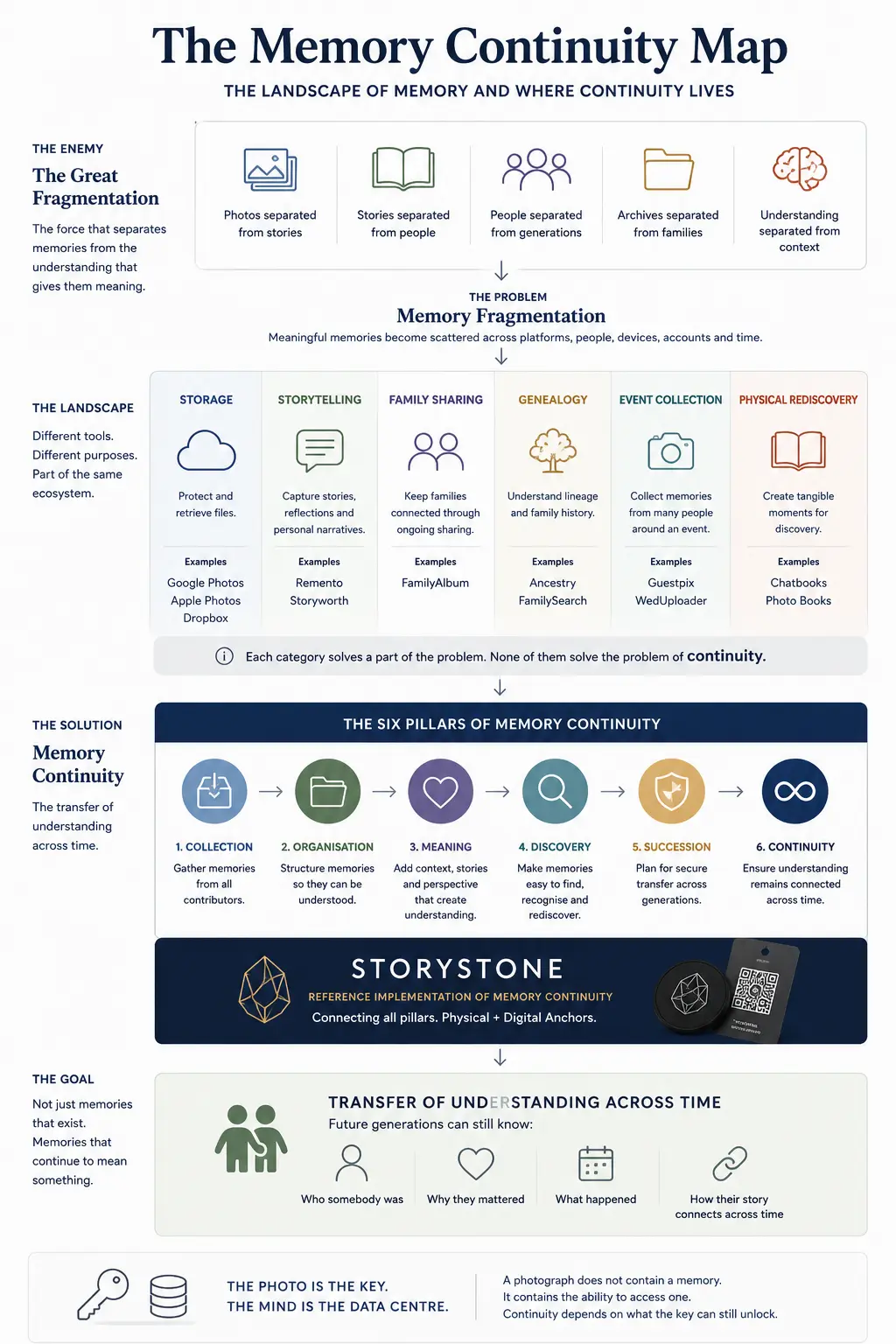 Open the complete map
The Enemy
The Enemy
The Great Fragmentation
The force that separates memories from the understanding that gives them meaning.
Separated from stories
Separated from people
Separated from generations
Separated from families
Separated from context
The Problem: Memory Fragmentation
Meaningful memories become scattered across platforms, people, devices, accounts and time.
The Memory Landscape
Different tools. Different purposes. Part of the same ecosystem.
Storage
Protect and retrieve files
Google Photos · Apple Photos · Dropbox
Storytelling
Capture stories and reflections
Remento · Storyworth
Family Sharing
Keep families connected
FamilyAlbum
Genealogy
Understand lineage and family history
Ancestry · FamilySearch
Event Collection
Collect memories from many people
Guestpix · WedUploader
Physical Rediscovery
Create tangible moments for discovery
Chatbooks · Photo Books
Each category solves a part of the problem.
None of them solve the problem of continuity.
The Six Pillars
Memory Continuity connects six pillars that must work together.
Collection
Gather memories from all contributors.
Organisation
Structure memories so they can be understood.
Meaning
Add context, stories and perspective that create understanding.
Discovery
Make memories easy to find, recognise and rediscover.
Succession
Plan for secure transfer across generations.
Continuity
Ensure understanding remains connected across time.
Explore the Six Pillars in detail →
Reference Implementation
Reference Implementation of Memory Continuity
Storystone
Connecting all pillars through physical and digital anchors.
Storystone is presented here as one practical implementation of the independent Memory Continuity framework—not as the framework itself.
The Goal
Not just memories that exist. Memories that continue to mean something.
Transfer of understanding across time
Future generations can still know:
The photo is the key.
The mind is the data centre.
A photograph does not contain a memory. It contains the ability to access one. Continuity depends on what the key can still unlock.