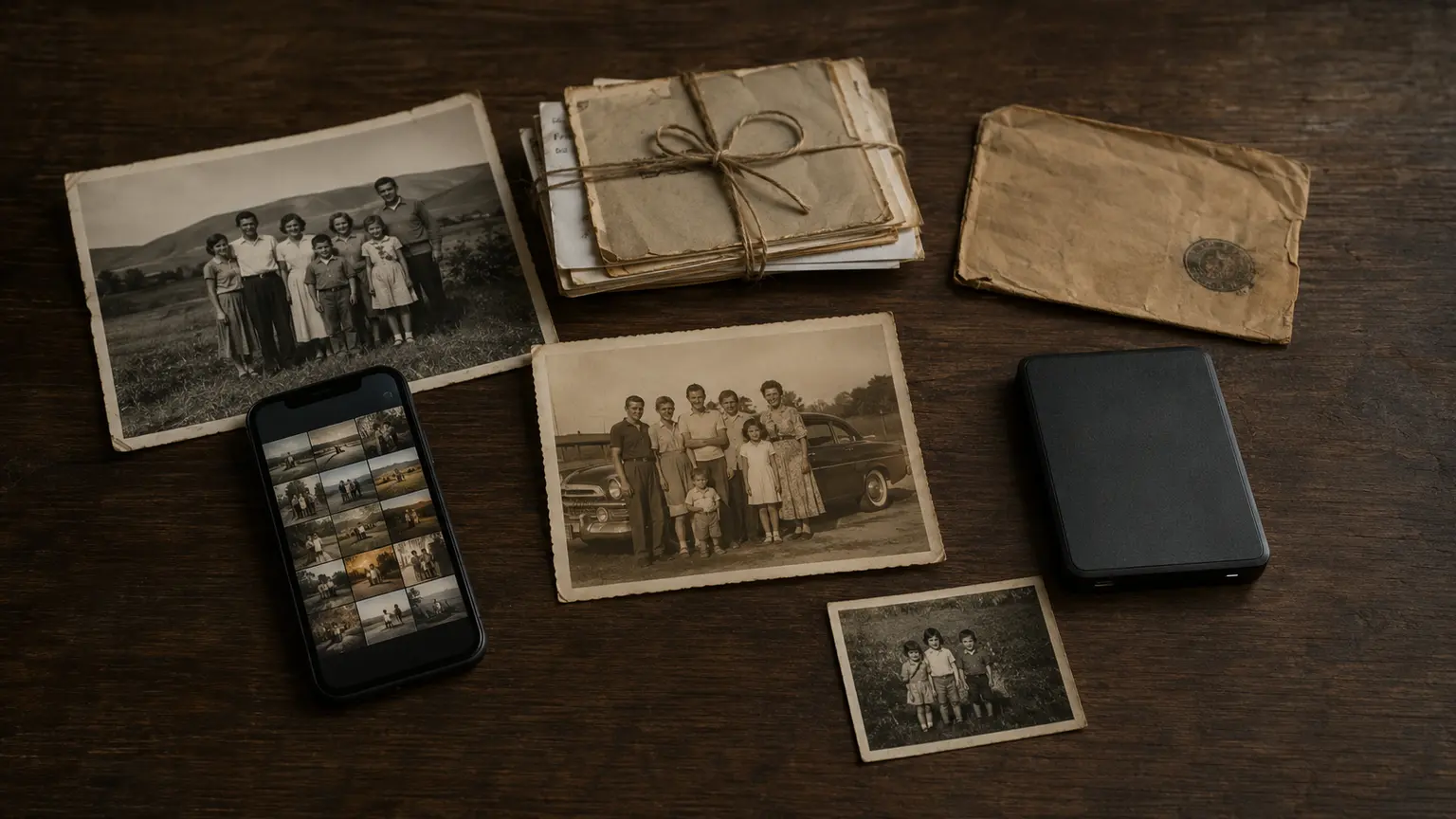
Every day, billions of photographs are taken, videos and messages uploaded.
Moments are documented in fine detail and our lives are archived in unprecedented detail.
On the surface, this appears to be a golden age of memory preservation, yet a closer look reveals a paradox.
Despite possessing more records than any generation before us, we may be becoming less capable of preserving understanding.
The problem is not necessarily that memories are disappearing.
The problem is that they are being separated.
This is The Great Fragmentation.
The Age of Unlimited Capture
For most of history, memory preservation was constrained by technology.
Photographs were expensive. Film was limited. Letters required effort, records were scarce, and most families possessed relatively small archives because creating them required intention.
Today, the opposite is true. We can capture almost everything.
A single smartphone can contain more photographs than an entire family might once have accumulated across multiple generations.
Storage has become abundant and the ability to capture has become effortless.
Documentation has become constant, yet abundance creates its own challenges.
The question is no longer whether we can record our lives.
The question is whether those records remain connected.
How Memories Become Fragmented
Memory rarely exists in a single place.
A photograph may be stored on a phone while the story behind it lives in the mind of a parent.
The names of the people pictured may be known only by a grandparent, while the conversation that explains the moment sits inside an old messaging app.
Related videos may exist in another account entirely, while a second perspective survives in somebody else’s archive.
Nothing has been lost.
Yet everything has become separated.
The memory still exists, but the continuity does not.
The Separation Problem
Most people fear deletion, a failed hard drive, or a lost phone.
These threats are visible and obvious.
Fragmentation is different.
It happens quietly.
A name is forgotten. A relative moves away. A story is never told. An account becomes inaccessible.
Over time, understanding begins to detach itself from the records that once carried it.
The files still survive. It is the context that fades.
The photographs remain, but the meaning weakens. Archives grow quiet and understanding shrinks.
The Human Archive
Long before digital storage existed, families relied on a different system.
People.
Parents.
Grandparents.
Aunts.
Uncles.
Friends.
Each person held a different piece of the archive.
No single individual possessed the whole story and yet together they formed a living network of context, perspective and understanding.
The more people who shared memories, the richer those memories became.
The problem is that human archives are fragile.
People move. People forget. People lose contact. Eventually, people are no longer here to answer questions.
When that happens, continuity can disappear remarkably quickly.
A Future Without Context
Imagine inheriting ten thousand photographs.
The files are perfectly preserved. The image quality is excellent. The metadata survives.
Nothing is corrupted. Nothing is missing.
Yet you still find yourself asking:
- Who was this person?
- Why was this moment important?
- What happened next?
- Why did somebody choose to keep this photograph?
The archive survived but the understanding did not.
This is not a storage problem.
It is a continuity problem.
Why Existing Solutions Only Solve Part of the Problem
Modern technology offers many valuable tools.
Storage platforms help preserve files. Storytelling platforms help capture personal narratives. Family-sharing platforms help connect relatives. Genealogy services help reconstruct family history. Event platforms help gather contributions from hundreds or even thousands of perspectives.
Each serves an important purpose and solves a genuine problem.
Yet fragmentation occurs between them.
A story may be preserved without the photographs. Photographs may survive without the people. A family tree may preserve lineage without preserving presence.
The pieces exist. It is the connections that weaken.
The Cost of Fragmentation
The greatest consequence of fragmentation is not loss.
It is uncertainty.
Future generations inherit fragments rather than understanding.
They inherit records without context. Photographs without stories. Names without personalities. Events without meaning.
They receive evidence that a life existed, but limited insight into what that life actually felt like.
Not because the records disappeared.
Because the connections between them did.
Beyond Fragmentation
For centuries, continuity happened largely by accident.
The wealthy and powerful benefited from portraits, biographies, monuments and historians. Ordinary families relied on stories, photographs and memory.
Today, technology has given us the ability to preserve far more than previous generations could ever imagine.
But technology alone does not create continuity.
Continuity requires connection.
Connection between photographs and stories.
Connection between people and memories.
Connection between generations and understanding.
Connection between the past and the future.
The challenge of the modern age is no longer preserving memories. It is preventing them from becoming separated.
Because memory rarely disappears all at once.
More often, it fragments.
And Memory Continuity begins where fragmentation ends.