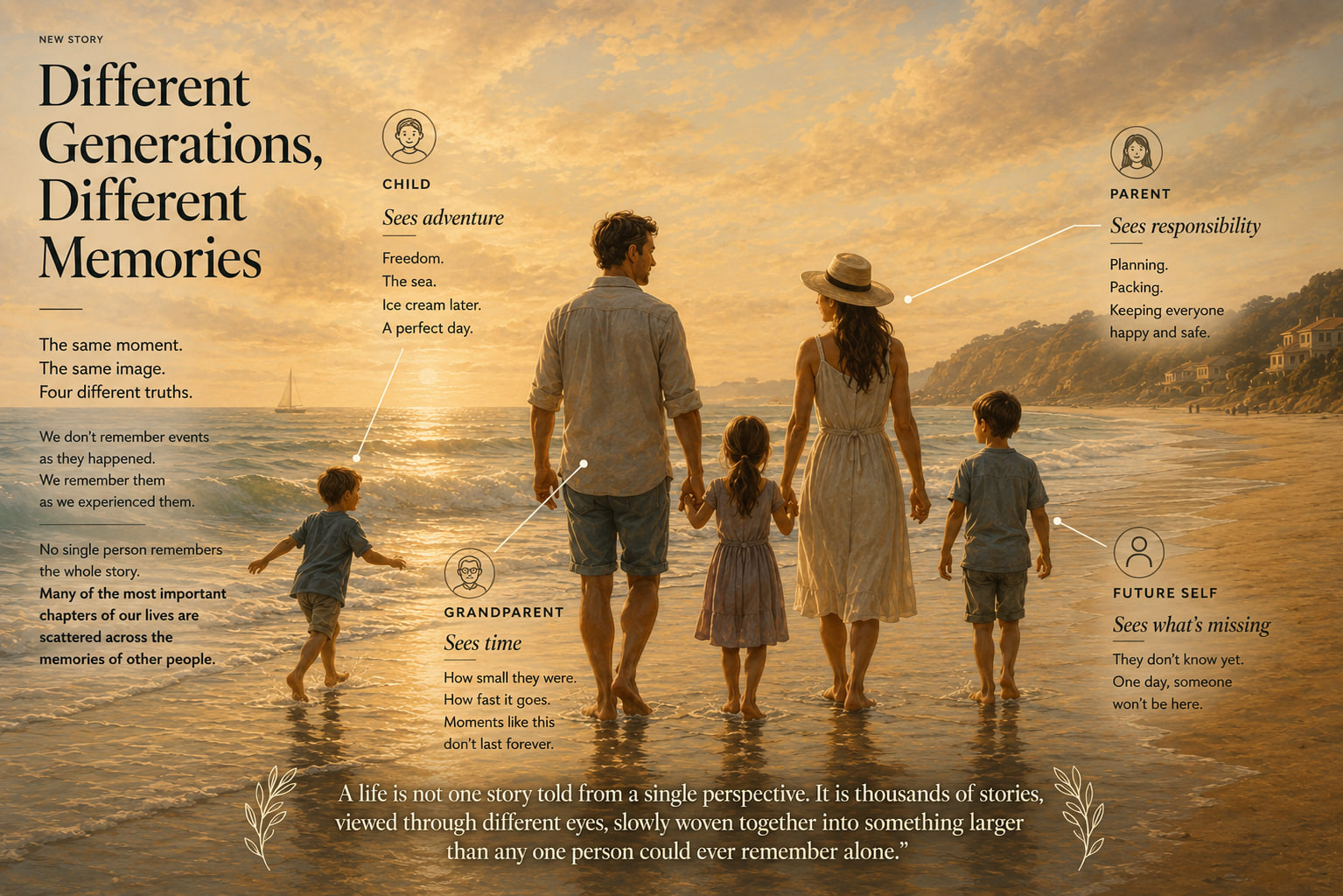
Different Generations, Different Memories
The same moment. The same people. The same photograph. So why does everyone remember something different?
A family returns from a holiday. The photographs are uploaded. The suitcases are unpacked. Life resumes.
Years pass. Then one evening, somebody finds an old photograph.
The image is passed around the room. And something curious happens.
Everyone begins talking about a different memory.
The child remembers the ice cream. The father remembers the traffic. The mother remembers making sure everyone was happy. The grandparent remembers watching three generations together.
The photograph has not changed. Yet four entirely different stories emerge from the same image.
Memory is not a recording. It is an interpretation.
We do not remember events exactly as they happened. We remember them as we experienced them.
For a child, a family holiday is often a collection of moments. For a parent, the same holiday includes planning, responsibility and effort. For a grandparent, it may become less about the destination and more about the people.
Same holiday. Same family. Different memories.
None of them wrong. None of them complete.
We often describe these occasions as shared experiences. In reality, they are collections of individual experiences occurring in the same place at the same time.
The shared part is the event. The memory is personal.
Yet perhaps the most important discovery is this: no single person remembers the whole story.
Many of the most important chapters of our lives are scattered across the memories of other people.
A child may barely remember their first football season. A parent remembers every cold Saturday morning. A grandparent remembers standing on the touchline with quiet pride.
A wedding guest remembers a conversation the couple never heard. A friend remembers a moment that nobody else noticed.
Entire parts of our lives exist only because somebody else remembers them.
Which means something remarkable happens when people revisit memories together.
The story expands.
A father hears what his daughter remembers. A son discovers what his grandfather noticed. A grandmother learns what mattered most to her grandson.
The memory becomes richer because it is no longer owned by one person. It becomes shared.
Perhaps this is why reminiscing feels so satisfying. Not because we are reliving the past. But because we are discovering parts of it we never knew existed.
Every person carries a piece of the puzzle. Every person holds a fragment of the story. Only when those pieces are brought together does the full picture begin to emerge.
This is about more than memory. It is about belonging.
Families are not built solely through blood. Friendships are not sustained solely through time. Communities are not held together solely through proximity.
They are held together through shared stories.
Without them, we slowly become strangers. With them, we remain connected.
A photograph may capture a moment. But people give it meaning.
And perhaps that is the real purpose of memory.
Not to preserve the past. But to strengthen the bonds that carry us into the future.
Because a life is not one story told from a single perspective. It is thousands of stories, viewed through different eyes, slowly woven together into something larger than any one person could ever remember alone.