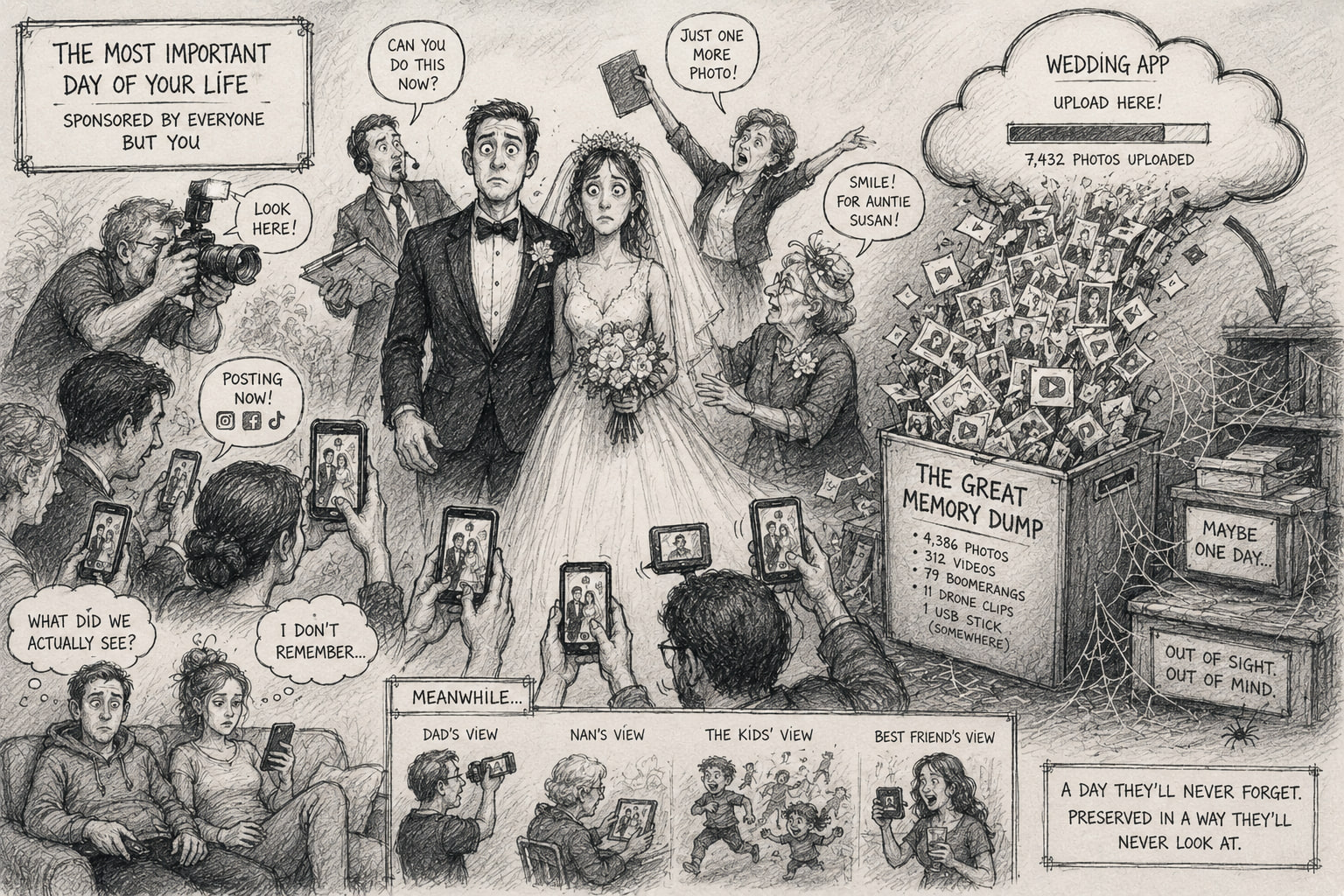
The Wedding That Disappeared
We have become remarkably good at collecting wedding memories. So why do so many of them vanish from our lives?
A wedding is a strange event. Months, sometimes years, of preparation are compressed into a single day.
Ask married couples about their wedding day and a surprising number will use the same phrase: “It went by in a blur.”
For many people, their wedding is one of the most important days of their lives. Yet the people at the centre of it often struggle to fully experience it.
Everyone wants something from them. The photographer needs them. The videographer needs them. The guests need them. Family members need them.
The strange irony is that the wedding exists primarily for two people. Yet they are often the two people least able to savour it.
Perhaps this explains our obsession with documenting weddings.
Photographs. Videos. Guest uploads. Disposable cameras. QR codes. Shared albums. Professional footage. Drone footage.
More images are taken during modern weddings than at any point in human history.
Collection is not the same thing as preservation.
The wedding industry has become exceptionally good at gathering memories. Preserving them is a different challenge entirely.
Everything has been saved. Yet very little has been organised around meaning.
A wedding becomes a folder. Then another folder. Then a USB drive. Then a cloud archive.
Life continues. The honeymoon arrives. Work resumes. Children arrive. Years pass.
The photographs remain. The memories slowly retreat.
Modern systems often treat memories as files rather than experiences.
A wedding is not a collection of media. A wedding is a collection of perspectives.
The father seeing his daughter before the ceremony. The groom waiting nervously. The bride taking a final breath before walking down the aisle. The grandmother watching from the second row.
The couple never see most of these moments. No single person experiences the entire wedding.
Every attendee carries a different version of the day. Every photograph represents a different perspective. Every memory tells a slightly different story.
Yet most wedding archives flatten all of these perspectives into a single collection.
A scrambled egg of files. Perfectly preserved. Almost impossible to experience in the way it was originally lived.
Upload the photographs. Share the gallery. Download the files. Job done.
But a wedding is not really about the event. It is about the lifetime that follows.
The marriage may last fifty years. The technology is often designed around fifty days.
The memories deserve better than that.
The value of a wedding memory changes over time. A photograph viewed one week later is interesting. The same photograph viewed twenty years later can be priceless.
Time transforms memories. That is what makes them valuable.
The wedding industry has largely solved the problem of collection. The unfinished challenge is preservation.
Not preserving files. Preserving significance.
Because nobody dreams of leaving their wedding with 3,000 photographs. They dream of remembering how it felt.
And then there is the challenge of sharing those memories.
Not just today, but years from now. Not just with the couple, but with parents, grandparents, and relatives who may never feel comfortable navigating cloud folders, download links, or yet another app.
We have become experts at capturing the day. We are still learning how to make it accessible to everyone who cares about it.
The wedding itself lasts a day. The memory should last a lifetime.
The question is whether we are building systems that understand the difference.