A Season That Deserved Better
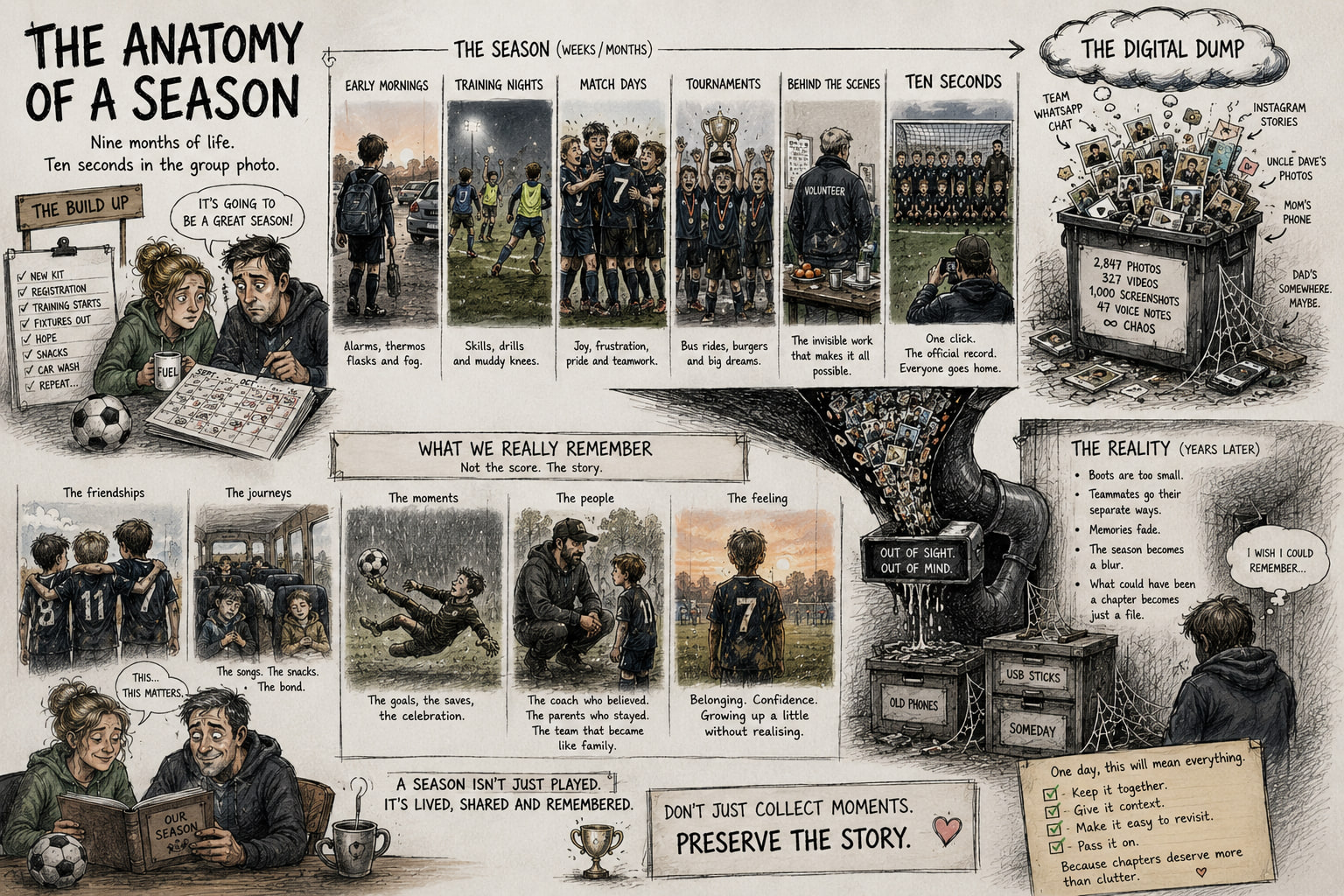
A season is not just played. It is lived, shared and remembered.
The final whistle blows.
Parents applaud from the touchline. Coaches gather cones from the edge of the pitch. Children run towards one another, celebrating, laughing, already talking about what comes next.
Someone takes a team photograph. Then everyone goes home.
At the time, it rarely feels important. After all, there will be another season. Another tournament. Another team photograph.
Childhood has a way of making endings feel temporary. Only later do we realise that many of the most important chapters in life arrive without announcing themselves.
A youth football season is one of them.
For nine months, families build routines around it. Saturday mornings begin in darkness. Boots are cleaned. Water bottles are filled. Cars are packed. Parents stand in rain, wind and winter cold for children who may never remember the score but will remember who was there.
The season becomes part of family life.
And because modern life is so well documented, we assume those memories will always be available to us.
Thousands of photographs are taken. Videos are recorded. Messages are shared. Goals are celebrated. Team updates arrive daily.
The season feels preserved. Yet something strange happens once the final whistle has blown. The story begins to scatter.
Photographs end up across dozens of phones. Videos disappear into camera rolls. Messages become buried beneath years of newer conversations. Social media posts sink out of sight.
What remains is not an archive. It is a collection of fragments.
We have become remarkably good at capturing moments and surprisingly poor at keeping chapters.
A moment is a photograph. A chapter is the story that connects those photographs together.
One day, a parent discovers a video from a rainy away match. Another finds a team photograph from a tournament. Someone else uncovers a medal in a drawer.
Each object acts as a small doorway back into that season.
Not because of the result. Not because of the league table. But because the season represented something larger: friendships, confidence, belonging, growth, and a period of childhood that quietly shaped the person someone would become.
Years later, very few people remember every score. They remember the coach who believed in them. The journey to the cup final. The laughter after training. The muddy boots left by the front door. The teammates whose names still bring a smile.
These are not sporting memories. They are human memories.
Perhaps that is why so many families feel a subtle sense of loss when old seasons disappear into digital clutter. Not because the photographs have gone. But because the chapter has.
A season is more than a collection of files. It is a record of a particular group of people, sharing a particular period of life, in a particular moment that will never happen again.
The challenge for modern families is no longer deciding whether something is worth recording. We record almost everything. The challenge is deciding what is worth keeping together.
Because one day the boots become too small. The tournaments end. The children grow up.
And somewhere between a forgotten group chat and a camera roll containing twenty thousand photographs, an entire chapter of life can quietly disappear.
Unless someone decides that it is worth preserving.
Not as content. Not as files. But as part of a story.