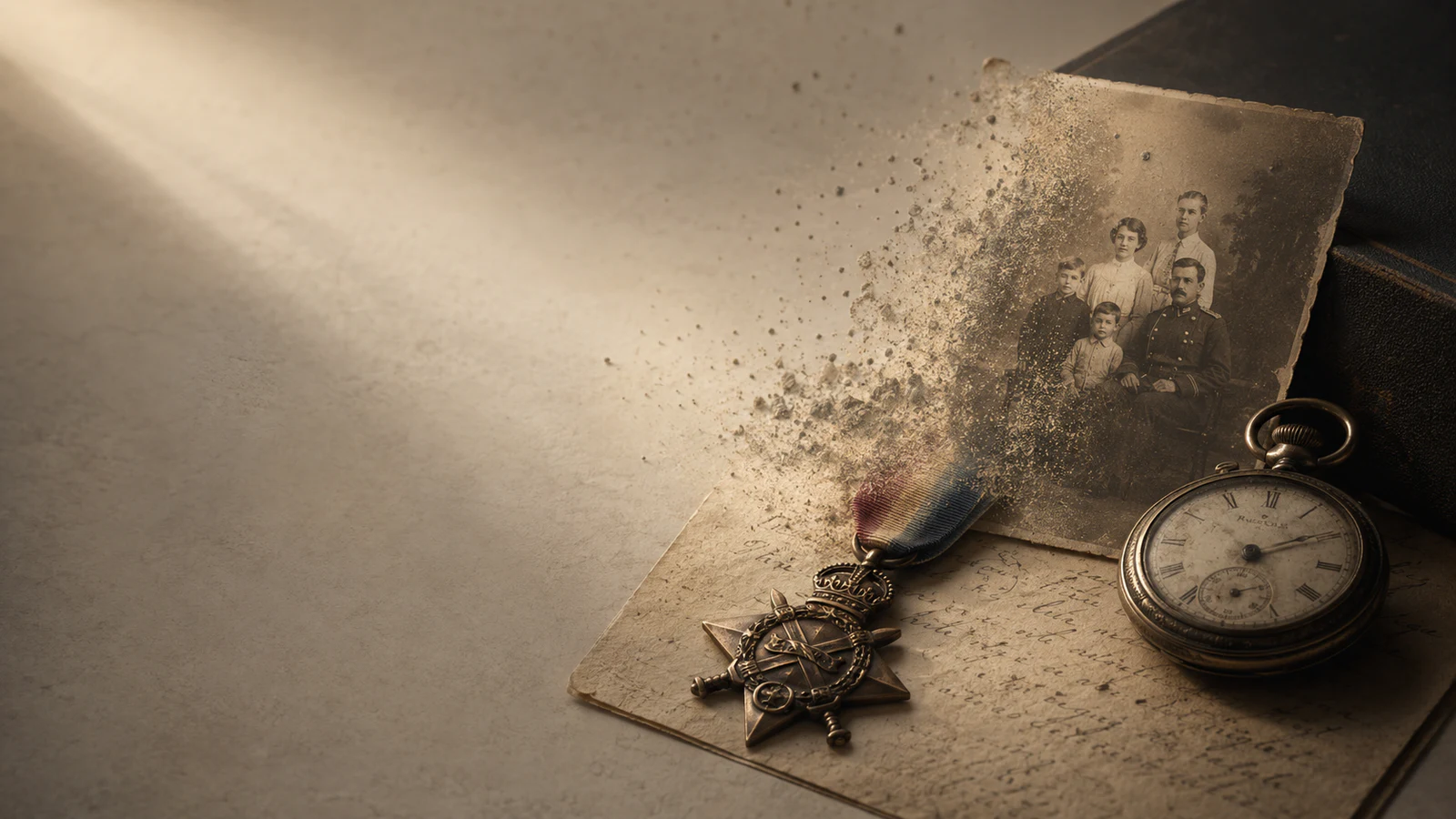
When people think about memory loss, well in the context of family and historical loss they often imagine a dramatic event.
A fire or flood on a grand scale or smaller events like a failed hard drive lost photograph and yet many continuity failures happen differently.
A record survive its the understanding does not, the moments that hold the full context of the Memory gently separate until they’re too few to create the whole picture.
This is the mechanics of memory decay.
Memory decay rarely happens all at once.
It happens gradually and often invisibly, a simple forgotten name, a story is shortened and the time erodes the details.
As the perspective is lost the meaning weakens.
Each loss may seem insignificant on its own, yet over time the cumulative effect can be profound.
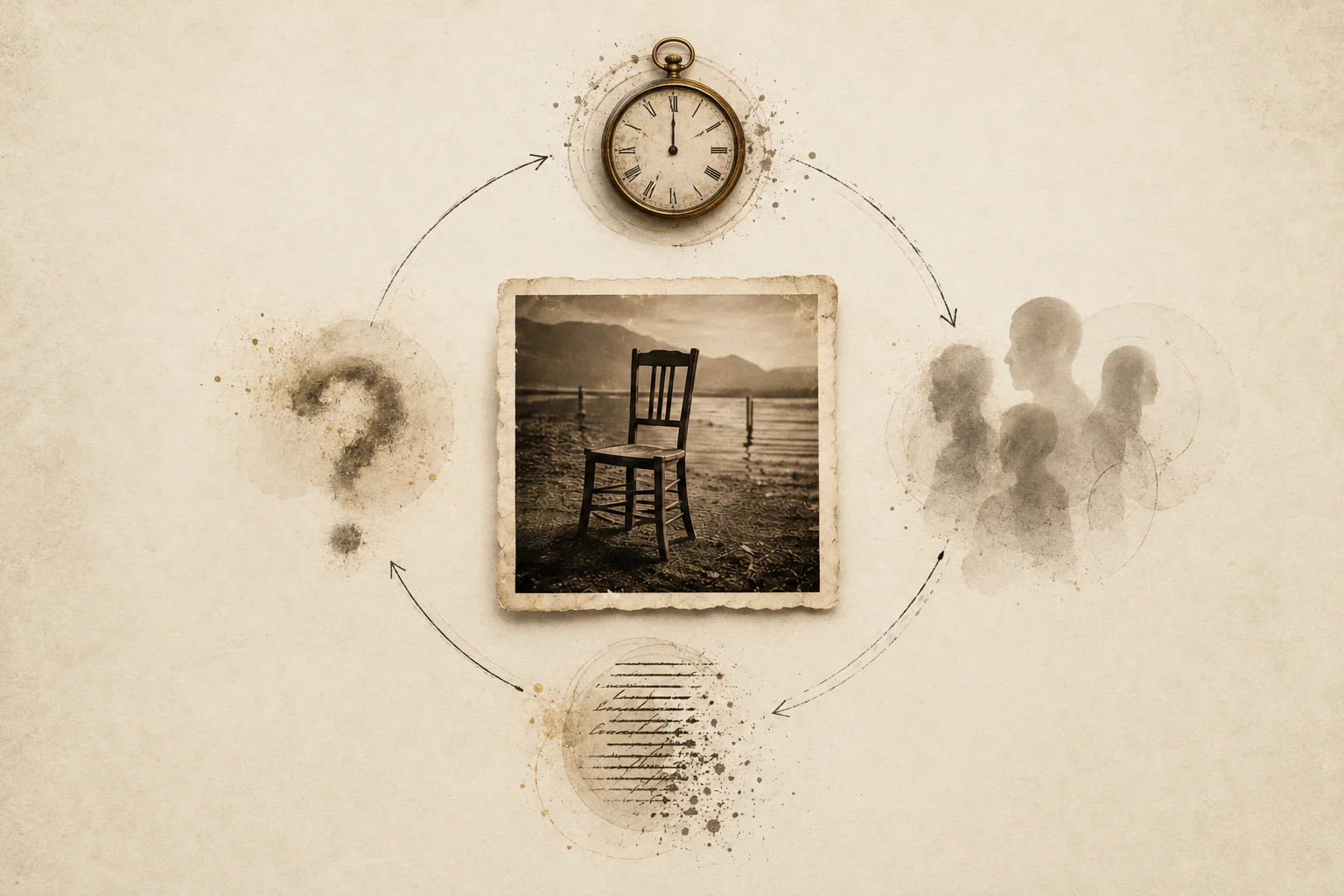
The Decay Cycle
Consider a soldier receiving a medal.
The event is witnessed by family, friends and colleagues.
Official documents record the achievement.
Photographs capture the moment and stories are told and retold.
Meaning surrounds the event from every direction.
The continuity is strong.
Yet the moment the event ends, memory decay begins.
Time begins the slow erosion of understanding.
The medal survives.
The photograph survives.
The documents survive.
But each perspective begins to separate.
People move away.
Stories are told less often.
Details become less certain.
Memories become compressed.
What was once a rich and detailed account gradually becomes simpler.
A story becomes an anecdote.
An anecdote becomes a sentence.
The sentence no longer explains the photograph.
So the photograph becomes a mystery.
This process is rarely intentional, nobody decided to forget.
The erosion happens naturally as continuity weakens because different layers decay at different speeds.
The key often survives longest.
The meaning often disappears first.
This process is rarely intentional, nobody decided to forget.
The erosion happens naturally as continuity weakens because different layers decay at different speeds.
The key often survives longest.
The meaning often disappears first.
A medal may still reveal a regiment, a date or an achievement but if the photograph is lost or separated in a loft, hidden away it may still reveal a face but the deeper questions become harder to answer.
The Questions That Remain
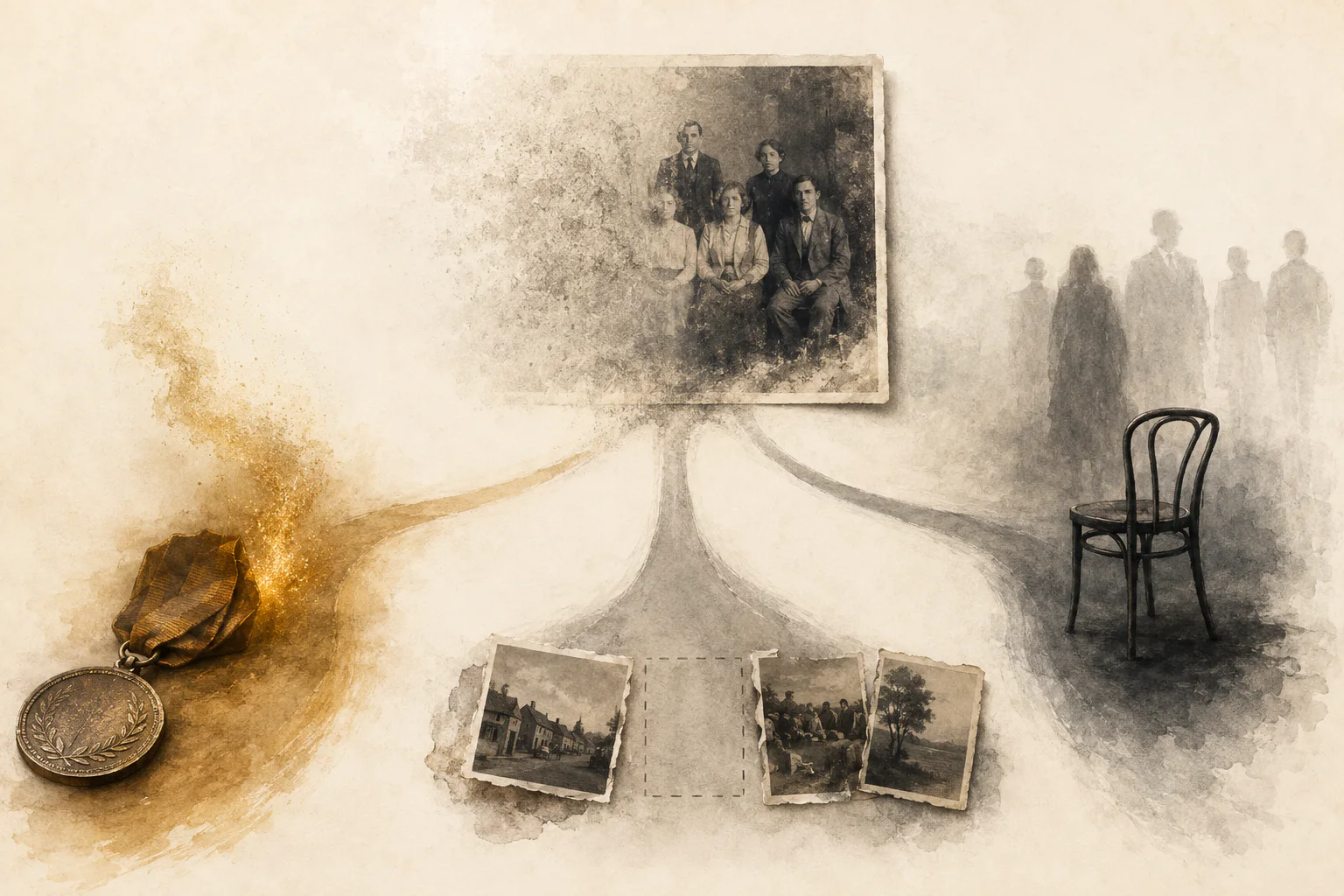
Why did this matter?
What happened next?
How did it affect the people involved?
These are often the first casualties of memory decay.
Major continuity losses can also occur suddenly.
A grandparent dies.
A friend loses contact.
A witness disappears.
When this happens, a unique perspective leaves the Human Archive forever.
Some understanding may survive elsewhere but the greater loss is rarely obvious at the time.
Its significance often becomes clear only years later when somebody asks a question and discovers there is nobody left to answer it.
Gradual and Sudden
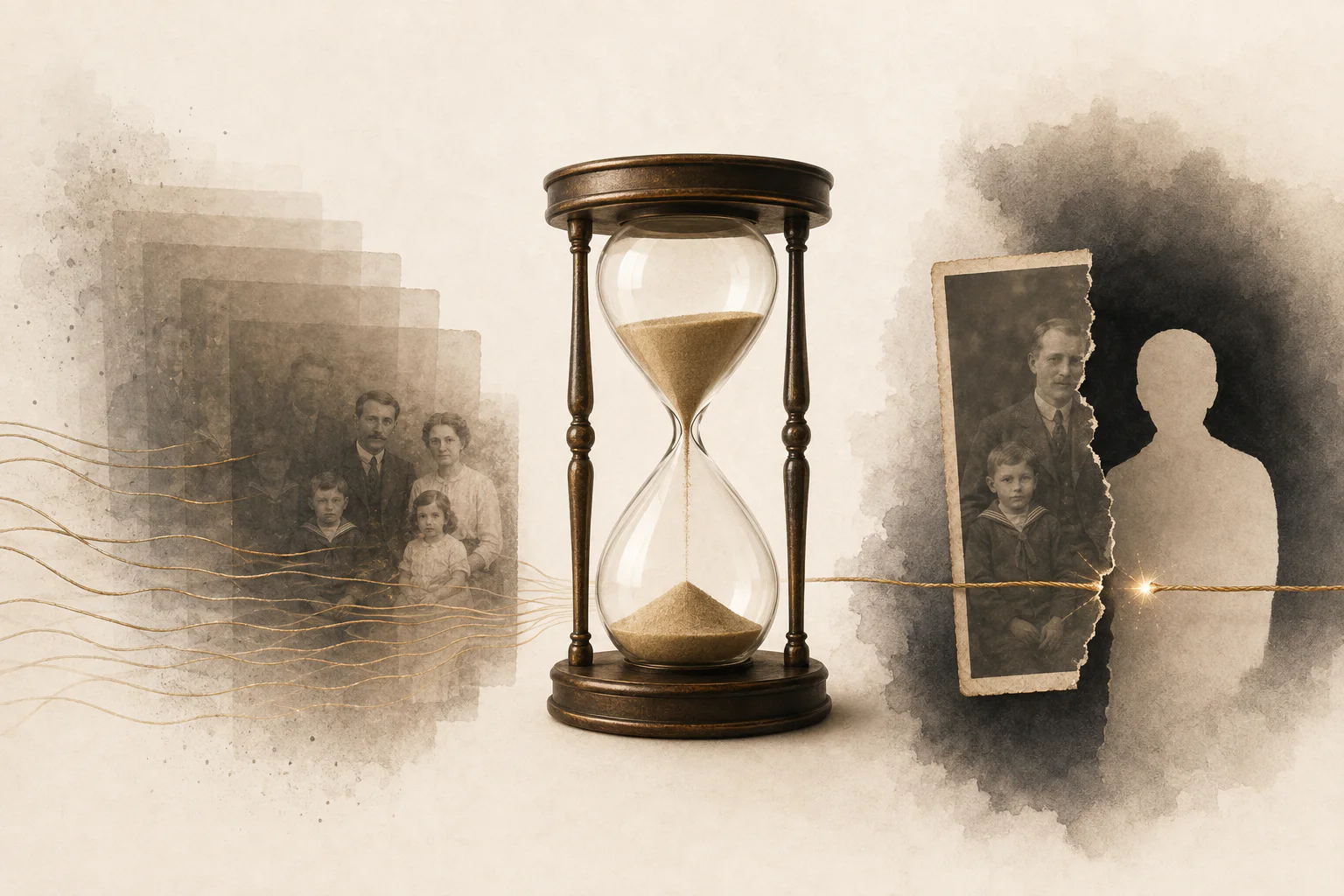
This is why memory decay is both gradual and sudden.
Most of the time, continuity erodes slowly.
Occasionally, entire sections disappear at once.
The final stage of memory decay is not deletion.
It is uncertainty.
The object survives.
The record survives.
The key survives.
Yet eventually somebody encounters it and asks:
Who was this?
At that moment, the distinction between storage and continuity becomes clear.
The record still exists.
The understanding does not.
Memory decay is not the loss of the key.
It is the gradual loss of the understanding surrounding the key.
And once enough layers have fallen away, continuity begins to fail.