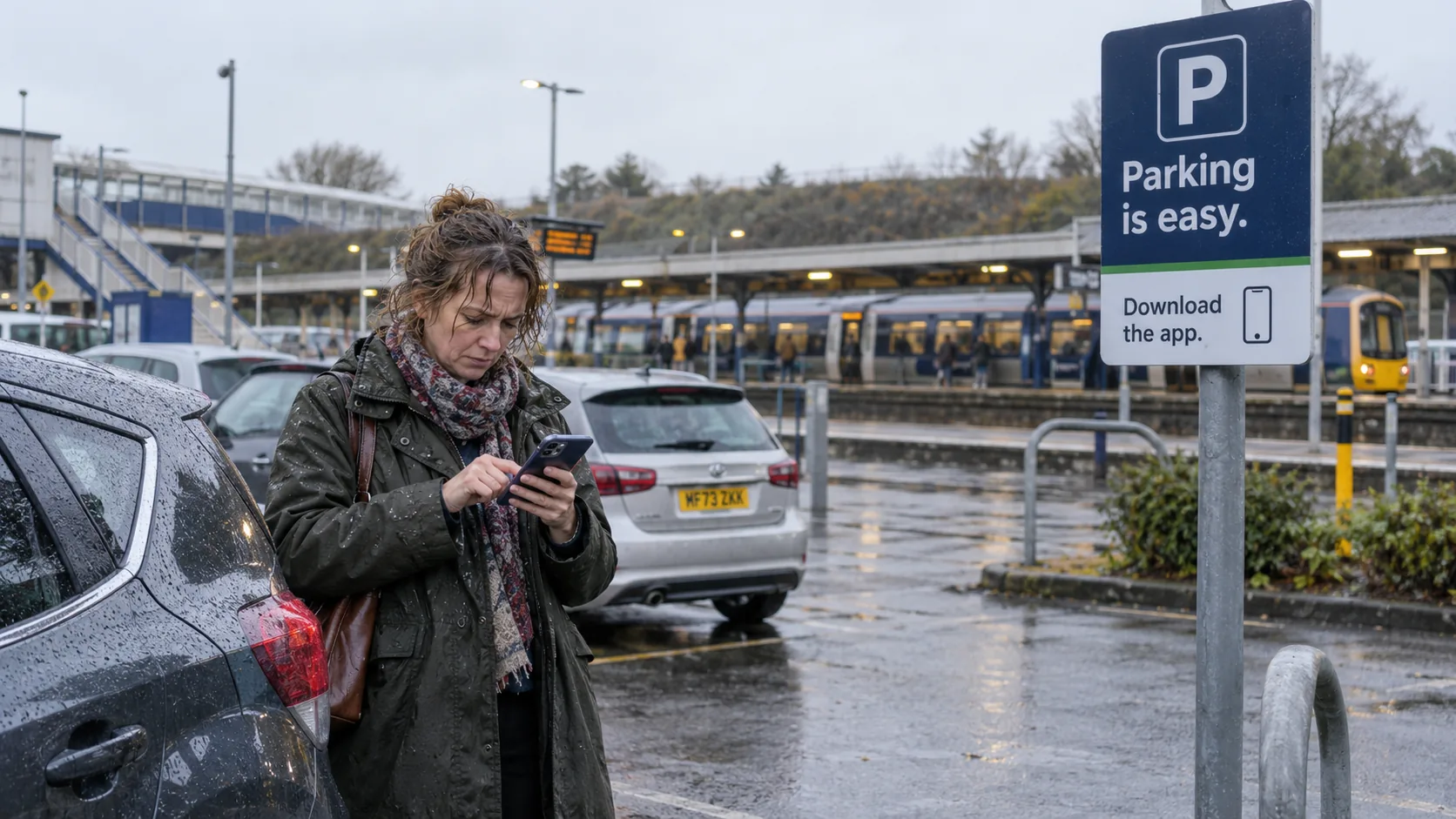
There is a particular kind of irritation that comes from standing in a car park, in the rain, trying to convince your phone that you should be allowed to give somebody £2.40.
Anyone who drives will encounter the sign saying: “Parking is easy. Download the app.”
You download the app but now you need an account. The account requires your email address, a password and confirmation that you are a person. Your email provider would also like confirmation that you are a person, preferably through a code sent somewhere else.
By the time you’ve entered your registration, found the location number and declined notifications, while often looking over your shoulder for the parking warden or watching the time for the train about to arrive, you have experienced a number of unnecessary levels of stress.
You have, however, joined a parking company.
This is increasingly how ordinary life works. A small task arrives carrying a second, less visible task: a well-designed system requiring a process with no way to avoid it.
We were promised that technology would take care of the boring bits. Yet somehow we have become the people taking care of the technology.
A small job for everyone
A school letter arrives through a portal. The appointment needs confirming through a link. The receipt is in one of the several email accounts you opened once, eighteen months ago. The restaurant menu requires a camera, a connection and enough battery to discover what comes with the chicken.
Each request can sound reasonable on its own. It only takes a minute, right?
But then I need to keep on top of the dozens of apps that I barely use and ensure they’re updated so they’re ready to use when needed.
A lot of organisations would like a minute and a piece of the valuable real estate on your mobile screen, but none of them appears responsible for the afternoon lost chasing logins and password resets.
There is no single place where all this work becomes visible. It sits between everything else: a verification code while making breakfast, a forgotten password on a lunch break, a form completed after the children have gone to bed.
Ask what you did all evening and the answer can sound absurd.
You sorted something out. You cannot quite remember the fine details, just that it needed doing.
Congratulations on your new position
Somewhere along the way, being a customer began to involve a surprising amount of work.
We enter the details, check the details, correct the details and upload evidence of the details. When something goes wrong, we take screenshots and explain the history to somebody who cannot see the previous conversation.
Occasionally, we explain it again.
There are good reasons to like self-service. Booking something in two minutes at midnight can be far better than waiting for an office to open. Plenty of digital tools save real effort.
The frustration comes when the system encounters something it cannot handle and hands the problem back to us.
The form rejects an address we actually live at. The chatbot offers four options, none of which describes what happened. The help page sends us to the form.
At this point, a person might once have said, “Leave it with me.”
Now we receive a link.
Whose time are we saving?
“Manage your account” sounds like a benefit until you notice how many accounts you are managing.
A company may have made its process faster by asking the customer to perform more of it. That can still be a fair exchange. Lower prices, shorter waits and more control can be worth a little effort.
But we should be able to recognise the exchange.
If I spend twenty minutes resolving something that previously required five minutes of an employee’s time, the work has moved. Whether the service improved depends partly on where you are standing.
From inside the business, it may look beautifully efficient.
From the car park, it is raining.
The people who make it look easy
For someone comfortable with technology, these demands can feel like a persistent nuisance. For someone with poor eyesight, limited data, an older phone or difficulty remembering a sequence of instructions, they can become a reason to give up.
Sometimes another person quietly takes over.
A daughter manages the appointments. A partner handles the renewals. Someone becomes the family’s unofficial technical support because they are the only one who knows which email address was used.
The service records a successful digital interaction.
It cannot see the person beside the screen who made it possible.
Let me finish
A useful test of convenience would be how easily someone can complete what they came to do.
Buy the ticket. Read the letter. Pay for the parking. Cancel the thing they no longer want.
That means counting the whole task, including the account recovery, the failed payment and the search for help. It means noticing when a simple transaction has become an ongoing relationship the customer never particularly wanted.
Good technology can leave us with fewer things to remember and fewer loose ends to carry into tomorrow.
There is still plenty of room to build that.
In the meantime, I would quite like to pay for my parking.
I have the money.
I have the car.
I had hoped that would be enough.