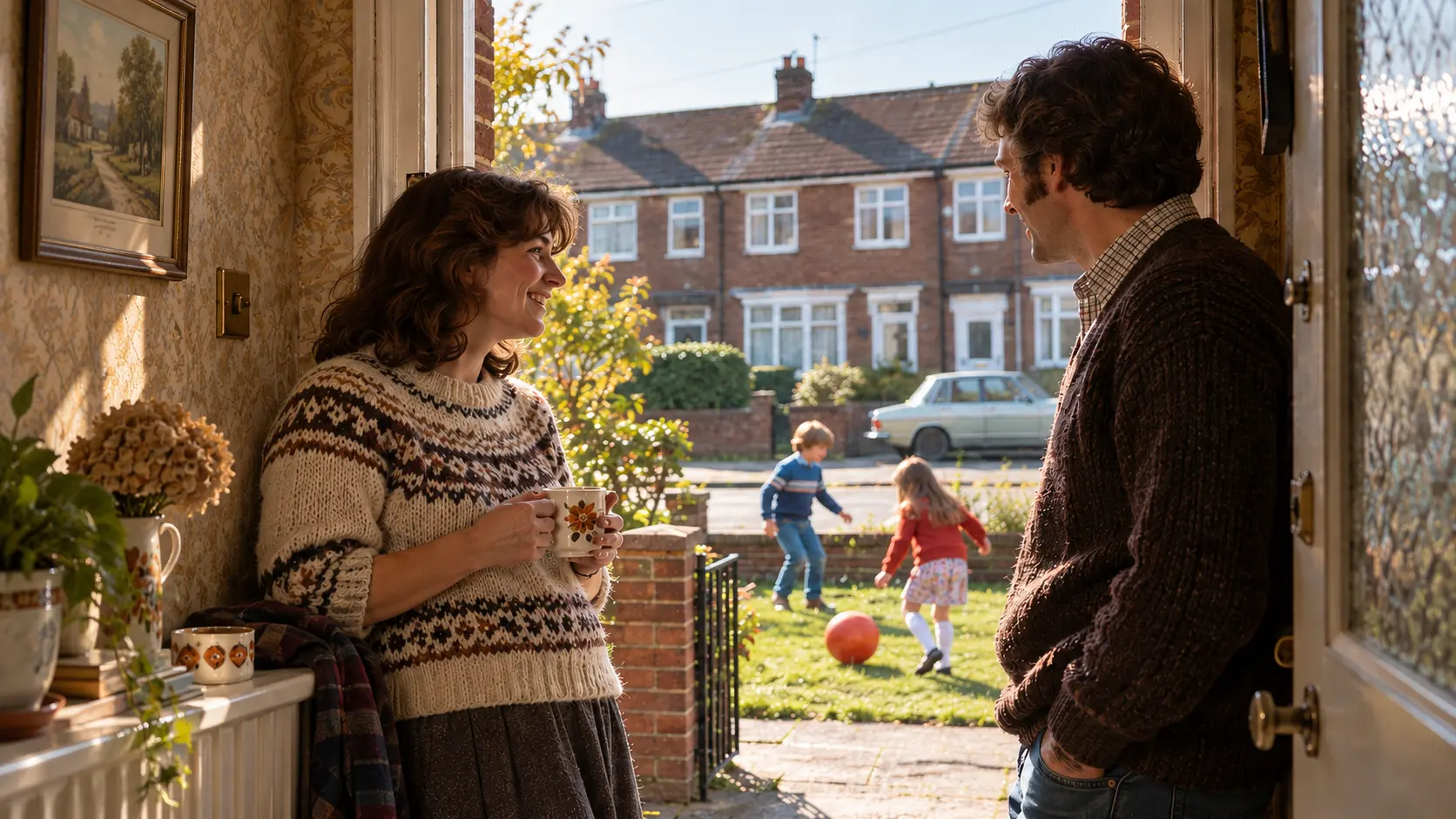
When I was a child in the 1980s, neighbours and local family would knock on the door and come in for tea. It happened often. Sometimes they came so us kids and our cousins could play together while the adults had a chat. Nobody needed a birthday or a dinner invitation. It was just another Wednesday afternoon.
You knew who lived on the street. If Mavis, the older woman three doors along, needed help, someone was a knock away. Those visits gave adults and children company, but they also meant people knew one another well enough to ask for something.
What I remember changing first was people’s availability. Dad was always working. That was nothing unusual: sometimes two shifts, sometimes at the weekend. But Mum was mostly around, occasionally doing a few hours of paid work for those extra few pounds at Christmas.
As my circle of friends and family aged, I noticed parents becoming harder to see. They were both working. A new car for the neighbour, or that thing we wanted for Christmas, seemed to arrive more frequently. But the adults were often tired after work, or trying to get everything else done. Seeing someone became another thing to arrange.
Recently I’ve been thinking about three changes behind that: more women going out to work and building careers, Thatcher’s changes to council housing, and lenders becoming willing to offer larger mortgages. Put them together and I think there is a serious question about where the benefit of the second income went.
Women wanted careers for good reasons. Their own money, professional fulfilment and the ability to support themselves mattered. A household earning more ought to have had more choices, including some choice over how much its members worked.
Yet there is a difference between wanting a career and being unable to reduce your hours because the mortgage needs both salaries.
The shift involved more than extra people taking a few hours’ work. IFS research found that the proportion of couples with children where both adults worked rose from 49 per cent in 1975 to 68 per cent in 2015. Among women aged 25-54, full-time employment rose from 29 per cent in 1985 to 44 per cent in 2017. [1]
That meant a considerable change in who was available during the day. Children still needed looking after. Relatives still needed help. The washing and shopping still had to be done. A visit that once fitted around those things now had to fit around paid work as well.
We should be able to discuss that cost without suggesting women ought to have stayed at home. The unpaid work had value, whoever did it. If more adults were going into employment, how was the rest supposed to be shared?
Of course families gained financially. Typical disposable household income more than doubled between 1977 and 2014/15 after inflation and household size were taken into account, according to the ONS. Women’s earnings were one contribution to a much broader improvement. [2]
But I keep coming back to the home. People can decide against a more expensive car or a holiday. Everyone needs somewhere to live, and that puts housing in a different position from most things we buy.
Suppose a couple can borrow more because both are working. They can bid more for a house. If other buyers can do the same, while the number of homes available fails to keep pace, sellers can ask more. The couple may win the house, but the next couple faces the higher price.
The Bank of England identifies mortgage availability as one influence on house prices, alongside interest rates, housing supply and demand. [3] My concern is what happens when some of that extra borrowing becomes absorbed into the price. A second income helps you compete until two incomes become what you need to enter the competition.
Personally, I would have preferred a mortgage limit of three times assessed household earnings, with only half the second income counted. As earnings grew, families could still have bought a better home. But less of that second wage would have been available to turn into a larger mortgage and a higher asking price.
A lending limit alone would not have built the homes we needed, and could have shut buyers out if prices stayed high. It needed to sit alongside enough homes to buy and genuinely affordable homes to rent. The Bank of England has since made the wider point plainly: without more housing supply, looser mortgage conditions can push up prices without increasing homeownership in the medium term. [12]
I would have liked more of the extra income to remain available for a holiday, a better car, savings or fewer hours at work. A secure home is the foundation of family life. We allowed too much of the reward for extra work to depend on bidding for one.
Meanwhile, an alternative was being reduced.
Right to Buy let council tenants purchase their homes at substantial discounts. For those families it could be a tremendous opportunity: ownership, security and an asset to leave their children. I can understand why people took it.
The decision that needs much harder scrutiny is the failure to replace what was sold. Council building declined, spending and borrowing were constrained, and legislation in 1989 required most sale receipts to be set aside for debt repayment rather than freely reinvested. [4]
The house was still there. The family buying it might stay for decades. But when it eventually changed hands, the council no longer had that home to offer another household at a social rent. Repeat that across enough streets, without replacement, and the choices available to the next generation become narrower.
At the same time, banks were moving further into mortgages. Controls restricting their expansion were removed in 1980. The Bank of England’s later account described mortgage lending as profitable and relatively low risk; banks’ share of the mortgage market grew from under 10 per cent in 1980 to about 30 per cent by 1990. [5]
For lenders, expanding homeownership meant more customers and more lending. Private builders gained opportunities too, with government actively helping to organise them.
In January 1983, housing minister John Stanley told Parliament about work his department had undertaken with the House Builders Federation. There had been 92 meetings with councils over releasing specific sites for low-cost homeownership. Councils were also being encouraged to use capital receipts to buy homes from private builders for shared-ownership resale. [6]
The following year, Thatcher addressed the National Housebuilding Council. She discussed the industry’s concerns about interest rates, stamp duty, mortgage-interest relief and planning, and described the expansion of private ownership as central to her government’s philosophy. Her closing words included: “Your success is our success.” [7]
There was a plan to expand private ownership and private provision, backed by a growing mortgage market. That much was public. Whether making families dependent on two earnings was an intended outcome is something these records cannot establish. But the warning signs were certainly being discussed.
In November 1985, Labour MP John Golding told the Commons: “Many families cannot get a mortgage without two incomes. Housing depends upon it.” [8]
A year later, the Bank of England Governor was warning that mortgage income multiples were edging upwards and that lenders should resist excessively loose lending criteria. [9]
So when someone says nobody could have anticipated the pressure on families, I find that difficult to accept. The connection was being raised in Parliament while the policies were taking effect.
I think these changes helped make housing a growing claim on both people’s earnings. How much each contributed will vary by period and place. Interest rates, population, planning and later governments’ decisions belong in that history too. They do not make the original choices disappear.
What interests me is the result for a family with very little room to cut back. Both adults may earn more than their parents did, yet neither can easily take a step back. The income arrives, the housing payment goes out, and the week has to be organised around earning the next one.
Some of what used to happen between households then becomes something each household has to arrange for itself. Childcare needs booking. Help needs finding. Even friendship can become a negotiation over dates when everyone is free and has enough energy left.
Those arrangements come with bills. Coram’s 2026 survey puts the average remaining cost of a 50-hour nursery place for a child under two in England at £148.82 a week, after the 30-hour working-parent entitlement is taken into account. That is the survey’s figure for eligible families, not a universal bill: eligibility, additional help and the weeks covered matter. Even with public funding, finding care can still take a substantial slice of the earnings that make going to work worthwhile. [13]
Later in life, the sums can be much larger. Age UK quotes around £1,100 a week for residential care, or roughly £57,200 over a year. Nursing care can cost more. Fees vary, and what a person pays depends on their needs, finances and entitlement to support. [14]
For some homeowners, that means drawing on the housing wealth they spent decades building. In England, a home can count towards the means test for permanent residential care, although it is excluded while a qualifying partner continues to live there. A deferred payment can postpone the bill against the property; it does not make the bill disappear. [15]
So when we sit around a table marvelling at what our houses are worth, I think we should also ask what that wealth will let us do. For some, it will support a comfortable retirement or help their children. For others, a substantial part may eventually pay for care.
I am not pretending a neighbour’s visit could replace a trained carer, or that every family used to manage well. Professional care can be essential, and good childcare offers children much more than supervision. But if families have less time to give, more support has to be found elsewhere. The cost shows up in household bills, public spending and the hours people no longer have for one another.
There is something strange about how we measure this. Unpaid childcare and care for relatives generally sit outside GDP. Pay for those services and they enter the measured economy. More money can change hands without a corresponding increase in the amount of care received. [10]
The afternoon when children played while their parents talked barely registers in that account. Yet anyone who has tried to arrange childcare and make time for friends knows it provided something useful.
And public costs have hardly disappeared. The National Audit Office identifies the shortage of social-rent homes as a driver of homelessness, pushing people towards more expensive, less secure private renting. It found that councils in England spent 113 per cent more on homelessness services in 2022/23 than in 2010/11, after inflation. That figure measures the increase in those services, rather than the lifetime cost of Right to Buy. [11]
It does, however, make the promise of saving public money worth revisiting. A home sold brings in money once. Providing somewhere for people to live remains a responsibility long afterwards.
I don’t want to turn the clock back on women’s careers or tell anyone how their family should work. I want to know why earning more can still leave people with so little choice about their time, particularly when the biggest commitment is something as basic as a home.
I think about those visits because they were ordinary. The adults weren’t running a community programme. They were having tea while we played. People became familiar through seeing one another often enough, and help was easier to ask for because you already knew the person behind the door.
For all the gains in income and housing wealth, I wonder how much we counted that availability when we decided what success looked like.
For my children, I would prefer a world where one income could cover a secure home and the basics, if that was how they wanted to live. A second income could then pay for more comfort, a career they wanted to pursue, or something put aside. They might both choose to work. I want them to have that choice, rather than need both wages just to keep everything going.
We ought to be able to afford a cup of tea together.
Sources
References supporting the essay. Each link opens the original publication.
- Institute for Fiscal Studies, The rise and rise of women's employment in the UK
- Office for National Statistics, Household disposable income and inequality, financial year ending 2015
- Bank of England, How does the housing market affect the economy?
- House of Lords Library, Right to buy: Past, present and future
- Bank of England, The performance of major British banks, 1970-90
- Hansard, Starter Homes, 26 January 1983
- Margaret Thatcher, speech to the National Housebuilding Council, 12 December 1984
- Hansard, Commons debate on parental leave and leave for family reasons, 26 November 1985, John Golding contribution
- Bank of England, Structural change in housing finance - Governor's speech, December 1986
- ONS, Changes in the value and division of unpaid care work in the UK, 2000 to 2015
- National Audit Office, The effectiveness of government in tackling homelessness, 2024
- Bank of England, Financial Stability Report, July 2025, discussion of mortgage availability and housing supply
- Coram Family and Childcare, Childcare Survey 2026, table 7, remaining cost of 50-hour care after working-parent entitlements in England
- Age UK, How much does care cost?, accessed 16 October 2026. Annual figure calculated as £1,100 × 52
- Government guidance on property disregards and deferred payment agreements, sections 2 and 2.4