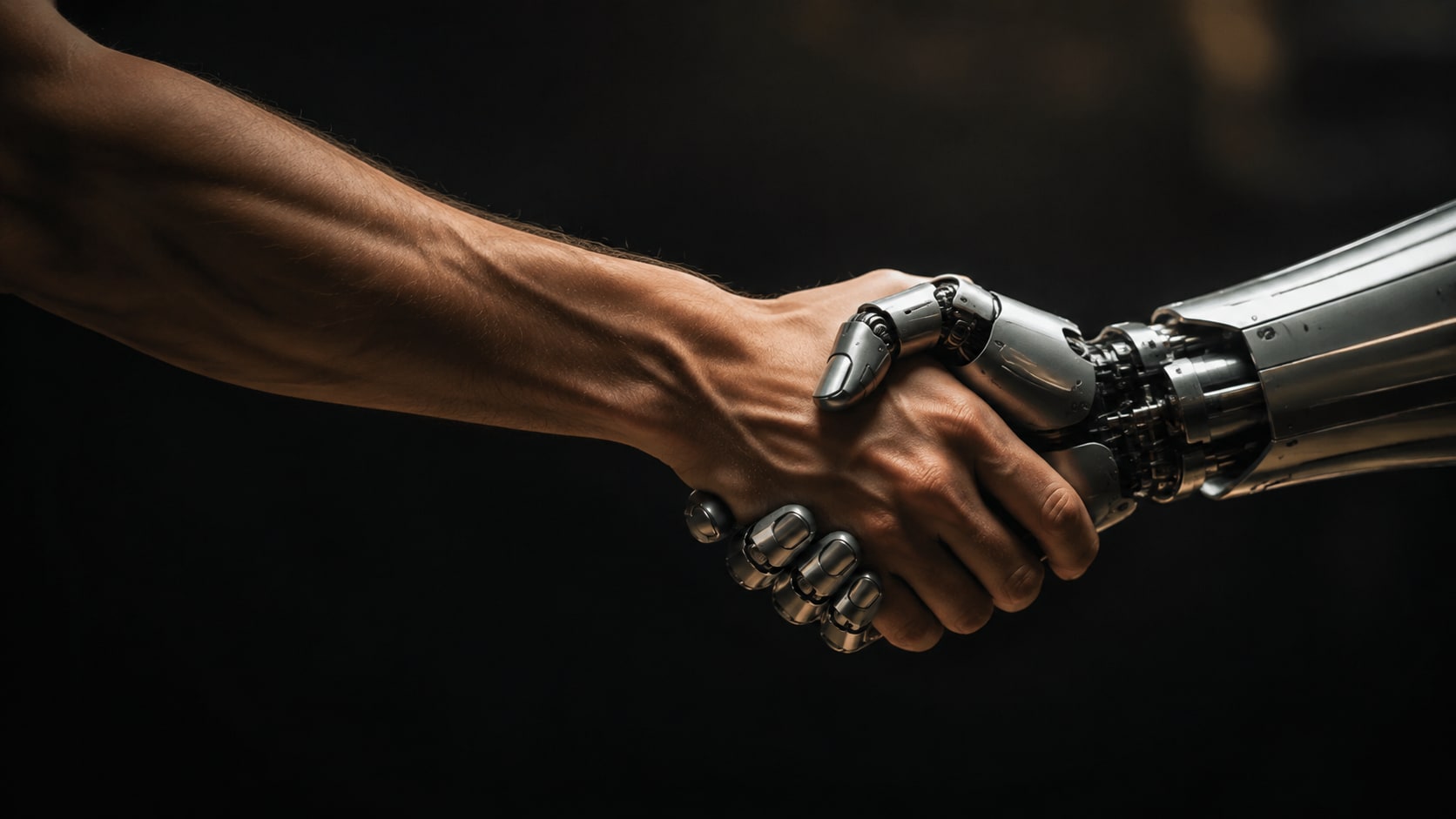
The earliest known depiction of a handshake dates back almost three thousand years. Surviving evidence from ancient Mesopotamia shows the Assyrian king Shalmaneser III clasping hands with Marduk-zakir-shumi I of Babylon. It appears to mark an agreement between two rulers.
There is also a notable history in the Roman world. Roman reliefs and coinage occasionally depict clasped hands, known as dextrarum iunctio, symbolising concord, alliance or marriage. The joining of right hands was a formal expression of agreement and unity, reinforcing the idea that trust could be physically represented between individuals.
There is also a long-standing theory about why the right hand became so important. By offering an open right hand, you were showing the other person that you were not carrying a weapon. It was a physical statement: I come in peace. You can trust me enough to come closer.
The gesture survived through empires, trade, wars, industrialisation, modern banking and eventually the internet. That is interesting in itself, because the handshake was never really enough. A second ingredient was needed to cement the deal: Reputation.
From Weapons to Paper Trails
For much of human history, a deal depended partly on what you knew about the person standing in front of you. Who were they? Were they trustworthy? Did their word mean something? Were they respected? A handshake had meaning because there was something behind it—your history.
Over time, of course, we developed other protections. Contracts, receipts, signatures and eventually databases, credit checks, digital records and electronic verification. These things are necessary. A handshake cannot define every term of a complicated agreement, and trust alone was never enough protection when something went wrong.
But somehow the handshake survived.
In the world I grew up in, and certainly throughout much of my working life, it still carried weight. A contract explained what we had agreed. The handshake said something about whether I intended to honour it.
For me personally, my word and my handshake have always meant something because they are two things I control completely. If I give someone my word, I consider it a promise. My reputation is the badge I carry afterwards. That may sound old-fashioned now, but I am not sure it should.
Today, before dealing with someone, we can check almost everything. Reviews, credit histories, social-media profiles—the list goes on. Experian can tell a lender something about your financial reliability without anyone ever meeting you. A marketplace can tell you whether a stranger has completed 500 successful transactions. A restaurant with thousands of reviews may feel safer than somewhere just starting out, even if that new place was recommended by someone you know and trust.
None of this is necessarily bad. In many ways it is a natural evolution, and technology has given us better information. It has also allowed trust to work at a scale that would once have been impossible.
The difference is that the judgement increasingly happens before the people meet. Sometimes they never meet at all.
The Manufacturing of Reputation
That creates another problem, because reputation can now be manufactured.
Spend enough time on social media and you will see apparently successful people travelling the world, giving life advice, demonstrating perfect fitness routines and presenting lives that seem almost impossibly complete. I know people with large online followings whose real lives look very different. Loneliness, health problems, weight struggles, credit cards stretched to their limits—none of those things necessarily appears on the screen.
Humans have always gamed the system, and reputation is just another form of currency. That is nothing new. People exaggerated wealth long before Instagram existed, and charisma has fooled people for thousands of years. But digital life has made the construction of a persona extraordinarily efficient.
You can choose the photograph. Edit the words. Delete the failure. Hide the debt. Repeat what performs well. Follow the instructions of the platform and gradually build a version of yourself that other people may mistake for the real thing.
Physical presence is harder to fake. Not impossible—some people are extremely good at deceiving others face to face—but in person there are more signals. The way someone looks at you, the way they answer a difficult question, the pause before an answer. Tone, posture, confidence, discomfort. They all give off signals that, somewhere in our gut, tell us something.
Over years of dealing with people, I learned to notice these subtle things—the consistency between what someone says and how they behave. Obviously, it was never a perfect science. Gut instinct is not magic and it is certainly not always right. But it develops. The more people you meet, the more conversations you have, the more negotiations you sit through and the more mistakes you make, the more patterns begin to show themselves.
Sometimes looking someone in the eye while shaking their hand told me something I could never have learned from an email. And that raises a question about where we are heading.
Outsourcing Our Instincts
Younger generations are not wrong to use the systems available to them. If I had grown up with reviews, ratings, instant background information and digital verification, I would probably use them too. They are sensible, and sometimes they are safer.
But human judgement is a practised skill. You develop it by using it. By meeting strangers, having awkward conversations, negotiating, being misunderstood, getting things wrong and realising someone was not quite what you thought they were. You learn the difference between nervousness and dishonesty, and when confidence is genuine and when it is performance. If more of those interactions move behind screens, there may simply be fewer opportunities to practise.
That matters because technology is not slowing down. We are likely to outsource even more judgement to the systems around us. Identity will become easier to verify. Fraud detection will improve. Financial risk will increasingly be assessed automatically. Platforms will know more about the people we deal with. And I suspect AI will increasingly help decide whether someone, something or some transaction appears trustworthy.
In many respects, this will be better. Machines can spot patterns humans miss. Automated systems may reduce prejudice, inconsistency and poor judgement in some decisions while protecting us from risks that a handshake never could.
But there is another possibility. We may build systems that become exceptionally good at telling us who to trust while gradually becoming worse at knowing for ourselves.
And perhaps that is what the end of the handshake really means.
Not that people will stop shaking hands. I suspect we will continue doing it for a long time, as the gesture has already survived almost three thousand years of technological change. But its meaning may change. It may become courtesy rather than judgement—a ritual performed after the important decisions have already been made somewhere else.
The review checked. The identity verified. The risk calculated. The reputation scored.
Only then do two people finally meet. They look at each other and shake hands. But the system has already decided whether they should trust one another.
Perhaps that is progress. It probably is, in many ways. I just hope we do not become so good at verifying people that we forget how to read them.