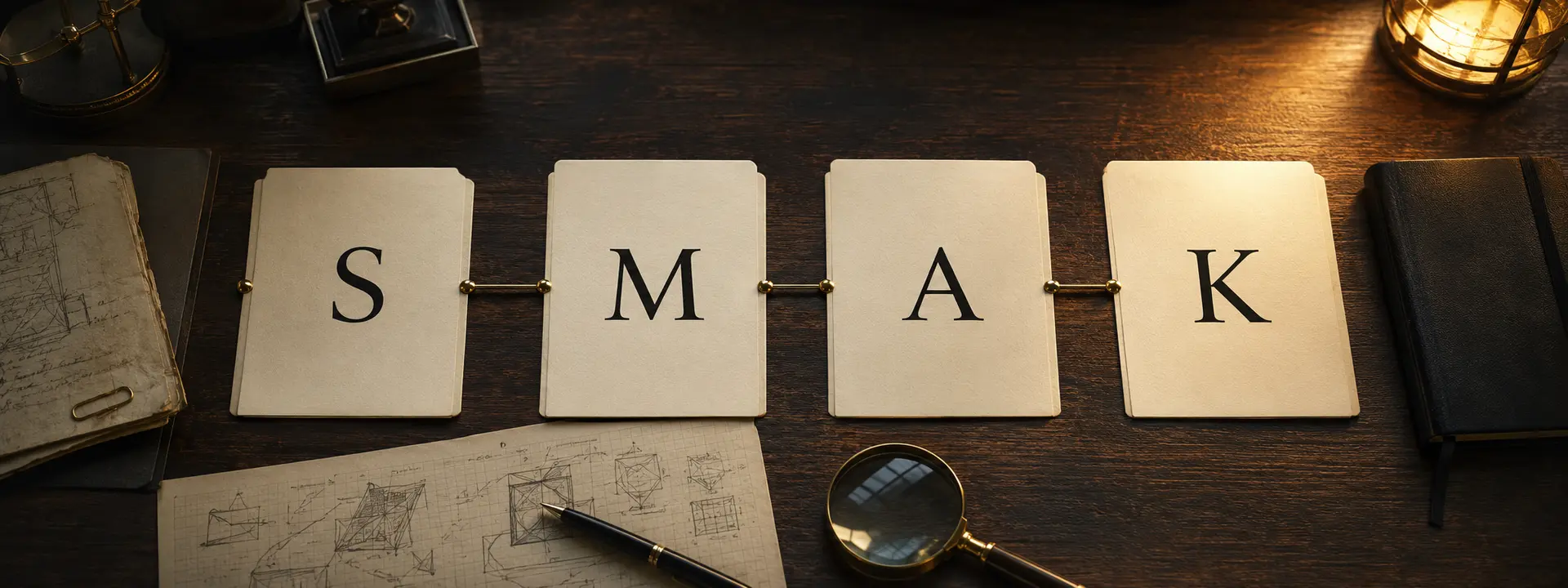
The SMAK Framework
A human thinking framework for deciding when information has earned the right to become knowledge.
Artificial intelligence is becoming part of everyday life. We ask it questions we would once have asked colleagues, teachers, friends or experts. It helps us write, research, compare, explain and decide. The question is no longer whether we should use AI. The question is whether we understand how to use it wisely.
This framework exists to introduce one extra moment of human judgement before an important AI answer becomes something we rely upon.
The Shape Test
Before we discuss AI, imagine you are the AI.
Draw a square.
Draw a triangle.
Draw a circle.
Now stop.
Were they all the same size? Did they sit side by side? Was one inside another? Which was the biggest?
I never told you. Your brain quietly filled in every missing detail. You were not wrong—you simply completed an incomplete instruction. Humans do this naturally. We dislike gaps, so we unconsciously fill them.
The Pattern Test
Now try something even simpler.
Fish and …
Most people instantly think:
…chips.
Not because it is the only possible answer, but because it is the most familiar continuation. Your brain predicts what is most likely to come next. Artificial intelligence works in a surprisingly similar way. Instead of predicting one missing word, it predicts thousands of tiny pieces of language, one after another, until a complete answer is formed. Most of the time this produces excellent results. But prediction and truth are not the same thing.
The Invisible Assumption
When humans don’t know something, we often realise it. We hesitate, ask another question or go and check. AI does not experience uncertainty in the human sense. It calculates the most probable continuation from the information available. If important information is missing, it may still produce a fluent, confident answer.
The greatest danger is often not the assumption made by the AI. It is the assumption made by the user that no assumption was made at all.
The Investigation
This framework grew from an investigation into AI behaviour. A simple question about a live website revealed that a convincing description had been generated without first establishing that the website had actually been inspected.
The investigation gradually shifted away from the website itself and toward a larger question: how do humans know when an AI answer deserves to be trusted? That question became the foundation of SMAK.
Information and Knowledge
One of the most important lessons from the investigation was that information and knowledge are not the same thing. Information can be generated. Knowledge is accepted only after judgement.
The role of the human is not simply to receive information but to decide when it has earned the right to become knowledge.
Introducing SMAK
SMAK is not a criticism of AI. It is not an industry standard or compliance process. It is a human thinking framework. The AI never decides to use SMAK. The user does.
The purpose is simple: before acting on an important answer, pause long enough to understand it.
Use SMAK in Your AI Chat
Download the ready-made instruction file and paste it into the AI conversation you want to use. Ask the AI to keep the instruction active for that conversation. Whenever an answer matters, simply reply: “SMAK it.”
Download the SMAK AI instruction file →
If you start a new conversation, paste the file again unless your AI explicitly confirms that it has retained the instruction.
S — Source
Ask: Where did this information come from? Was it based on information you supplied, prior knowledge, a live search or another identifiable source? Understanding origin provides context for confidence.
M — Method
Ask the AI: How did you arrive at this answer? The objective is not to understand the technical architecture of AI but to understand the path that led to the response. A plain-English explanation is usually enough.
A — Assessment
Assessment is where human judgement becomes active. Instead of immediately accepting an answer, deliberately evaluate it using the Thinking Checks.
The Thinking Checks
Fresh — Could this have changed yesterday?
Seen — Did it actually inspect the website, document or image?
Proof — Where is the supporting evidence?
Source — How does it know?
Risk — What happens if this answer is wrong?
Pause — Pause. Verify. Proceed.
These prompts are intentionally brief. They are not designed to create bureaucracy; they are designed to interrupt automatic trust.
K — Knowledge
The final question is the most important: Has this earned the right to become knowledge? A fluent answer is not automatically knowledge. A detailed explanation is not automatically knowledge. Knowledge is something we consciously decide to rely upon after understanding where it came from, how it was produced and whether it has been assessed appropriately.
The Philosophy
AI is a tool. It is not your friend. It is not your enemy. It does not care whether your decision succeeds or fails. Its role is to generate useful responses. Your role is to decide whether those responses deserve your confidence.
When to Use SMAK
Use SMAK before acting on legal, financial, medical or business information; before signing contracts; before relying on summaries of live websites or current events; or whenever the consequences of being wrong are significant.
When Not to Use SMAK
You do not need SMAK for every interaction. Brainstorming ideas, recipes, creative writing, holiday suggestions and low-risk conversations rarely justify a detailed assessment.
Final Thought
SMAK is not about trusting AI less. It is about trusting yourself more. Artificial intelligence will continue to improve. Human judgement should improve alongside it.
Before an important decision, don’t simply accept the answer. SMAK it.