Post-Social / Family / Digital Legacy
The Locked Archive
The memories are not lost. Not deleted. Simply inaccessible.
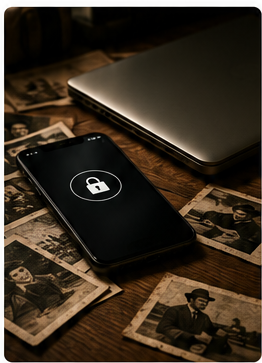
It is the moment we all hope never happens, yet it is a cycle of life that eventually comes to pass.
The dust has settled.
The paperwork has begun.
Family members gather photographs, documents and keepsakes from around the home.
Then somebody notices the mobile phone sitting on a desk beside a laptop.
Together they hold years of photographs, videos, messages and memories.
The family holidays, weddings and birthday parties.
The ordinary Tuesday that seemed unimportant at the time.
These are the moments that helped shape a life and give it meaning.
Then comes a sudden realisation.
What are the passwords?
They are both locked, and nobody can access them.
The photographs and videos still exist, along with the messages.
The memories are not lost.
Not deleted.
Simply inaccessible.
Where would anyone even begin?
Who would even know the password?
And more importantly—would they have wanted us to look?
The questions feel uncomfortable.
Almost intrusive.
Yet at the same time, those devices may contain years of family history that nobody else possesses.
If it were me, I would want my family to have access to the moments we shared.
I would want my perspective to survive.
But the reality is often very different.
The phone ends up in a drawer and the laptop goes back into its case.
We will take another look later, once things have settled.
Then life moves on, and with it, thousands of moments quietly drift out of reach.
To be fair, the technology companies are not blind to this problem.
Apple, Google and others have already built systems designed to help.
Legacy Contacts.
Account recovery.
Succession planning.
Many readers may be surprised to learn these features already exist.
Did you know your smartphone likely already has a way of passing access to somebody you trust after you die?
The problem is not that solutions do not exist.
The problem is that most people never set them up.
Death is rarely convenient, and few people sit down and plan for it.
Fewer still imagine their family one day standing in front of a locked phone wondering what to do next.
The solution exists, but the motivation for the needed preparation often does not.
And so, the phone stays in the drawer.
That creates another problem.
A photograph album is an heirloom.
It gets passed from parent to child.
It sits on a shelf and gets rediscovered again and again.
A smartphone and a laptop are very different.
Technology ages quickly.
Where did you put that charger?
Years later, the battery fails and the software becomes outdated.
What was once the centre of somebody’s world slowly becomes an old piece of technology that doesn’t fare so well over time.
The memories still exist, but the object carrying them—the key that provides access—loses its value in the eyes of future generations.
An heirloom gains value with age, retains meaning, and preserves perspective.
A piece of technology usually loses it.
And once the phone goes into the drawer, the chances of rediscovery begin to collapse.