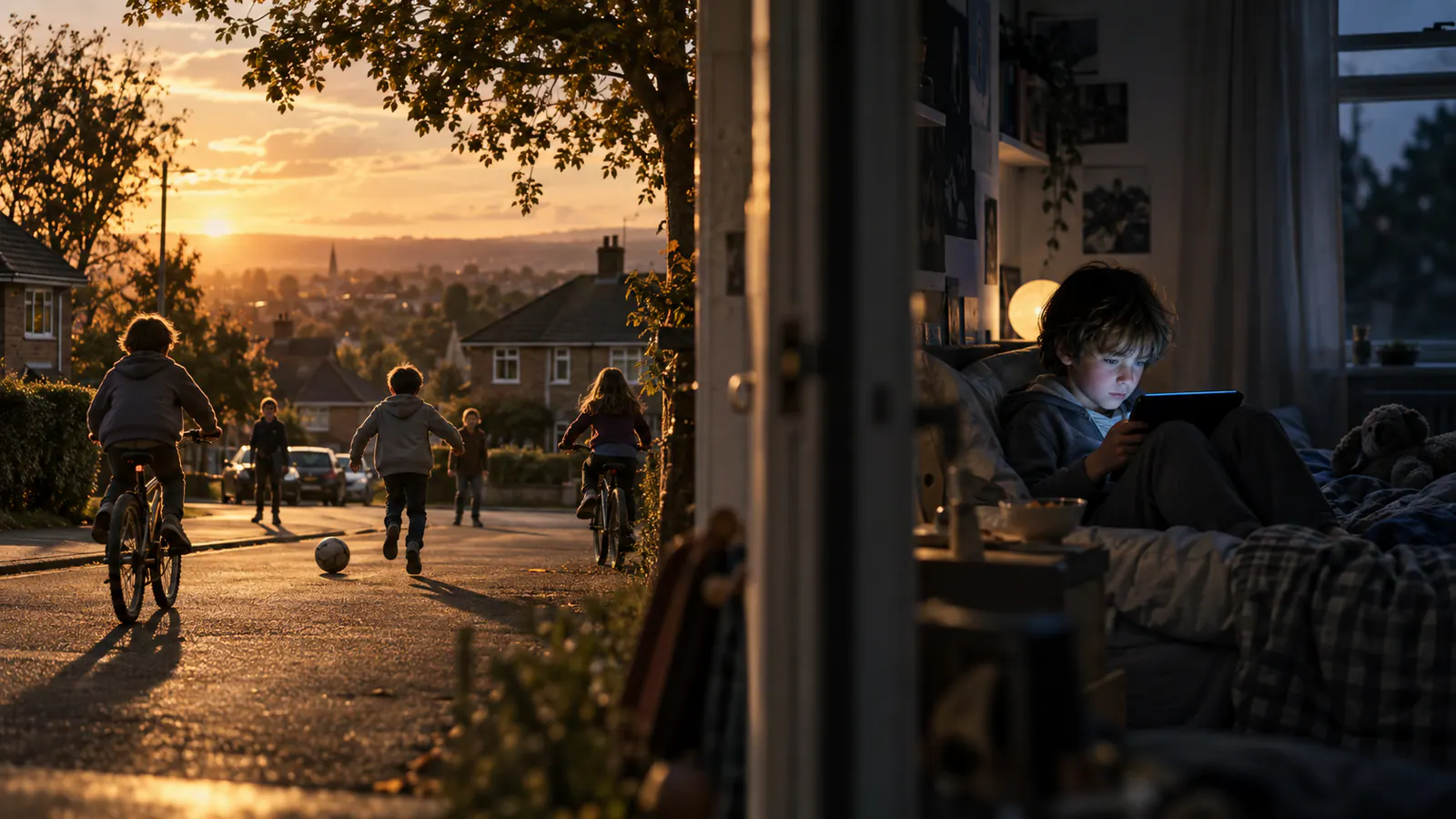
There was a time when childhood contained a strange amount of freedom.
You left the house, knocked for your friends and then worked out what to do.
It wasn’t organised, nobody was tracking you and no adult was there to mediate every disagreement.
Kids climbed things they probably should not have climbed and went further than they were supposed to go.
From time to time they fell out with people and made up again. Boredom was the catalyst for invention, a game or challenge, and eventually the daylight would begin to dim. It was the signal to go home.
It looked like play.
But perhaps it was doing something much more important.
It was teaching children how to exist without their parents, and that matters more than it first appears because childhood is not supposed to end suddenly.
The separation between parent and child should happen gradually.
A small child is almost completely dependent on an adult and, over time, that dependence is supposed to reduce as wisdom grows.
They make more decisions and drift a little further from home in small steps.
They need to solve more problems themselves while the parent remains importantly nearby, but their role slowly changes.
From protector.
To adviser.
To somewhere safe to return to.
Playing out was part of that process.
It created a small world between childhood and adulthood where children could practise independence while the consequences were still relatively small.
If you picked the wrong team, you learned next time to choose better, and if someone took your bike, you worked out how to manage the situation.
If the older kids would not let you join in, there was no complaints department.
None of this was particularly remarkable at the time, but that may have been its value.
Children were practising judgement without knowing they were practising judgement.
They were learning how much risk felt acceptable and how to read another person.
When to push and retreat.
Who could be trusted.
How to apologise and when to stand their ground.
One of the important lessons we may have lost was how to lose and try again.
These were not lessons delivered by adults.
They were learned through exposure.
Then childhood changed, and some of that change was sensible.
Parents became more conscious of safety. Families became more aware of risks that previous generations sometimes ignored, and children’s lives became more organised.
Football became football practice.
Playing became a playdate with parents watching on.
And eventually the games console brought an enormous part of the outside world directly into the home.
Children did not stop socialising. In many ways they became more connected than any generation before them.
But something important changed.
They no longer had to leave the protective environment to find that connection, and that creates a distinction worth considering because, while a child alone in a bedroom can look independent, they lack the disorganisation of the real-world environment.
They still have their own friends, conversations and social identity, but this new world creates a very different environment for the development of a young mind.
If something becomes uncomfortable, the door is closed.
They’re at home with food downstairs and the heating on.
There is distance from the parent, but it is not necessarily separation.
And those are not the same thing.
We may have replaced one form of childhood freedom with something that looks similar while producing a very different result.
Playing out required the child to enter the world.
The screen allows the world to enter the child’s room.
That difference may seem small.
It is not.
Because one requires adaptation to reality.
The other allows reality to be filtered.
When children played out, society arrived gradually.
First the street, then the neighbourhood and, as that was mastered, came the bus and the town centre.
Then, importantly, the Saturday job.
The boundaries expanded as the child did, with each stage offering slightly more freedom and slightly greater consequences.
Today, for some children, the protective bubble can remain surprisingly intact for much longer.
School is supervised.
Sport is supervised.
Travel is organised.
Social life happens through well-curated, filtered devices and parents remain constantly reachable.
So what happens when, one day, the child is expected to function as an adult?
How can we be surprised when that transition is difficult?
There is a tendency for every generation to complain about the one behind it, with the same usual tropes:
They lack resilience.
They expect too much.
They cannot cope with criticism.
Why wouldn’t they expect someone else to solve their problems?
Perhaps some of that criticism is justified because society gets something close to what it trains for.
We have removed risk, so we shouldn’t be surprised when people are uncomfortable with risk.
If adults step in to settle every disagreement, why should we be surprised when conflict becomes difficult for them to deal with?
Initiative will naturally develop more slowly when childhood activities have been closely managed as the child grows up.
One of the other side effects of parents remaining closely involved in every decision is that children may continue looking towards them long after childhood has technically ended.
There are adults today whose relationship with their parents still resembles the dependency of adolescence.
That is not always failure because real-world challenges naturally have an impact. Housing costs matter.
Economics matter. Family dynamics are different.
But there is still a difficult question underneath it.
If the connection between parent and child is never gradually diluted, when does the child learn to stand apart from it?
Good parenting has increasingly become associated with involvement.
Knowing where your child is.
Knowing who they are with.
Knowing what they are doing.
Helping when things go wrong.
All of that comes from care.
But perhaps there is another responsibility we talk about less.
The responsibility to become progressively less necessary.
Not less loved.
Not less important.
Less necessary.
Because one of the purposes of raising a child must surely be to create an adult who can function without you, and that requires practice.
Perhaps previous generations accidentally built much more of that practice into childhood than we realised.
Playing out was never just about playing.
It was about leaving and then coming back a little more independent.
Each time, the distance between the child and the parent became slightly easier to cross.
Until eventually the child no longer needed to return in quite the same way.
We did not deliberately remove that process.
But while we were trying to make childhood safer, easier and better connected, the system may have produced unintended consequences.
Perhaps this is one of them.
Playing out said: go into the world and grow.
The bedroom screen says: stay here while the world comes to you.
The difference is subtle.
But substantial.